
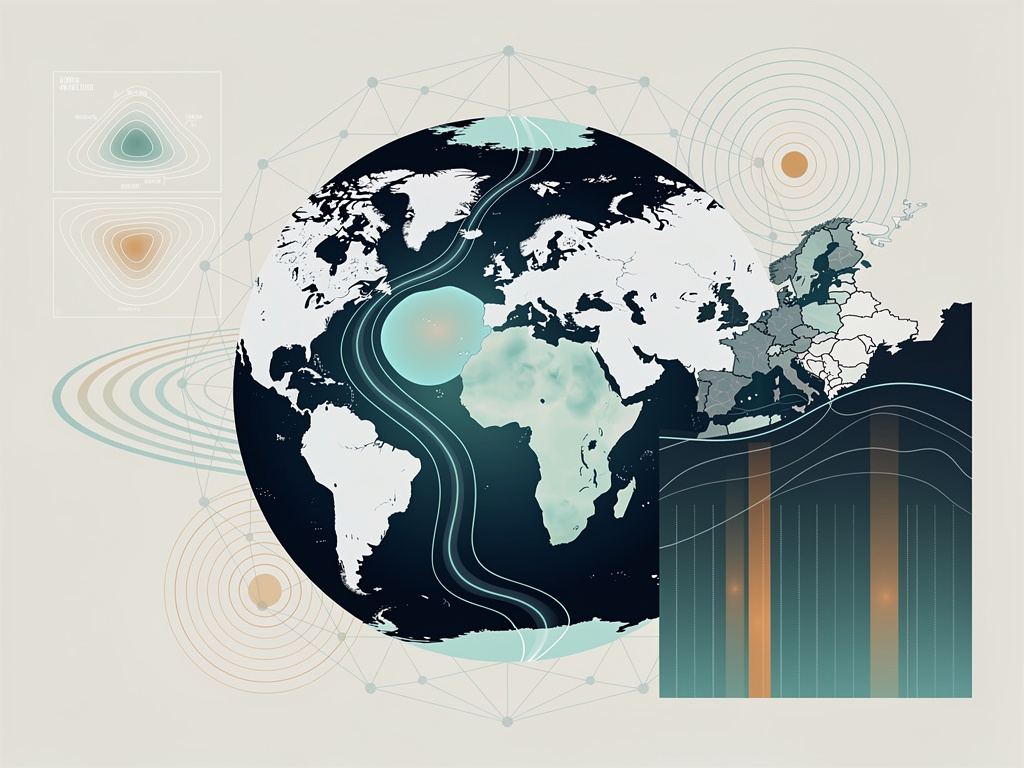
Scientists have zeroed in on a stubborn patch of chilly water in the North Atlantic. This so-called cold blob, southeast of Greenland, bucks the global ocean warming trend. And a fresh analysis ties it directly to slowdowns in a vital current system.
The Atlantic Meridional Overturning Circulation, or AMOC, carries warm tropical water northward. It releases heat to the atmosphere before sinking and returning south at depth. But that process shows strain. Fresh meltwater from Greenland dilutes surface salinity. Density drops. Sinking slows.
The Evidence Builds
Researchers examined reanalysis data that blends observations with models. They tracked ocean heat transport into the subpolar region. The numbers pointed one way. Reduced heat delivery from the AMOC explains the cooling. Not just surface winds or clouds. “It is changing ocean heat transport” which is driving the cooling of the cold blob, said Stefan Rahmstorf, a study author and physics and oceans professor at Potsdam University, Germany (CNN).
The blob itself has cooled nearly 1°C since the early 20th century. Meanwhile, most ocean surfaces have warmed. This contrast stands out. Models have long forecast such a pattern under AMOC decline. Now real-world data aligns closer than before.
David Thornalley, a professor of ocean and climate science at University College London, reviewed the work. The study strengthens the case linking the cold blob to a weakening AMOC. Yet he added a note of caution. Sparse real-world measurements mean the datasets “are best viewed as good approximations rather than perfect representations of reality” (CNN).
But the signal grows harder to dismiss. Earlier research from the same Potsdam team and others identified the same fingerprint. A 2018 paper already connected the warming hole to AMOC slowdown from roughly 20 Sverdrups in 1950 to about 17 in the 2000s. The latest reanalysis, published in recent days, reinforces that view with updated tools.
And the implications stretch far. A further weakening of the AMOC could have major repercussions for future climate for millennia, given that the AMOC is known to have a tipping point beyond which it is likely to shut down, the study authors write (Phys.org).
Short sentences land hard. Collapse. Irreversible on human timescales. Disruptive cooling across northwest Europe. Accelerated sea-level rise along the U.S. East Coast as water piles up. Shifts in rainfall patterns that could hit agriculture and storms.
Observations from mid-2026 show the cold blob reappearing after a brief pause. One index tracking it flipped negative again. Forecasts suggest it lingers. If it persists for years, it could eventually cool the climate around Greenland, Iceland and northern Europe (The Washington Post).
Models differ on exact timing. Some suggest the AMOC could approach a tipping point within decades under high emissions. Others see slower decline. Consensus holds that weakening is very likely this century. Full shutdown carries lower but nonzero odds.
Why It Matters Now
Global oceans absorb over 90% of excess heat from greenhouse gases. The Atlantic leg of the conveyor redistributes much of it. When that leg falters, heat builds elsewhere. Tropical regions may warm faster. Weather bands shift.
Freshwater influx from accelerating Greenland ice loss feeds the problem. Salinity in key sinking zones has dropped. Density-driven circulation responds. The cold blob sits precisely where the AMOC should deliver its biggest heat punch to the air. Less punch. More chill.
Recent coverage echoes the concern. A Nature research highlight from June 9 described the cold blob as evidence for a troubling climate trend. Weakening of a major ocean-current system is causing temperatures to drop in a patch of the Atlantic Ocean (Nature).
Similar reports surfaced across outlets this week. They draw on the same underlying reanalysis. None contradict the core finding. Instead they amplify calls for sustained monitoring. Direct measurements remain limited. Satellite data, buoys and ship surveys help. Yet gaps persist at depth.
Stefan Rahmstorf and colleagues argue the evidence now warrants attention from policy makers. An unacceptable risk, he posted on X alongside the CNN coverage. Continued slowdown, even shutdown cannot be excluded.
Europe stands to lose the mild winters the AMOC helps provide. Winters could grow harsher. Summers cooler in some spots. Rainfall might redistribute, stressing crops already facing heat and drought elsewhere. Fisheries in the North Atlantic could see productivity swings as nutrient upwelling changes.
On the opposite side of the ocean, U.S. coastal cities already battle rising seas. AMOC slowdown adds a dynamic component. Water that would have flowed away instead stacks higher. Some studies link past slowdowns to inches of extra rise from Florida to New York.
So the cold blob operates as both symptom and early indicator. It reveals heat transport in decline. It hints at larger reorganization ahead. But scientists stop short of declaring imminent collapse. The system shows variability. Natural cycles overlay the human signal.
Still, the trend line worries them. Paleoclimate records show the AMOC has flipped states before. Those shifts coincided with abrupt regional temperature changes of several degrees within decades. No one expects exact repeats. The forcing today differs. The speed of greenhouse gas rise has no analog.
Improved models now incorporate more realistic Greenland melt rates. They still diverge on collapse thresholds. Some run hot. Others conservative. The cold blob helps calibrate them. When simulations reproduce the observed cooling only under weakened AMOC states, confidence grows.
Funding for ocean observation programs matters here. Arrays like RAPID at 26°N have tracked AMOC strength since 2004. They show decline. Extending similar coverage to the subpolar gyre could sharpen the picture. So could better satellite gravimetry and autonomous underwater vehicles.
Policy responses lag the science. Emissions cuts remain the surest brake on ice melt and heat buildup. Yet even under moderate scenarios the AMOC is projected to weaken further. Adaptation planners in Europe and North America may need to factor in altered temperature and precipitation baselines.
The blob itself fluctuates. Warm years intrude. Then cold returns. Its long-term persistence, however, aligns with model expectations for a system under stress. Less heat arrives. The surface cools. Feedbacks may amplify or dampen. Uncertainty remains.
But one fact stands clear. The North Atlantic isn’t warming uniformly. One patch defies the pattern. And that defiance carries a message about the circulation knitting the planet’s climate together. Ignore it at peril.


 WebProNews is an iEntry Publication