
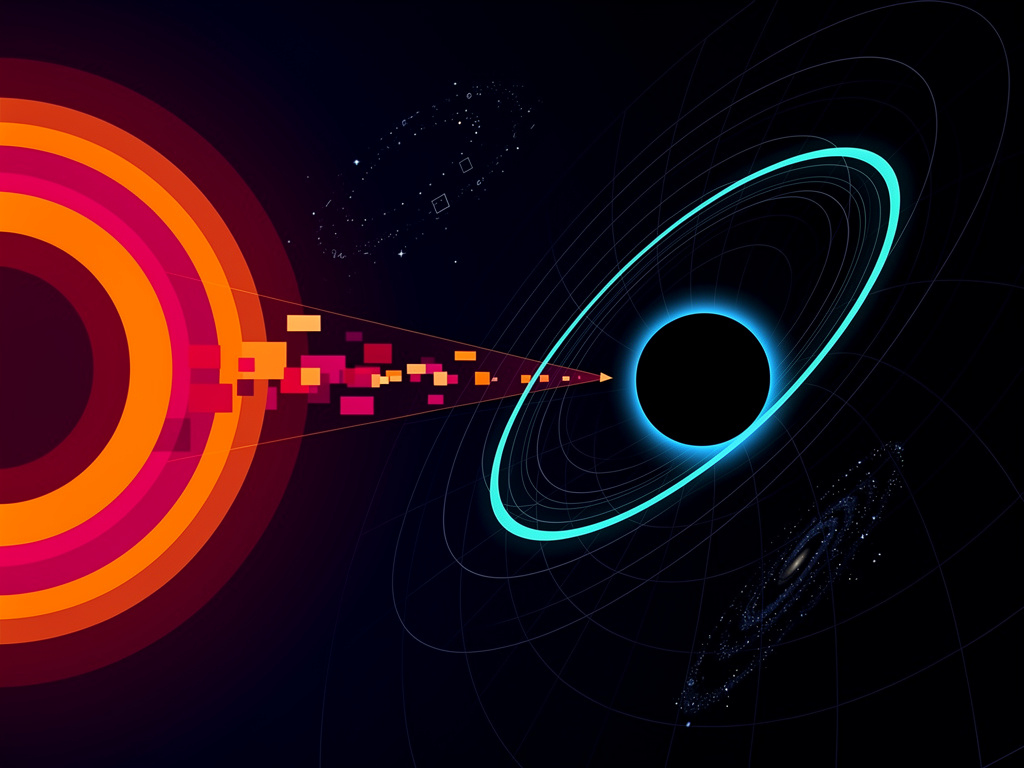
One massive star in the Andromeda galaxy simply winked out. No brilliant flash. No explosive aftermath. Just a slow fade captured across years of telescope data.
Researchers sifting through archival observations from NASA’s retired NEOWISE mission spotted the unusual behavior. The star, cataloged as M31-2014-DS1, brightened sharply in infrared light around 2014. Then its visible light plummeted. By 2023 the object had faded by a factor of more than 10,000 in optical wavelengths. It left behind a shroud of hot gas and dust. Nothing else.
This wasn’t the violent death astronomers expect from stars 20 times the sun’s mass or larger. Those typically end in supernovae that scatter heavy elements across space and leave neutron stars or black holes. Here the core apparently surrendered to gravity without a fight. The result? A black hole formed directly. A failed supernova.
The findings, published in the journal Science, offer the clearest evidence yet of this process. Lead author Kishalay De of Columbia University and the Flatiron Institute described the event as a rare window into black hole birth. “We interpret these observations, and those of a previous event in NGC 6946, as evidence for failed supernovae forming stellar-mass BHs,” the team wrote.
But how does a star this big vanish without a trace? Models suggest that when the core collapses, the rebound shock wave that would normally trigger an explosion stalls. The outer layers fall inward instead. Most of the star’s mass – roughly 98 percent in some estimates – ends up in the black hole. Only a modest amount of material gets ejected, enough to create the infrared glow but not enough for a supernova display.
Data from multiple observatories backed this picture. NEOWISE tracked the mid-infrared spike and slow decline. Ground-based telescopes and other space instruments confirmed the optical disappearance. Follow-up observations with the James Webb Space Telescope and Chandra X-ray Observatory, reported later in the Astrophysical Journal Letters, revealed a dust-enshrouded object consistent with a newborn black hole. No X-rays. No radio signals. Just that persistent infrared signature from heated dust.
The discovery builds on an earlier candidate. In 2009 a red supergiant in the Fireworks Galaxy, NGC 6946, dimmed dramatically after a modest outburst. Astronomers labeled it N6946-BH1. Many considered it the first plausible failed supernova. Now M31-2014-DS1 strengthens the case. Two examples in nearby galaxies suggest these quiet collapses may not be so rare.
Christopher Kochanek of Ohio State University, who has studied the NGC 6946 event for years, saw parallels. Hubble images before and after the disappearance showed the star gone. The new Andromeda data adds infrared detail that was missing before. It paints a fuller portrait of what happens when the explosion mechanism fails.
Yet questions remain. Why did the shock wave stall? Is it tied to the star’s exact mass, rotation, or composition? Some theorists point to the pair-instability process in very massive stars, though M31-2014-DS1 falls short of those extremes. Others suspect that even stars around 15 to 25 solar masses can take this route under certain conditions. The fraction could reach 30 percent of the heaviest stars, according to some models cited in coverage by Sky & Telescope.
Such events carry consequences for galactic chemistry. Supernovae seed the cosmos with carbon, oxygen, and iron. Failed ones lock most of that material inside the black hole. Over cosmic time this alters how galaxies evolve and how often we detect certain elemental signatures in distant light.
The infrared glow offers a practical way to find more examples. As NEOWISE and future infrared surveys scan the sky, similar fading giants may turn up. Each one will let astronomers test theories of stellar death in real time. And each will refine predictions for gravitational-wave detectors that listen for black hole mergers.
De’s team already identified another potential candidate. The work, supported by NASA’s Astrophysics Data Analysis Program, continues. So does scrutiny. One recent paper on arXiv examined the object’s late-time behavior and found no clear X-ray or radio emission, consistent with low accretion onto the black hole.
But the core message stands. Stars don’t always go out in fireworks. Some slip away. They collapse inward, form black holes, and leave only a fading echo in the infrared. The universe hides these births in plain sight. We just needed the right eyes – and enough patience – to notice.
Observations from 2005 through 2023 made the difference. Archival data, once filed away, became a treasure trove. It turned a disappearing dot in Andromeda into one of the most compelling stellar death stories in recent astronomy. And it reminded researchers that even well-studied processes hold surprises.
More candidates will likely follow. Telescopes grow more sensitive. Surveys cover more sky. The quiet deaths of massive stars may soon seem less exceptional. They may instead reveal themselves as a standard pathway, one that shapes the population of stellar-mass black holes across the universe.
For now, M31-2014-DS1 stands as a benchmark. A star that burned brightly, then dimmed, then vanished. Its story, pieced together from infrared archives and optical records, shows how much remains to learn about the final chapters of stellar lives. The black hole it left behind keeps its secrets. The dust around it still glows faintly. And astronomers keep watching.


 WebProNews is an iEntry Publication