
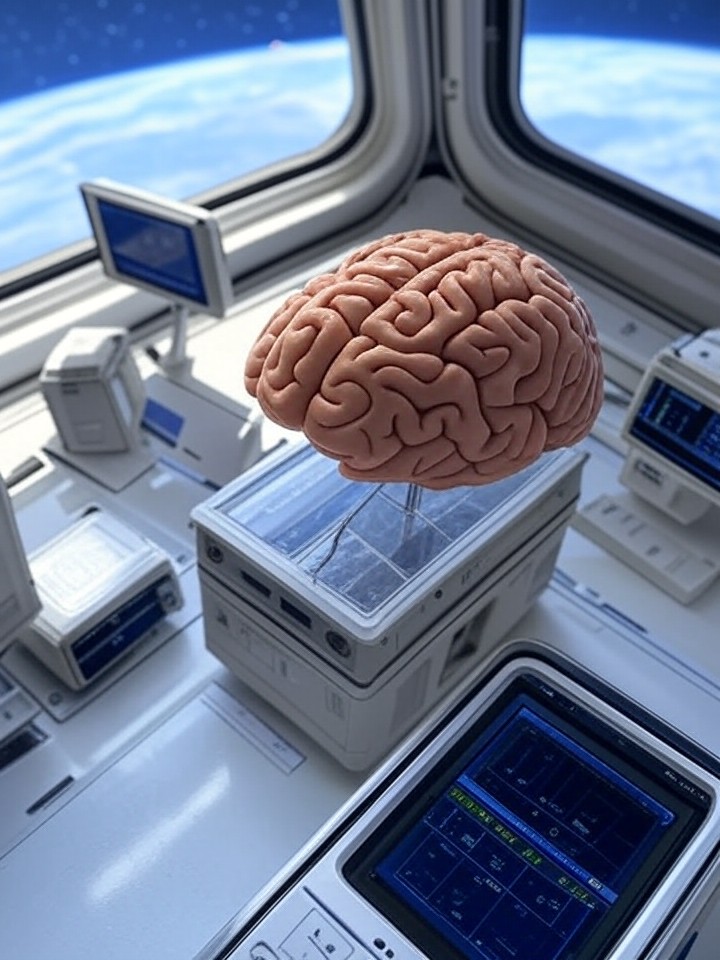
Floating Minds: The Unseen Shifts in Astronaut Brains During Space Voyages
In the weightless expanse of space, where gravity’s grip loosens, the human body undergoes profound transformations. Recent research has illuminated one of the most intriguing: the literal displacement of the brain within the skull. A study published just days ago reveals that astronauts returning from missions experience their brains shifting upward and backward, a phenomenon that could reshape our understanding of long-duration space travel. This isn’t mere speculation; magnetic resonance imaging (MRI) scans from multiple missions show consistent patterns of brain repositioning, raising questions about neurological health for future explorers heading to Mars or beyond.
The findings stem from a comprehensive analysis involving astronauts who spent varying times in orbit. For instance, those on short two-week stints exhibited noticeable shifts, but the changes amplified in six-month and year-long missions. Researchers observed that the brain doesn’t just move; it tilts and rotates slightly, affecting regions critical for sensory processing and balance. This displacement correlates with post-flight issues like dizziness and coordination problems, which most astronauts recover from within a week, though some anatomical alterations linger for months.
At the heart of this research is the role of microgravity, which disrupts the normal distribution of fluids in the body. On Earth, gravity pulls cerebrospinal fluid downward, but in space, it pools around the brain, exerting pressure that pushes neural tissue into new positions. This fluid shift isn’t benign; it can lead to increased intracranial pressure, potentially contributing to vision impairments reported by some spacefarers. The study, detailed in a report from Space.com, highlights how these changes are more pronounced in longer missions, tapering off after about six months as the body adapts somewhat.
Mapping the Neural Drift
To quantify these effects, scientists divided the brain into 130 distinct regions and tracked displacements across three spatial axes. The results showed widespread movement, not confined to isolated areas, indicating a holistic repositioning. For veterans of multiple flights, the interval between missions plays a crucial role; shorter recovery times on Earth lead to greater ventricular expansion post-flight, as noted in a 2023 paper from Scientific Reports. This suggests cumulative impacts that space agencies must account for in crew selection and mission planning.
Beyond positional shifts, the brain’s structure undergoes subtler changes. Gray matter volume decreases in certain areas, while white matter microstructure alters, potentially affecting cognitive functions. Extracellular free water distribution also shifts, which could influence neural signaling. These observations come from a systematic review in PMC, emphasizing that while some changes reverse upon return to gravity, others persist, hinting at long-term adaptations or risks.
Industry experts are particularly concerned about implications for deep-space missions. NASA’s Artemis program, aiming for lunar bases and eventual Mars outposts, involves extended periods in microgravity. If brain displacement leads to chronic issues, it could necessitate countermeasures like artificial gravity simulations or pharmacological interventions to mitigate fluid shifts. Posts on X from sources like NASA’s Johnson Space Center have long highlighted related concerns, such as spinal fluid accumulation causing vision changes, underscoring the need for ongoing monitoring.
Historical Context and Evolving Insights
This isn’t a new discovery, but recent studies build on decades of data. Back in 2017, MRI scans of cosmonauts revealed narrowing of cerebrospinal fluid spaces and shifts in brain position after prolonged spaceflight, as reported in tweets from the New England Journal of Medicine. Those early findings focused on volume changes, with decreased cortical volume and increased ventricular spaces persisting for months after landing. Today’s research refines this, using advanced imaging to detect rotational elements previously overlooked.
Comparisons with ground-based simulations, like head-down bed rest, provide valuable controls. In these experiments, participants mimic microgravity effects, showing similar but less severe brain shifts. A recent article from NBC News details how such analogs help isolate variables, confirming that duration in space directly correlates with the magnitude of displacement. For one-year mission participants, shifts were the most dramatic, with sensory regions linked to balance showing the greatest movement.
The functional fallout is equally compelling. Astronauts often report “space fog” upon return, a temporary haze in cognition that aligns with these anatomical changes. Balance tests post-flight reveal deficits that improve quickly, but the persistence of brain position alterations—up to six months in some cases—suggests deeper neuroplasticity at work. As outlined in ScienceDirect, these effects accumulate over multiple missions, prompting calls for personalized health protocols.
Implications for Future Missions
For space agencies, these revelations demand action. The International Space Station has served as a living laboratory, with Expedition 73 focusing on brain adaptation and bone loss, as shared in X posts from the station’s official account. Such studies inform countermeasures, from exercise regimens to lower body negative pressure devices that draw fluids downward, simulating gravity’s pull. Yet, experts warn that for Mars voyages, which could last years, current strategies may fall short.
Private sector players like SpaceX are also taking note. With ambitions for civilian space travel, understanding brain displacement becomes crucial for passenger safety. A Futurism piece, Astronauts’ Brains Are Being Displaced, describes the upward and backward shift as a “new wrinkle” for space tourism, potentially requiring pre-flight screenings or onboard monitoring tech. Integrating AI-driven MRI analysis could enable real-time assessments during flights.
Moreover, gender and age factors warrant exploration. Most studies have involved male astronauts, but as crews diversify, differences in fluid dynamics might emerge. Recent X discussions from researchers point to potential variations, urging inclusive datasets. This ties into broader health equity in space exploration, ensuring that findings apply universally.
Bridging Gaps in Knowledge
Despite advances, limitations persist. Sample sizes remain small due to the elite nature of astronaut corps, and imaging opportunities are constrained by mission timelines. Authors of a Moneycontrol report, Astronauts’ brains shift back, forward, and rotate, recommend larger cohorts and longitudinal tracking to overcome these hurdles. Collaborative efforts between NASA, ESA, and private firms could expand the data pool.
On the horizon, innovations like wearable neuroimaging devices promise to capture in-flight changes without bulky equipment. This could reveal how brain shifts evolve in real time, informing adaptive therapies. For instance, if ventricular expansion peaks early in a mission, targeted interventions could be deployed promptly.
The psychological angle adds another layer. While physical shifts are measurable, their impact on mental health—such as mood or decision-making—remains underexplored. Anecdotal reports from astronauts describe altered perceptions in space, possibly linked to these neural repositions. Integrating behavioral studies with anatomical data, as suggested in a Smithsonian Magazine article, Spaceflight Temporarily Changes the Position and Shape of Astronauts’ Brains, could yield holistic insights.
Toward Safer Cosmic Journeys
As humanity eyes permanent off-world settlements, mitigating brain displacement is paramount. Pharmaceutical options, like drugs that regulate fluid pressure, are under investigation. Centrifuges on spacecraft could provide intermittent gravity, preventing shifts altogether. These solutions draw from cross-disciplinary research, blending neurology, aerospace engineering, and physiology.
Veteran astronauts offer invaluable perspectives. Those with multiple missions report adapting over time, suggesting the brain’s resilience. Yet, for novices, the initial shock can be disorienting. Training programs now incorporate virtual reality simulations of microgravity effects to prepare crews mentally and physically.
Ultimately, these discoveries underscore space travel’s dual nature: a frontier of wonder and risk. By addressing brain shifts, we not only safeguard explorers but also advance terrestrial medicine. Insights into fluid dynamics could benefit patients with hydrocephalus or traumatic brain injuries, turning cosmic challenges into earthly gains. As a ScienceAlert piece notes, Astronauts Return to Earth With Lasting Brain Changes, the weightless environment reveals the brain’s plasticity, offering lessons that transcend orbits.
Emerging Frontiers in Space Neurology
Looking ahead, international collaborations will be key. The European Space Agency’s contributions to brain imaging studies complement NASA’s efforts, fostering a global knowledge base. Recent X posts from figures like Kathy Lueders highlight ongoing research into preventing fluid-induced changes, including dietary adjustments to manage intracranial pressure.
Ethical considerations also arise. Should mission durations be capped based on brain health metrics? Or can we engineer habitats with artificial gravity to eliminate the issue? These debates rage in industry circles, balancing ambition with safety.
In the end, as we push boundaries, understanding the brain’s dance in microgravity ensures that astronauts return not just physically intact but neurologically sound. This evolving field promises to redefine human limits, one shifted synapse at a time.


 WebProNews is an iEntry Publication