
A small company in Huntington Beach, California, wants to do something no one has ever done: capture a near-Earth asteroid, haul it into lunar orbit, and mine it for platinum-group metals. Not in some distant future. Within the next decade.
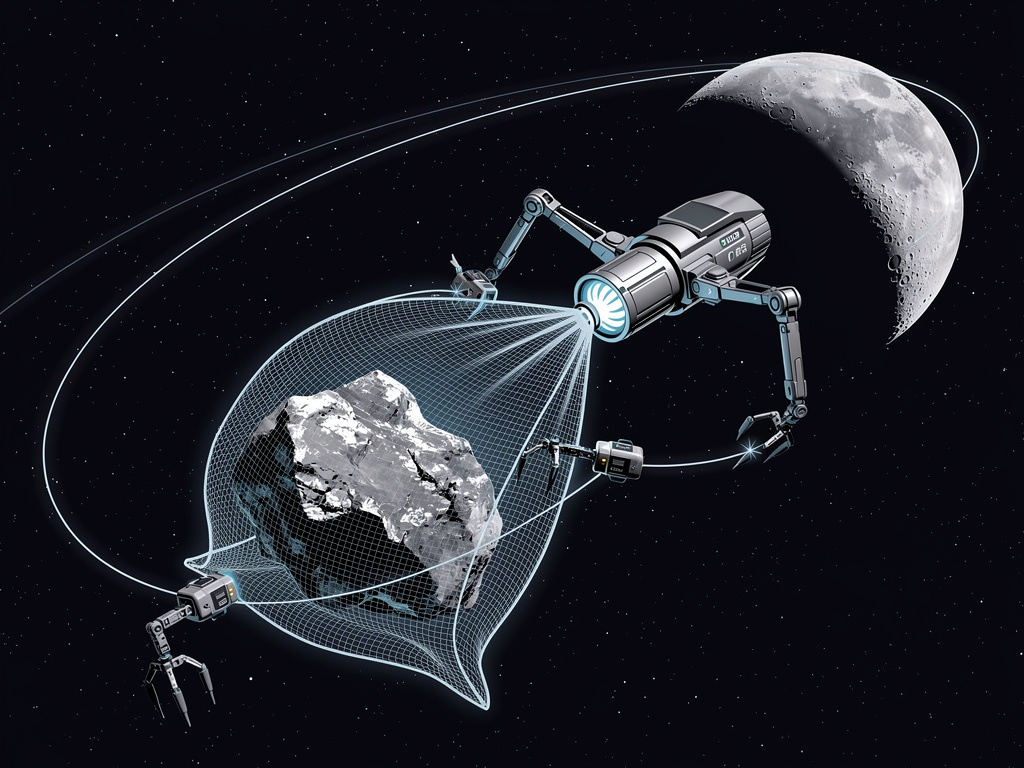
AstroForge, the asteroid mining startup founded in 2022, has unveiled a mission architecture so audacious it sounds like science fiction. The plan calls for wrapping an asteroid — one roughly 20 to 40 meters across — in an enormous containment bag, then using electric propulsion to slowly nudge the captured rock into a stable orbit near the Moon. Once there, the company would extract and process valuable metals in a microgravity environment far more accessible than the asteroid belt.
As reported by Ars Technica, the concept draws on a NASA study from 2012 known as the Asteroid Redirect Mission, which proposed a similar capture-and-relocate approach before the agency shelved it in 2017 under budget pressures. AstroForge’s version is leaner, cheaper, and designed entirely around commercial extraction of platinum-group metals — iridium, osmium, ruthenium, and platinum itself — materials that trade at thousands of dollars per ounce and underpin industries from automotive catalytic converters to hydrogen fuel cells.
Matt Gialich, AstroForge’s co-founder and CEO, has been candid about the company’s rocky path to this point. Its first two missions — Brokkr-1, a refining demonstration launched as a rideshare payload in 2023, and Odin, a flyby reconnaissance mission that launched in early 2025 — both encountered significant problems. Brokkr-1 lost communications shortly after deployment. Odin’s spacecraft, built by Impulse Space, experienced thruster anomalies that complicated its trajectory. Neither mission fully achieved its objectives.
And yet AstroForge keeps going.
The company has raised over $55 million in venture funding to date, with backing from Initialized Capital, Y Combinator, and other Silicon Valley investors. Gialich has argued that early failures are part of the process — that the data gathered from partial successes still advances the company’s engineering knowledge. It’s a philosophy borrowed from SpaceX’s early Falcon 1 failures, a comparison AstroForge invites.
The bag itself is the centerpiece of the new architecture. Constructed from ultra-high-strength synthetic fibers — think industrial-grade Kevlar or Dyneema composites — the containment structure would be deployed from a spacecraft that first matches velocity with the target asteroid. The spacecraft approaches slowly, unfurls the bag around the asteroid, then cinches it tight. No drilling. No anchoring. Just envelopment.
This sounds simple. It isn’t.
Asteroids of this size class rotate, sometimes unpredictably. Their surfaces can range from solid nickel-iron to loose rubble piles barely held together by their own negligible gravity. A bag that works on a solid metallic body might shred against the jagged, irregular surface of a rubble pile. AstroForge says its target selection process will focus on M-type (metallic) asteroids, which are more likely to be coherent bodies and, conveniently, more likely to contain the platinum-group metals the company wants.
The propulsion challenge is equally formidable. Moving an asteroid massing thousands of metric tons requires either enormous thrust or enormous patience. AstroForge is betting on patience. Solar electric propulsion systems — ion drives, essentially — produce tiny amounts of thrust but can operate continuously for months or years. Over time, that adds up. NASA’s Dawn spacecraft used a similar system to orbit both Vesta and Ceres. But Dawn was moving itself, not a captured rock.
According to Ars Technica, AstroForge estimates that redirecting a suitable asteroid into a distant retrograde orbit around the Moon — a gravitationally stable parking spot — would take between two and five years of continuous thrusting, depending on the asteroid’s mass and the specifics of its original orbit. The company plans to use multiple propulsion modules attached to the bag’s exterior, distributing thrust across the structure.
The economics are where things get interesting. A single metallic asteroid 20 meters in diameter could contain platinum-group metals worth tens of billions of dollars at current market prices. That figure has fueled decades of asteroid mining hype. But there’s always been a catch: extraction costs, launch costs, and the sheer technical difficulty of operating mining equipment in deep space.
AstroForge’s approach tries to sidestep the hardest part by bringing the asteroid closer to Earth. Mining operations in lunar orbit could be resupplied from Earth far more easily than operations in the asteroid belt. Refined metals could be returned to Earth’s surface using relatively simple reentry capsules. The company envisions a processing station in lunar orbit — a facility that would receive captured asteroids sequentially, extract their metals, and ship product back to terrestrial markets.
There are skeptics. Plenty of them.
Philip Metzger, a planetary physicist at the University of Central Florida who has studied space resource extraction extensively, has noted in public commentary that the mass estimates for small asteroids carry huge uncertainties. A target that looks promising from telescopic spectral data might turn out to be far less metal-rich than expected, or far more massive than projected, making the redirect impractical. Ground truth is hard to come by when your mine is millions of kilometers away.
The regulatory picture adds another layer of complexity. The 2015 U.S. Commercial Space Launch Competitiveness Act grants American companies the right to own and sell resources extracted from celestial bodies, but the legal framework around physically relocating an asteroid remains untested. Moving a space rock into lunar orbit raises questions under the Outer Space Treaty of 1967, which prohibits national appropriation of celestial bodies but says nothing explicit about corporate capture and relocation. International space law scholars have debated this gap for years without resolution.
AstroForge isn’t the only company eyeing asteroid resources. TransAstra, founded by former NASA engineer Joel Sercel, has proposed its own optical mining technique that would use concentrated sunlight to heat asteroid surfaces and liberate volatiles. Karman+, a UK-based startup, is developing prospecting missions. But none have articulated a capture-and-redirect strategy as specific as AstroForge’s new plan.
The broader context matters too. Platinum-group metals face tightening supply on Earth. South Africa produces roughly 70% of the world’s platinum and an even higher share of rhodium. Supply chain concentration, labor disputes, and the geological reality of declining ore grades have pushed prices higher and made manufacturers nervous. The automotive industry alone consumes vast quantities of palladium and rhodium for catalytic converters, and the emerging hydrogen economy will need platinum for fuel cell electrodes. If space-sourced metals could undercut terrestrial mining costs — a big if — the market implications would be enormous.
But we’re getting ahead of ourselves. AstroForge hasn’t bagged anything yet.
The company’s next planned mission, designated Vestri, is expected to be a closer reconnaissance flight to a specific asteroid target the company has identified but not publicly named. Gialich has said AstroForge is keeping the target’s identity confidential to prevent competitors from racing to the same body — a claim that itself signals how seriously the company takes its commercial prospects, or at least how seriously it wants investors to take them.
SpaceX’s Starship, if it achieves its promised cost-per-kilogram to orbit, could be transformative for AstroForge’s plans. Launching a containment bag system large enough to envelop a 20-meter asteroid, along with the propulsion modules and processing equipment, would require payload capacities far beyond what current commercial rockets offer. Starship’s fully reusable architecture and 100-plus-metric-ton payload capacity to low Earth orbit could make missions feasible that would be economically impossible on a Falcon Heavy or Vulcan Centaur.
So the plan depends, in part, on someone else’s rocket working as advertised. That’s a dependency AstroForge shares with half the commercial space industry right now.
There’s also the question of timeline. Gialich has spoken publicly about wanting to achieve a first asteroid capture by the early 2030s. Given the company’s track record of mission delays and partial failures, outside observers tend to add years to any stated schedule. Aerospace ventures almost always take longer and cost more than projected. AstroForge’s ambitions are no exception.
Still, the underlying logic has a certain elegance. Rather than building a mining operation in deep space — with all the logistical nightmares that entails — you bring the mine to you. Rather than developing complex drilling and extraction robots that must operate autonomously for years, you relocate the raw material to a place where human oversight and resupply are practical. It’s the difference between building a factory in Antarctica and shipping the ice to your existing factory.
Whether the engineering can match the logic remains the open question. The bag must survive deployment, capture, and years of continuous stress during the slow-motion redirect. The propulsion system must function flawlessly over a multi-year burn. The target asteroid must actually contain what spectral analysis suggests it contains. And the entire operation must cost less than the metals are worth.
Each of those is a hard problem. Together, they constitute one of the most ambitious commercial space ventures ever proposed.
AstroForge appears undeterred. The company recently expanded its engineering team and has been posting job listings for specialists in advanced materials, electric propulsion, and autonomous guidance systems. It has also engaged with NASA’s Small Business Innovation Research program, seeking government contracts that could offset development costs while maintaining its commercial independence.
The asteroid mining industry — if it can even be called an industry yet — has seen waves of enthusiasm before. Planetary Resources, backed by Google’s Larry Page and filmmaker James Cameron, raised tens of millions in the early 2010s before being acquired and effectively dissolved. Deep Space Industries followed a similar arc. Both companies underestimated the cost and difficulty of their missions and overestimated how quickly revenue would materialize.
AstroForge’s leadership says it has learned from those predecessors. The company’s focus on a single commodity class (platinum-group metals) rather than a broad resource portfolio, and its willingness to iterate through low-cost missions before committing to a flagship capture attempt, reflect a more disciplined approach. Whether discipline alone is enough to overcome the fundamental physics and economics of asteroid mining is another matter entirely.
For now, the giant bag remains a concept — detailed engineering work, to be sure, but still on paper and in simulation. The asteroid it’s meant to capture is still orbiting the Sun, indifferent to the plans being drawn up in a Southern California office park. And the investors writing checks are betting on a payoff that, even under optimistic projections, is years away.
But if AstroForge pulls it off — if a spacecraft built in Huntington Beach really does wrap a bag around a primordial chunk of metal and drag it to the Moon — it would be the most consequential resource extraction event since the first offshore oil well. The platinum-group metals locked inside near-Earth asteroids represent wealth measured in trillions. Getting to it is the problem humanity has never solved.
AstroForge thinks a bag is the answer. The next few years will tell us whether they’re visionaries or dreamers. Possibly both.


 WebProNews is an iEntry Publication