
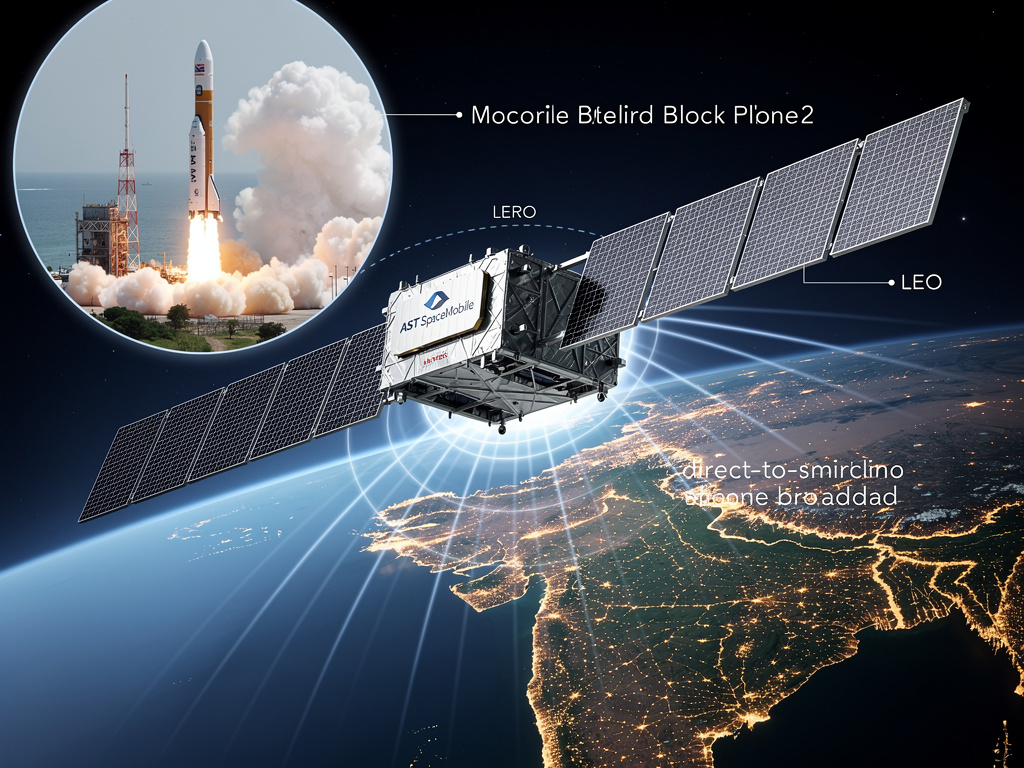
India’s Satish Dhawan Space Centre roared to life early Wednesday as the LVM3-M6 rocket pierced the pre-dawn sky, carrying AST SpaceMobile’s BlueBird Block-2 satellite—the largest commercial communications array ever deployed in low Earth orbit. Weighing in at a record 6,100 kilograms for an Indian launcher, this spacecraft marks the opening salvo in AST’s aggressive expansion to deliver cellular broadband directly to unmodified smartphones, positioning the Texas-based company as a direct challenger to Elon Musk’s Starlink dominance.
The mission, executed flawlessly by the Indian Space Research Organisation (ISRO), injected the satellite into its intended orbit just 15 minutes after liftoff at 8:55 a.m. IST. ISRO Chairman V. Narayanan hailed it as ‘the heaviest satellite ever lifted from Indian soil using an Indian launcher,’ underscoring the precision of the deployment. ISRO’s official mission page details how the LVM3, with its 640-tonne liftoff mass and 43.5-meter height, surpassed previous payloads like the 5,805-kg OneWeb batch it launched in 2023.
Engineering Marvel in Orbit
BlueBird Block-2 boasts a massive 2,400-square-foot communications array, powered by AST’s custom AST5000 ASIC chips after five years of development equivalent to 150 human-years of effort. This next-generation bird is the first of dozens slated for rollout, with BlueBirds 8 through 25 already in production, according to posts from AST SpaceMobile on X. The satellite aims to bridge connectivity gaps in remote areas, enabling 4G/5G signals to standard mobile devices without specialized hardware.
Unlike Starlink’s focus on high-speed internet via user terminals, AST’s direct-to-device model targets partnerships with telecom giants like AT&T and Verizon, potentially unlocking billions in revenue. The launch from Sriharikota, Andhra Pradesh, was a commercial coup for ISRO’s NewSpace India Ltd., which secured the deal amid growing demand for heavy-lift capacity. SpaceNews reports this kicks off a cascade of launches, with BlueBird 7 eyeing Cape Canaveral next.
Geopolitical and Market Ripples
Prime Minister Narendra Modi celebrated the feat on X, calling it ‘a significant stride in India’s space sector’ that strengthens global partnerships. His post, viewed millions of times, highlighted the mission’s role in India’s burgeoning commercial space ambitions. Narendra Modi’s X post emphasized the precise orbital insertion, boosting NSIL’s profile as a cost-competitive alternative to SpaceX Falcon 9 rides.
AST shares surged post-launch, reflecting investor enthusiasm for its Starlink rivalry. TipRanks noted the deployment as a pivotal step in space-based mobile connectivity, with analysts eyeing revenue from non-U.S. markets where Starlink faces regulatory hurdles. Bloomberg’s coverage frames it as AST’s bold challenge to SpaceX, with the satellite’s scale—largest in LEO commercial history—designed for superior coverage and capacity. Bloomberg.
Technical Edge Over Competitors
The LVM3-M6’s cryogenic upper stage (C25) enabled the heavy payload to low Earth orbit, a testbed for future Gaganyaan human missions. The Indian Express explains how this 6,100-kg beast pushes LVM3 limits, validating upgrades for heavier geosynchronous transfers. AST’s Block-2 iteration improves on earlier BlueBirds with enhanced solar arrays and phased-array antennas for seamless handoffs between satellites and cell towers.
Posts on X from ISRO captured the countdown drama, with liftoff livestreams drawing global viewers. The agency confirmed separation and orbit attainment swiftly, paving the way for BlueBird’s phased-array unfurling. Space.com described the 15-minute ascent as a record-breaker for smartphone-connecting tech, contrasting Starlink’s terminal-reliant model.
Strategic Launch Cadence Accelerates
AST plans multiple launches via ISRO, Blue Origin’s New Glenn, and SpaceX ironies aside, to deploy 45-60 Block-2 satellites by mid-2026. Business Today breaks down the satellite’s role in a constellation enabling broadband over oceans and rural voids. Partnerships with Vodafone and Rakuten further cement its global footprint.
Market watchers see this as a liquidity event amid thin Christmas-week trading, with Benzinga highlighting AST’s momentum as indexes hit highs. Benzinga. Tech in Asia positions AST as Starlink’s fiercest mobile-service foe, leveraging India’s launch economics—far cheaper than U.S. alternatives.
Regulatory and Spectrum Horizons
Success hinges on FCC approvals and spectrum deals; AST secured key U.S. clearances earlier this year. DD News reported ISRO’s pride in the heaviest Indian soil lift-off. DD News On Air. Economic Times previewed the Dec. 24 slot, now history. The Economic Times.
Invezz underscored the direct-to-device advance challenging SpaceX. Invezz. TIME magazine named BlueBirds a 2025 Best Invention, per AST’s X announcements, validating the tech’s disruptive potential.
Path to Commercial Orbit
With BlueBird 6 operational, AST eyes beta service in 2026, scaling to full constellation for ubiquitous coverage. ISRO’s track record—Chandrayaan successes—bolsters confidence. Advanced Television noted production ramp-up for subsequent birds. Advanced Television. This India-launched giant sets the pace in the race for sky-high cellular networks.


 WebProNews is an iEntry Publication