
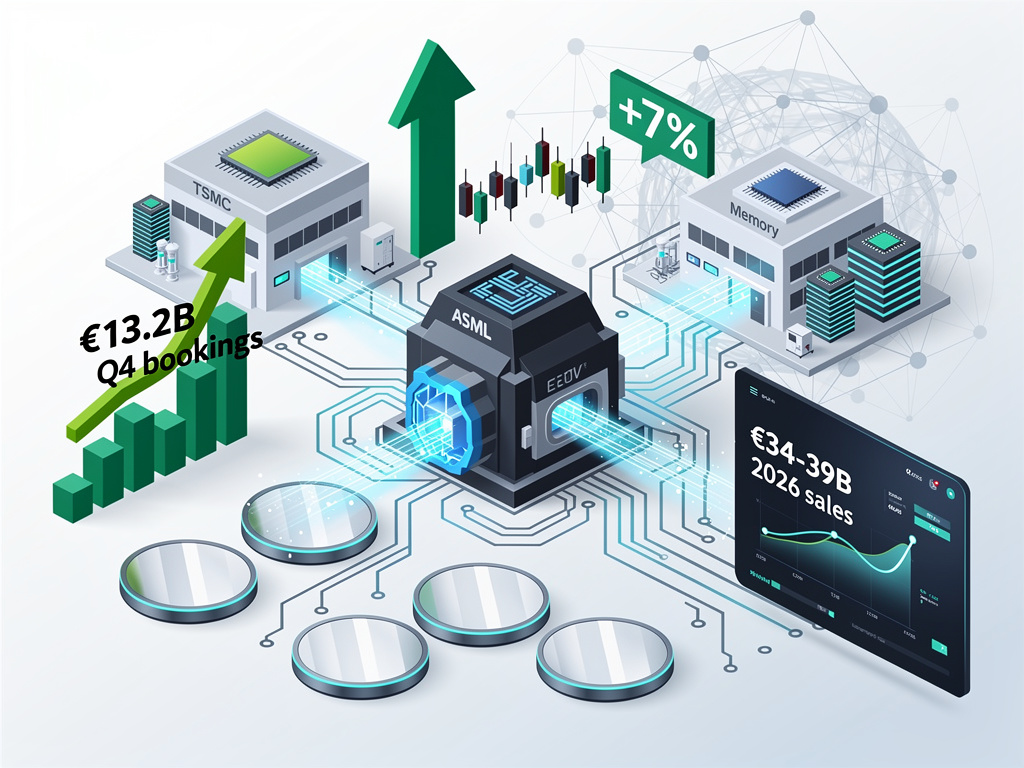
ASML Holding NV shares rocketed 7% Wednesday after the Dutch lithography leader unveiled fourth-quarter orders that obliterated estimates, propelled by unrelenting demand for machines etching the world’s most advanced AI chips. Bookings hit a staggering €13.2 billion ($15.8 billion) in Q4 2025, more than doubling analyst forecasts of €6.32 billion compiled by Visible Alpha, as reported by CNBC. The surge underscores the durability of artificial intelligence infrastructure spending, even as skeptics question its sustainability.
Full-year 2025 net sales reached €32.7 billion, up 16% from the prior year, with Q4 alone delivering a record €9.7 billion, including revenue from two High-NA extreme ultraviolet (EUV) systems, according to ASML’s official release via GlobeNewswire. Gross margins held firm at 52.8% for the year and 52.2% in the quarter, while net income climbed to €9.6 billion annually and €2.8 billion in Q4. Year-end backlog stood at €38.8 billion, with €25.5 billion in EUV, signaling robust visibility into future revenue.
Chief Executive Christophe Fouquet attributed the momentum to customers’ shifting outlook. “In the last months, many of our customers have shared a notably more positive assessment of the medium-term market situation, primarily based on more robust expectations of the sustainability of AI-related demand,” Fouquet stated in the earnings release. “This is reflected in a marked step-up in their medium-term capacity plans and in our record order intake.”
AI Tailwinds Drive EUV Dominance
Of the Q4 bookings, €7.4 billion came from EUV systems, ASML’s crown jewels essential for sub-2-nanometer chips powering Nvidia Corp. and Advanced Micro Devices Inc. processors. Demand stems from foundries like Taiwan Semiconductor Manufacturing Co. and memory giants Samsung Electronics Co. and SK Hynix Inc., racing to expand capacity amid AI data center buildouts by Microsoft Corp., Alphabet Inc.’s Google and Amazon.com Inc. “Overall there is good fourth-quarter orders and 2026 outlook, driven by AI demand for EUV in both logic and DRAM,” Mizuho Securities analyst Kevin Wang noted, as cited by Reuters.
TSMC, ASML’s top customer, recently projected 2026 capital expenditures exceeding $52 billion, much directed at advanced nodes requiring EUV tools. SK Hynix, reporting record quarterly earnings on the same day, echoed the frenzy, with Barclays analysts anticipating it will take delivery of 12 EUV machines in 2026 amid a memory shortage projected through 2027. The installed-base business, generating €8.2 billion in 2025 from services and upgrades, further bolsters margins as the EUV fleet expands.
ASML’s monopoly on EUV lithography—machines costing up to €300 million each—positions it as the linchpin of the semiconductor supply chain. No viable alternatives exist, ensuring pricing power and long lead times that provide unmatched demand visibility.
2026 Outlook Signals Acceleration
ASML raised its 2026 net sales forecast to €34 billion-€39 billion, implying 4%-19% growth over 2025 and surpassing consensus estimates of €35.1 billion. Q1 2026 sales are guided at €8.2 billion-€8.9 billion, with gross margins of 51%-53%. “We expect 2026 to be another growth year for ASML’s business, largely driven by a significant increase in EUV sales and growth in our installed base business sales,” Fouquet added. EUV revenue is set to “significantly go up” next year, per CNBC.
Chief Financial Officer Roger Dassen highlighted customer conviction: “I think it’s primarily on the basis of the more robust view that they have when it comes to demand for AI, which seems to be more sustainable from their vantage point. That recognition has led some of our customers to really invest in capacity and gear up their plans for medium-term capacity expansion.” Longer-term, ASML reaffirmed 2030 revenue guidance of €44 billion-€60 billion with 56%-60% margins.
To reward shareholders, ASML proposed a 17% dividend hike to €7.50 per share for 2025 and launched a €12 billion buyback through 2028, following €7.6 billion repurchased under the prior program.
China’s Share Shrinks Amid Restrictions
China accounted for 33% of 2025 sales, down from 41% in 2024, and Q4 net system sales reached 36%. However, Dassen forecasts a drop to 20% in 2026 due to U.S.-led export curbs blocking advanced EUV shipments. “ASML not allowed to ship most advanced machines to China,” CNBC reported. Despite this, non-China demand—fueled by AI—offsets the headwind.
U.S. CHIPS Act subsidies and European incentives, including the Netherlands’ €2.5 billion Project Beethoven, bolster ASML’s expansion. High-NA EUV, capable of 8-10 nanometer resolutions, begins ramping, with two systems recognized in Q4 revenue.
Analysts like ING’s Marc Hesselink called the bookings “a bang” before ASML discontinues quarterly reporting on them to curb volatility, per Reuters.
Job Trims Amid Boom Spark Questions
Paradoxically, ASML plans a net reduction of 1,700 positions—3.8% of staff—mostly in Dutch and U.S. R&D leadership, aiming for greater agility after decades of growth. “Even a great company needs to improve,” Fouquet told Bloomberg. Degroof Petercam’s Michael Roeg quipped the cuts amid records would fuel union talks.
Stock reaction was swift: shares hit record highs, up nearly 38% year-to-date, pushing market cap above $500 billion. X posts from traders hailed it as crushing the “AI bubble” narrative, with @Cmoney365247 declaring ASML “DESTROYS THE ‘AI BUBBLE’ NARRATIVE.”
The results affirm AI’s transformative force on semiconductors, with ASML at the vanguard. As data centers proliferate and nodes shrink, the company’s order book—bolstered by irreplaceable technology—promises sustained expansion.


 WebProNews is an iEntry Publication