
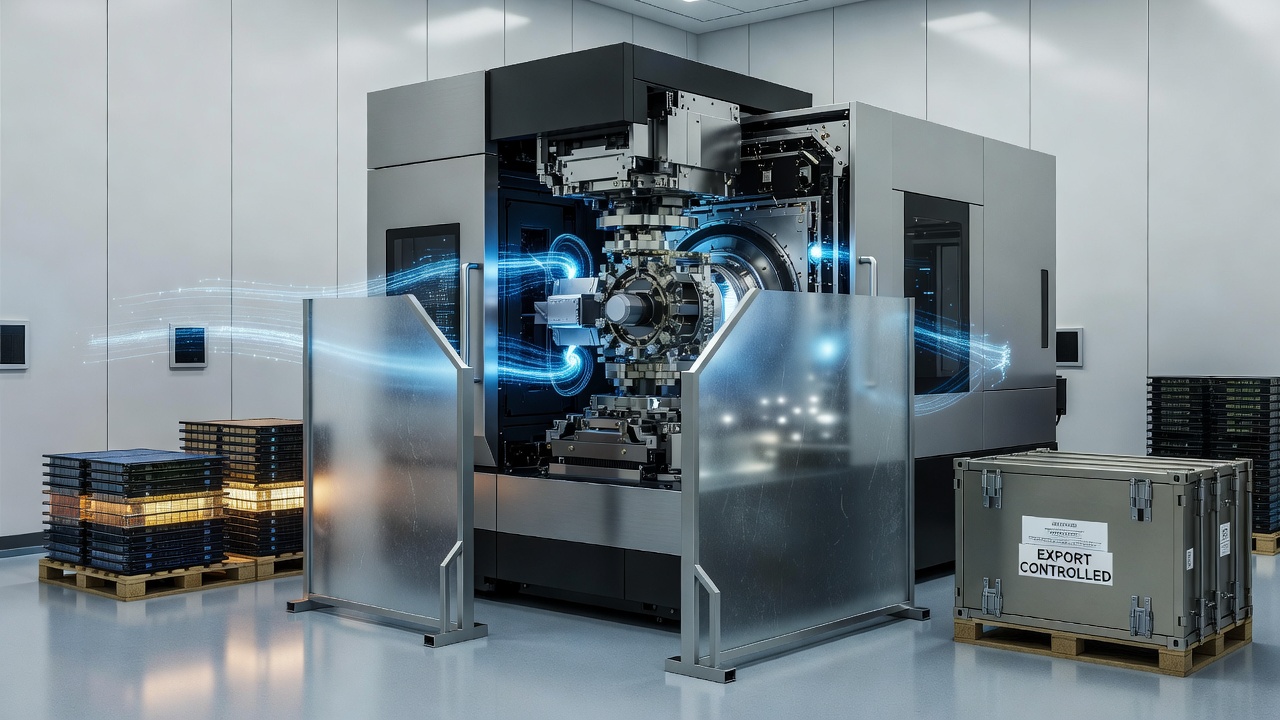
The Financial Times reported last month on a significant development in the semiconductor sector, where ASML, the Dutch company that dominates the market for extreme ultraviolet lithography machines, faces mounting pressure from both commercial demands and geopolitical constraints. This situation highlights the complex intersections between advanced technology manufacturing, international trade policies, and national security priorities that now shape global chip production.
ASML’s position as the sole supplier of machines capable of producing the most advanced semiconductors gives it unusual influence in an industry that underpins everything from smartphones to military systems. The Financial Times article details how the company has become caught between its commercial interests in serving customers worldwide and the export restrictions imposed by the Dutch government in alignment with United States policy toward China. These restrictions, which limit the sale of certain high-end lithography systems, reflect broader efforts to slow China’s progress in semiconductor manufacturing capabilities.
The lithography machines produced by ASML represent years of specialized engineering focused on using extreme ultraviolet light to etch circuit patterns onto silicon wafers. These systems cost hundreds of millions of dollars each and require cleanroom facilities that maintain air purity levels difficult for most people to imagine. The technical demands involved in generating and controlling light with wavelengths of just 13.5 nanometers have created a barrier to entry that no other company has yet overcome. This monopoly has made ASML a central figure in discussions about supply chain security and technological competition between major powers.
Industry observers point to the way these machines have enabled the production of chips with transistor densities that seemed impossible a decade ago. The ability to pack more computing power into smaller spaces has driven improvements across multiple sectors, from artificial intelligence training to automotive safety systems. Yet the same capabilities that fuel commercial innovation also carry implications for military applications, creating tension between economic benefits and security concerns.
The Dutch government’s decision to impose export controls on certain ASML systems emerged after extensive consultations with American officials. These measures target specific machine types that could accelerate China’s development of advanced processors for both civilian and military uses. The policy reflects a shift in how Western governments approach technology transfer, moving from relatively open markets to more selective restrictions based on strategic calculations.
ASML has responded by emphasizing its commitment to compliance while seeking to maintain business relationships where possible. The company has invested heavily in research and development, with annual spending that exceeds the budgets of many smaller nations. This investment has allowed it to stay ahead of competitors, but it also means the company must carefully balance its innovation priorities with the realities of operating in a politically charged environment.
The impact of these restrictions extends beyond ASML itself. Major chip manufacturers like TSMC in Taiwan and Samsung in South Korea rely on ASML equipment for their most advanced production lines. Any disruption in the supply of these machines affects their ability to meet growing demand for sophisticated processors. Meanwhile, Chinese companies such as SMIC have accelerated their own efforts to develop alternative technologies, though they continue to face significant technical hurdles in matching the precision achieved by ASML systems.
Economic analysts suggest that the current situation could lead to a bifurcation of the global semiconductor industry, with different technological standards and supply chains emerging for different markets. This separation would likely increase costs across the board as companies duplicate research efforts and maintain parallel production capabilities. The Financial Times report indicates that such fragmentation might slow overall innovation rates while raising prices for consumers and businesses alike.
From a technical perspective, the challenges involved in semiconductor manufacturing have grown more complex with each generation of chips. The transition to smaller process nodes requires not just better lithography but also advances in materials science, metrology, and process control. ASML has collaborated closely with suppliers and customers to address these challenges, creating an interdependent network of specialized firms that collectively push the boundaries of what is physically possible.
The company’s headquarters in Veldhoven, Netherlands, houses some of the most sophisticated manufacturing and testing facilities in the world. There, engineers work on systems that must maintain alignment accuracy within fractions of a nanometer while operating at speeds that allow for high-volume production. The precision required compares to hitting a target the size of a marble from hundreds of kilometers away while moving at highway speeds.
Geopolitical considerations have added another layer of complexity to these technical pursuits. Export licenses now factor into production schedules, and companies must navigate varying regulatory requirements across different jurisdictions. This environment demands that technology firms develop sophisticated compliance programs while still maintaining the agility needed to respond to rapid market changes.
Chinese officials have criticized the restrictions as unfair barriers to economic development, arguing that they violate principles of free trade. They point to China’s substantial investments in semiconductor research and its growing domestic market as justification for access to the best available tools. Western governments counter that national security considerations must take precedence when technologies have clear dual-use applications.
The situation has prompted increased investment in alternative approaches to chip manufacturing. Some companies are exploring new materials beyond traditional silicon, while others focus on advanced packaging techniques that can achieve performance gains without requiring the smallest possible feature sizes. These efforts represent attempts to work around the limitations imposed by both physics and politics.
For ASML specifically, the coming years will likely bring continued pressure to balance competing demands. The company has announced plans to expand its production capacity, but building new facilities for these specialized machines takes years and requires highly trained personnel who remain in short supply. The global competition for talent in fields like optics, laser physics, and precision engineering has intensified as more countries recognize the strategic value of semiconductor capabilities.
Market projections suggest that demand for advanced semiconductors will continue growing as artificial intelligence applications expand and other industries adopt more sophisticated electronic systems. This growth creates opportunities for ASML but also increases scrutiny from governments concerned about where these powerful chips ultimately end up. The company must therefore develop strategies that satisfy regulatory requirements while meeting the needs of its diverse customer base.
Industry experts anticipate that the current round of restrictions represents just the beginning of a longer process of technology control. Future measures might target additional types of equipment or components, further complicating global supply chains. Companies throughout the semiconductor value chain are already adjusting their business models to account for this new reality, seeking ways to maintain profitability while operating within tighter constraints.
The human element in all of this deserves attention as well. The engineers and scientists who design and build these machines possess specialized knowledge that has taken decades to accumulate. Their work requires intense concentration and creative problem-solving, often under tight deadlines driven by customer demands. The geopolitical tensions add stress to their professional lives, as they must consider the broader implications of their technical achievements.
Looking ahead, the semiconductor industry appears headed toward a period of adjustment and adaptation. The extraordinary capabilities enabled by ASML’s technology will continue advancing, but the distribution of these capabilities across different regions will be shaped by policy decisions as much as by scientific breakthroughs. This dynamic creates both challenges and opportunities for companies, researchers, and policymakers alike.
The Financial Times coverage captures how one company’s technical success has thrust it into the center of international strategic competition. ASML’s story illustrates the ways in which specialized manufacturing expertise can become a matter of global significance, influencing relationships between nations and the direction of technological progress. As governments continue to reassess their approaches to technology security, the experiences of ASML and its customers will provide important lessons about managing innovation in an age of heightened geopolitical awareness.
The situation also raises questions about the sustainability of current models for funding and organizing advanced research. When commercial enterprises bear the primary responsibility for developing technologies with significant military applications, the lines between private enterprise and public policy become increasingly blurred. Finding the right balance between encouraging innovation and protecting security interests will require ongoing dialogue between industry leaders, government officials, and academic researchers.
Ultimately, the challenges facing ASML reflect broader tensions in the global economy. The benefits of technological advancement have always been distributed unevenly, but the current situation amplifies these disparities in ways that carry both economic and strategic consequences. How companies, countries, and international institutions address these issues will help determine the shape of the semiconductor industry for years to come. The path forward likely involves some combination of continued technical progress, careful policy calibration, and pragmatic business decisions made under conditions of uncertainty.


 WebProNews is an iEntry Publication