
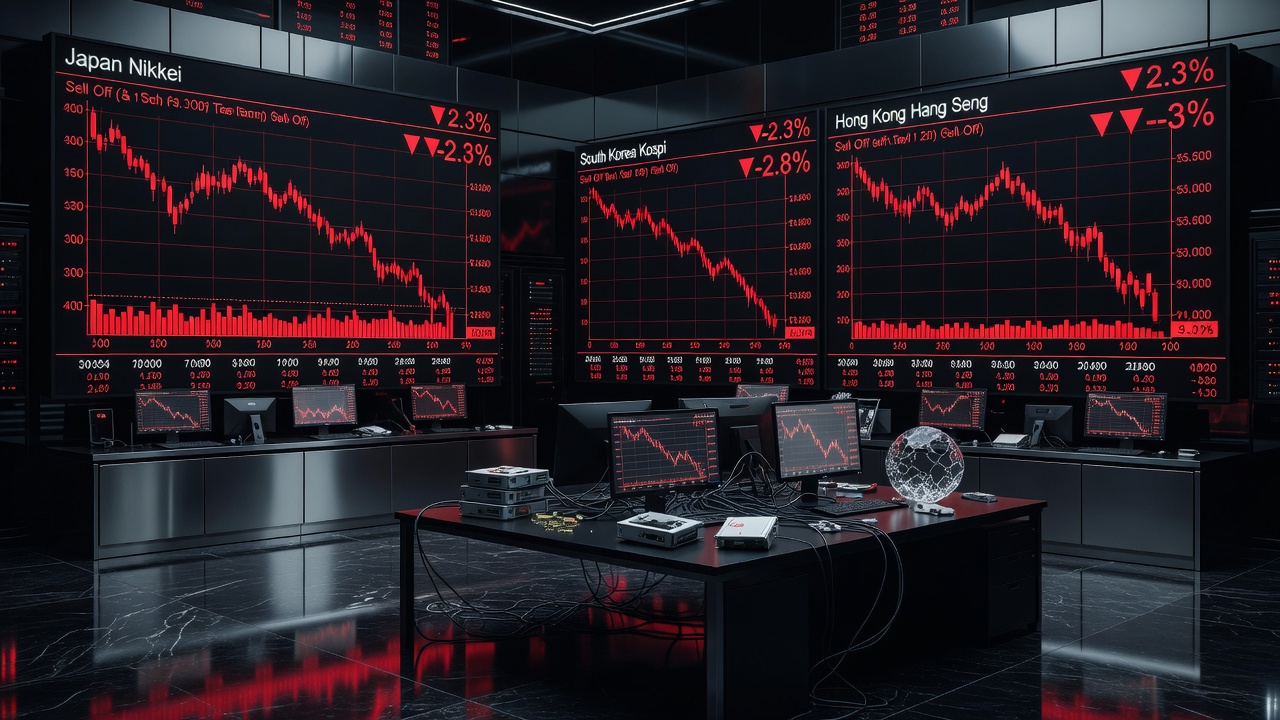
Asian shares experienced sharp declines on Monday as investors rushed to sell stocks amid growing concerns over potential disruptions to global trade policies under the incoming Trump administration. The sell-off reflected broader worries about tariffs and their impact on export-driven economies across the region. Markets in Japan, South Korea, and Hong Kong led the downward trend, with major indexes dropping by more than two percent in some cases.
The Yahoo Finance report highlighted how traders dumped shares early in the session after Donald Trump signaled plans to impose fresh tariffs on imports from several Asian nations. Japan’s Nikkei 225 fell around 2.3 percent while South Korea’s Kospi index shed nearly 2.8 percent. Hong Kong’s Hang Seng index posted even steeper losses, closing down more than three percent as technology and financial stocks bore the heaviest pressure. These moves came after similar weakness in European markets the previous Friday and ahead of a critical week for U.S. economic data releases.
Analysts pointed to several interconnected factors driving the sudden aversion to risk. Foremost among them was the renewed focus on protectionist trade measures. Trump has repeatedly promised to place tariffs of up to 60 percent on goods from China and additional levies on other trading partners. Such policies could raise costs for manufacturers that rely on Asian supply chains and reduce demand for finished products shipped back to American consumers. Companies in electronics, automobiles, and semiconductors felt the pinch immediately as investors repriced future earnings lower.
China’s mainland markets also joined the retreat despite efforts by Beijing to stabilize sentiment through policy support. The Shanghai Composite index dropped 1.9 percent while the Shenzhen Component fell 2.4 percent. Property developers and consumer discretionary firms suffered outsized losses after fresh data showed slowing retail sales growth in November. Although Chinese officials have pledged further monetary easing and infrastructure spending, market participants appear skeptical that these steps can fully offset external shocks from a more hostile U.S. trade stance.
Currency movements compounded the equity pressure. The Japanese yen strengthened against the dollar as traders anticipated possible intervention by Japanese authorities to support the currency. A stronger yen hurts Japanese exporters by making their products more expensive overseas. Meanwhile the South Korean won and Taiwanese dollar both weakened, reflecting expectations of capital outflows from those markets. Currency volatility often amplifies stock market swings because many regional companies hedge their foreign exchange exposure or borrow in dollars.
The technology sector proved especially vulnerable. Semiconductor firms such as Taiwan Semiconductor Manufacturing Company and Samsung Electronics saw their share prices tumble more than four percent each. These businesses supply critical components to global device makers and stand directly in the crosshairs of any new trade barriers. Memory chip producers also faced selling pressure after reports suggested that U.S. officials might tighten export controls on advanced chips to China. The sell-off extended to South Korean battery makers and Chinese electric vehicle suppliers, both of which depend heavily on access to the American market.
Financial shares did not escape the turmoil. Major banks in Singapore and Australia reported losses as bond yields climbed on expectations that the Federal Reserve might slow its rate-cutting cycle. Higher interest rates typically weigh on bank profitability by increasing funding costs while also pressuring asset valuations. Australian banks, which had enjoyed a strong run earlier in the year, gave back some of those gains in a single session. Insurance companies and asset managers followed suit as investors rotated away from risk assets.
Commodity prices offered mixed signals but largely reinforced the risk-off mood. Oil futures slipped below 70 dollars per barrel after OPEC+ members signaled they might delay planned production increases to support prices. Lower energy costs could eventually benefit Asian importers such as Japan and India, yet the immediate reaction was negative because reduced oil revenue in exporting nations could slow their demand for Asian exports. Copper and iron ore prices also retreated, hitting shares of mining companies listed in Australia and Indonesia.
Traders cited technical factors as well. Many regional indexes had rallied sharply in the weeks following the U.S. election on hopes that Trump’s policies would favor business through tax cuts and deregulation. That optimism has now given way to second thoughts as the details of actual policy implementation come into sharper focus. Overbought conditions on daily charts left markets susceptible to profit-taking once negative headlines emerged. Algorithmic trading programs likely accelerated the move once key support levels were breached.
Economists warn that prolonged trade tensions could shave several tenths of a percentage point from regional growth forecasts. Southeast Asian nations that serve as manufacturing alternatives to China might initially benefit from trade diversion but could suffer if overall global demand contracts. Vietnam, Malaysia, and Thailand have attracted significant foreign investment in recent years precisely because companies sought to reduce reliance on Chinese factories. A broad-based slowdown in U.S. consumption would undermine those gains.
Central banks across the region face difficult choices. The Bank of Japan must decide whether to continue gradual rate hikes or pause to support economic activity if export demand falters. The People’s Bank of China has room to cut rates further and inject liquidity, yet authorities remain wary of encouraging excessive leverage in the property sector. South Korea’s central bank has already signaled a more cautious approach to rate policy after inflation proved stickier than expected. Coordination among these institutions remains limited, raising the risk that policy responses become fragmented.
Looking ahead, investors will closely watch upcoming U.S. inflation figures and the Federal Reserve’s December meeting. Any indication that American policymakers intend to keep rates higher for longer could intensify pressure on Asian currencies and equities. At the same time, developments in U.S.-China diplomatic channels will matter greatly. Signs of negotiation or de-escalation could quickly reverse some of the recent losses, while escalation would likely trigger additional selling.
Market participants also eye corporate earnings reports scheduled for the coming weeks. Many Asian companies have already begun warning that margin pressure from higher input costs and softer demand could weigh on full-year results. Technology hardware firms in particular have lowered guidance citing inventory corrections and weaker consumer spending in key markets. These updates will test whether current valuations, already down from recent peaks, have fully priced in the new risks.
Retail investors in the region have grown more active in recent years through mobile trading platforms and government-backed investment schemes. Their behavior can sometimes amplify market moves. Early data from brokerage houses suggested heavy net selling by individuals in Hong Kong and South Korea on Monday, though institutional flows were harder to gauge in real time. Margin calls may have forced some leveraged positions to unwind, adding to downward momentum.
Despite the negative tone, not all voices adopted a purely bearish outlook. Some fund managers argued that Asian equities now trade at attractive valuations relative to historical averages and to U.S. markets. They pointed to strong balance sheets at many blue-chip companies and the potential for domestic consumption to pick up if governments roll out fresh stimulus. Long-term investors with multi-year horizons may view the current weakness as an opportunity to accumulate quality names at discounted prices.
Still, near-term sentiment remains fragile. Volatility indexes for Asian markets jumped sharply, signaling heightened fear. Options markets showed increased demand for downside protection through the remainder of the year. Bond markets likewise reflected caution, with government yields in Japan and Australia falling as investors sought safety.
The coming days will bring fresh economic releases from across the region, including industrial production numbers from China and export data from South Korea and Taiwan. These figures will help clarify whether the equity sell-off reflects genuine deterioration in fundamentals or merely a sentiment-driven correction. Until clearer signals emerge, traders appear likely to maintain a defensive posture, keeping positions light and hedges in place.
Global supply chain managers have already begun reviewing contingency plans. Firms that spent the past several years diversifying away from China now face the prospect of new tariff walls around the United States itself. Some may accelerate moves into Latin America or Eastern Europe, though each alternative brings its own logistical and political challenges. The uncertainty itself carries an economic cost, as delayed investment decisions slow productivity growth.
In equity markets, sector rotation has become evident. Defensive areas such as utilities, healthcare, and certain consumer staples held up better than cyclical industries. Within technology, software and internet platform companies with strong domestic user bases outperformed hardware manufacturers tied to global trade. This pattern mirrors shifts seen during previous periods of trade friction and suggests investors are trying to identify businesses less exposed to cross-border policy risk.
Trading volumes surged across most Asian exchanges, indicating broad participation in the sell-off rather than isolated moves. Futures markets pointed to further caution in overnight sessions, with European and U.S. equity futures also trading in the red. The interconnected nature of global finance means shocks in one time zone quickly transmit to others, often magnifying the original move.
Policymakers in affected countries will likely issue statements aimed at calming markets. Finance ministers and central bank governors have scheduled calls to discuss possible coordinated responses, though concrete action may take time. History shows that sudden market drops can reverse just as quickly once the initial panic subsides, particularly if positive news emerges from trade talks or domestic policy announcements.
For now, the dominant theme remains risk reduction. Portfolio managers are trimming exposure to export-sensitive sectors while increasing allocations to cash or short-duration government securities. Currency hedging costs have risen, making it more expensive for foreign investors to maintain positions in local markets. These practical constraints can prolong a sell-off even when underlying economic conditions have not changed dramatically.
The episode serves as a reminder of how political developments in one major economy can ripple across distant markets within hours. Asian business leaders have grown accustomed to operating in an environment shaped by great-power competition, yet each new policy announcement still tests corporate adaptability. Investors, for their part, continue to search for the right balance between long-term growth potential in the world’s most populous region and the immediate hazards posed by shifting trade rules.
As the week progresses, attention will turn to whether bargain hunters step in or if sellers maintain control. The speed and scale of any rebound will offer clues about underlying confidence. Until then, Asian shares are likely to trade cautiously, with every headline from Washington capable of moving prices sharply in either direction. Market resilience will be tested repeatedly in the months ahead as the new U.S. administration begins translating campaign promises into concrete actions.


 WebProNews is an iEntry Publication