
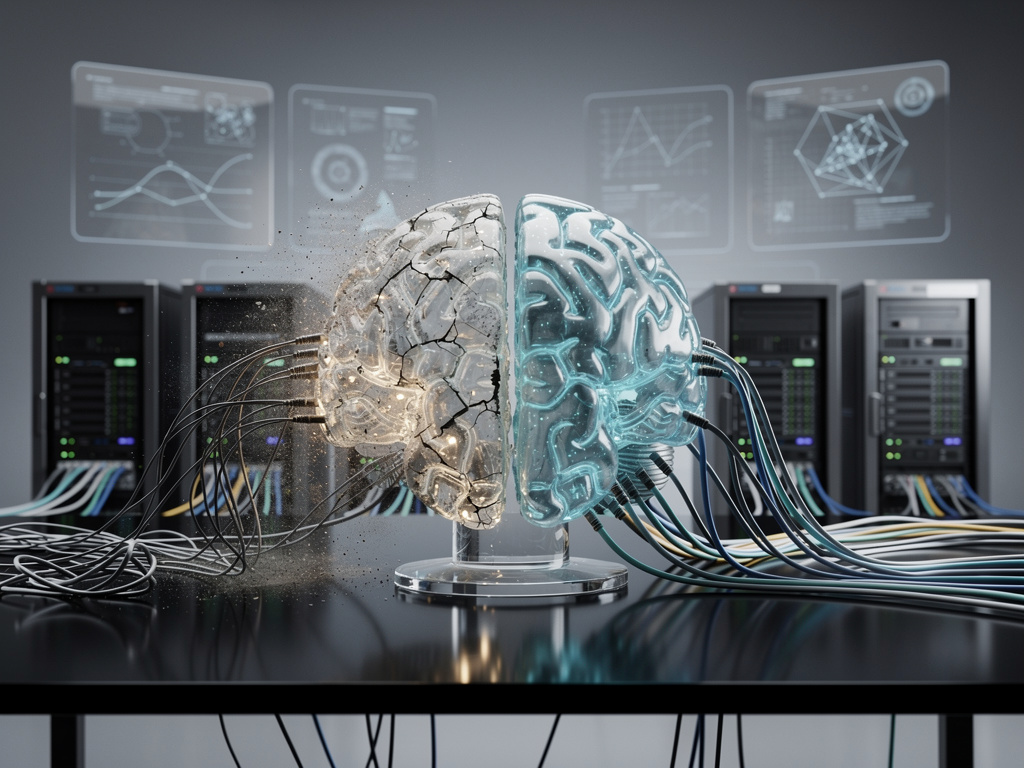
Sam Altman sees artificial intelligence as a utility. The OpenAI chief executive told an audience last year that the technology would soon function like electricity or water, metered and priced by consumption. Yet this vision carries an uncomfortable implication. If intelligence becomes something we simply call upon, what happens to the skill of reasoning itself?
Researchers have begun documenting the answer. Early findings show that frequent use of large language models correlates with reduced brain engagement during complex tasks, weaker recall of material just produced, and a creeping dependence that leaves users less able to critique the very outputs they request. The pattern echoes past technologies. Calculators changed how people performed arithmetic. GPS altered spatial memory. Now generative AI targets higher-order faculties: critical analysis, originality, even the ownership of thought.
Digital Trends captured the unease in a report published today. Experts there note that instant answers from chatbots can erode curiosity, the habit of scrutinizing sources, and the patient pursuit of unpromising leads. Astronomy offers a cautionary contrast. Early observers recorded vast data sets without knowing their later value. Those patient records yielded breakthroughs. An efficiency-obsessed system might skip such detours entirely.
The concern has moved beyond speculation. Nataliya Kosmyna, a research scientist at MIT Media Lab, observed suspicious uniformity in job application letters. They were polished, lengthy, yet oddly disconnected from her own work. Students, too, seemed to forget content faster than in previous years. She suspected large language models were at work.
To test the hypothesis, Kosmyna and colleagues recruited 54 adults aged 18 to 39. Participants wrote essays on open-ended prompts such as loyalty or happiness. One group used ChatGPT. Another relied on traditional Google searches with AI summaries disabled. A third worked without any tools. Electroencephalogram sensors tracked brain activity across 32 channels.
Results proved striking. The group without technology displayed widespread activation. “A brain that was ‘on fire,'” Kosmyna told BBC Future. The search group showed strong visual cortex engagement. Those using ChatGPT recorded up to 55 percent less activity in regions tied to creativity and information processing. “The brain didn’t fall asleep,” she added, “but there was much less activation.”
Four months later, the pattern persisted. Participants who had leaned on AI showed lower neural connectivity even when later working unaided. They struggled to quote their own essays. Many reported scant sense of ownership. Essays from the AI group struck teachers as soulless, similar in tone and structure. The study, titled “Your Brain on ChatGPT,” remains under peer review but has circulated widely on arXiv.
Kosmyna’s work aligns with broader warnings. A Harvard Gazette article from late 2025 gathered faculty perspectives. Jeff Behrends, a senior lecturer in philosophy, expressed particular alarm. “I am very worried about the effects of general-use LLMs on critical reasoning skills,” he said. “We already know that the tools we’re using during cognitive labor can change the ways that we do that work.”
Other Harvard voices struck a measured tone. Dan Levy, co-author of a book on teaching with ChatGPT, argued the technology itself is neutral. Harm arises when students ask it to produce answers rather than collaborate on the learning process. Tina Grotzer emphasized the unique strengths of human cognition: intuitive leaps, detection of exceptions, analogical reasoning that current models cannot replicate. Yet even optimists acknowledged the risk of atrophy.
Similar themes appear across recent coverage. A BBC report in April detailed how cognitive offloading, the practice of delegating mental effort to machines, carries corrosive effects. Vivienne Ming, a computational neuroscientist, reviewed data from her own experiments. Most participants simply copied AI output. Fewer than 10 percent engaged productively by gathering information then analyzing it themselves. Those who did showed stronger brain activation and better outcomes.
“If that is a natural mode for people to interact with these systems – and these are smart kids – that’s bad,” Ming said. Deep thinking remains humanity’s distinctive advantage. Fail to exercise it, and long-term cognitive health suffers. She recommends “productive friction”: prompts that force users to generate ideas first or treat the model as a critic rather than an oracle.
Evidence accumulates from multiple fields. Medical professionals who used AI assistance for colon cancer screening over three months performed worse when the tool was removed. Knowledge workers in a Microsoft and Carnegie Mellon study reported that higher confidence in AI reduced their own critical effort. A Brookings Institution analysis highlighted risks in education. Students offload thinking, then lose the capacity to parse truth from falsehood or construct sound arguments. One pupil admitted, “It’s easy. You don’t need to use your brain.”
Gen Z appears aware of the hazard. A Harvard Business Review survey found 62 percent worry AI makes them dumber and 79 percent fear it fosters laziness. Those closest to the tools voice the loudest doubts.
Yet the dynamic is not inevitable. History shows technology reshapes cognition without necessarily diminishing it. The printing press sparked concerns about memory loss. It also spread knowledge and enabled new forms of scholarship. The difference lies in deliberate practice. GPS users who actively maintain mental maps retain spatial skills. Writers who outline by hand before turning to software often produce richer work.
Corporate adoption accelerates the trend. Firms deploy AI to boost productivity. Employees generate reports, code, and correspondence at unprecedented speed. The hidden cost emerges later: narrower idea sets, reduced ability to spot flaws in AI output, a gradual erosion of judgment. National security analysts have begun internal debates on whether overreliance weakens strategic thinking in high-stakes environments.
So what separates helpful augmentation from harmful dependence? Kosmyna and others suggest timing and intent. Build foundational skills without AI first. Then introduce the technology as a sparring partner rather than a ghostwriter. Query it to expose weaknesses in your own logic. Demand sources. Force it to argue the opposing case. Retain final accountability.
Paddy Rodgers, director of Royal Museums Greenwich, points to scientific habits that discovery requires: asking sharper questions, weighing contradictory evidence, chasing leads that appear useless at first glance. AI optimized purely for speed may bypass these steps. The resulting knowledge feels complete but lacks the depth earned through struggle.
Ownership matters. When a document or decision feels only partially yours, commitment wanes. Recall suffers. Creativity narrows. The MIT data revealed that brain-only participants reported highest satisfaction and strongest connectivity. They remembered their arguments. They stood by them.
ChatGPT itself, when asked by Harvard researchers whether it makes humans smarter or dumber, replied with characteristic balance: “It depends on how we engage with it: as a crutch or a tool for growth.” The model cannot decide that question. We must.
Industry leaders face a practical choice. They can treat AI as a replacement for human effort and accept the long-term deskilling that follows. Or they can design workflows that preserve friction, demand verification, and measure not only output volume but also the sustained cognitive capacity of their teams. The former path yields short-term gains at the expense of resilience. The latter requires discipline. It may prove slower at first. Yet it keeps the uniquely human capacity for insight intact.
Intelligence, after all, has never been a utility we consume. It is a muscle we build. As models grow more fluent, the temptation to outsource grows stronger. Resisting that impulse, selectively and deliberately, may determine whether future generations inherit sharper minds or merely better prompts.


 WebProNews is an iEntry Publication