
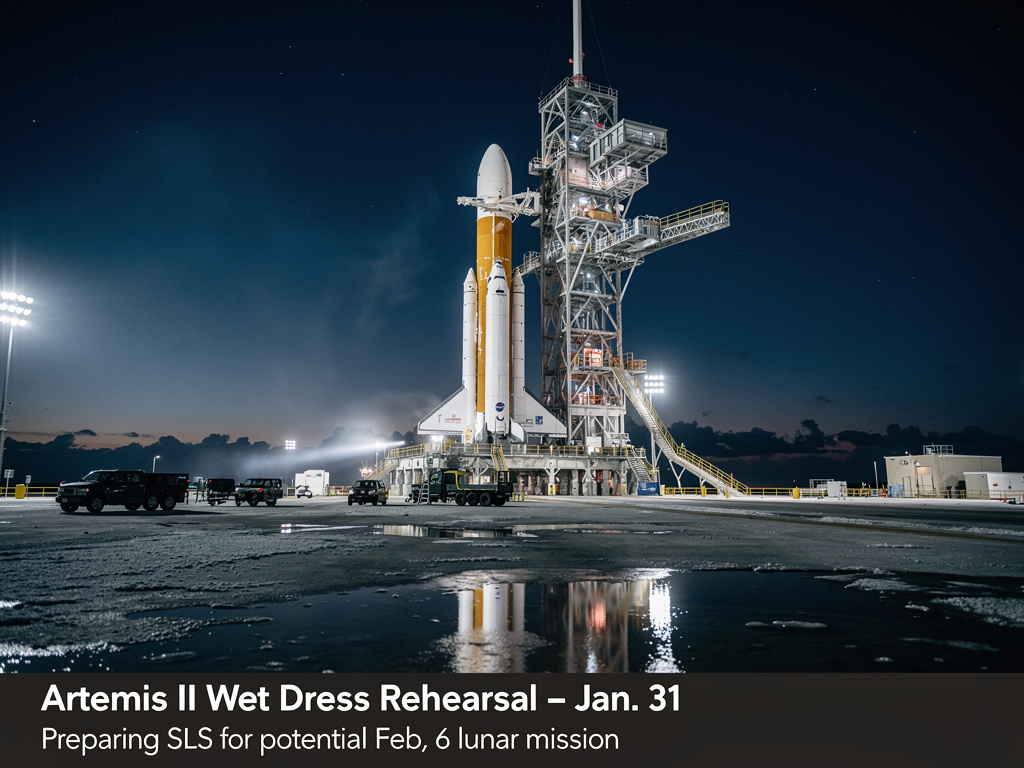
At Kennedy Space Center’s Launch Complex 39B, NASA’s towering Space Launch System rocket stands primed for a pivotal wet dress rehearsal, accelerated to as early as Jan. 31, 2026. This critical fueling test, involving over 700,000 gallons of cryogenic propellants, simulates launch countdown procedures and could clear the path for the first crewed lunar mission since Apollo 17 in 1972. The rehearsal marks the final major hurdle before a potential liftoff no earlier than Feb. 6, sending four astronauts on a 10-day lunar flyby aboard the Orion spacecraft.
The SLS rocket and Orion stack rolled out from the Vehicle Assembly Building on Jan. 17 after a 12-hour trek, arriving at the pad at 6:42 p.m. EST. Teams have since integrated ground systems, powered up components, and addressed minor issues like emergency egress basket brakes. Cold weather gripping Florida—temperatures dipping into the 20s—prompts vigilant monitoring, with environmental controls safeguarding the hardware. NASA officials express confidence in fixes from Space.com reporting on the test’s advancement.
“The upcoming wet dress rehearsal is a prelaunch test to fuel the rocket. During the rehearsal, teams demonstrate the ability to load more than 700,000 gallons of cryogenic propellants into the rocket, conduct a launch countdown, and practice safely removing propellant from the rocket without astronauts inside the spacecraft,” NASA stated in a blog update cited by MyNews13.
Rocket Rollout and Pad Preparations Accelerate Momentum
Engineers plan to begin fueling Thursday evening, Jan. 29, targeting a simulated T-0 at 9 p.m. EST on Jan. 31, or 0200 GMT Feb. 1. The countdown will scrub at T-33 seconds, reset to T-10 minutes, and run to T-30 seconds, testing holds and scrubs. NASA will stream the event, with coverage starting Saturday. Success hinges on avoiding Artemis I’s woes—four failed rehearsals due to hydrogen leaks that forced three rollbacks. Upgrades address those flaws, per Florida Today.
The crew—Commander Reid Wiseman, Pilot Victor Glover, Mission Specialist Christina Koch (all NASA), and Canadian Space Agency’s Jeremy Hansen—entered quarantine Jan. 23 in Houston. They name their Orion “Integrity,” symbolizing trust across teams. Hansen becomes the first Canadian on a lunar mission. The diverse quartet will verify life support, navigation, and deep-space systems during the figure-eight lunar trajectory.
Astronauts recently completed a Countdown Demonstration Test, rehearsing ingress without suits. Post-rehearsal, a flight readiness review will assess hardware, infrastructure, and teams before setting a launch date within the Feb. 6-11 window, constrained by Earth-Moon geometry, as detailed on NASA.gov.
Lessons from Artemis I Shape High-Pressure Test
Artemis I’s 2022 delays—leaks, sensor failures, hurricanes—underscore stakes. NASA refined procedures: flight termination devices installed pre-rollout, avoiding VAB returns. Weekend work loaded solid rocket boosters with hydrazine, fueled Orion components, and tested communications. Cold snap preparations include Orion water system checks for potability, noted in Scientific American.
“With cold weather sweeping the country and lower than normal temperatures expected in Florida Tuesday, Jan. 27, technicians are taking steps to ensure environmental control systems keeping Orion and SLS elements at the proper conditions are prepared for the cold,” NASA reported. Egress issues resolved ensure crew safety slides work in emergencies.
ULA-built Interim Cryogenic Propulsion Stage-2 will boost Orion from Earth orbit to lunar path. Post-splashdown, teams evaluate data for Artemis III’s 2028 south pole landing via SpaceX Starship or rivals.
Crew Quarantine Signals Imminent Flight Path
Quarantine minimizes illness risks, standard for high-stakes missions. Crew will arrive in Florida six days pre-launch for final walkdowns. Artemis II tests Orion’s breathable air generation, CO2 removal, and metabolic extremes during exercise and sleep, per NASA blogs.
The 322-foot SLS delivers 8.8 million pounds of thrust, far from Earth than any humans since Apollo. No landing, but far-side flyby validates systems for sustained presence.
“Artemis II will be a momentous step forward for human spaceflight. This historic mission will send humans farther from Earth than ever before,” said NASA Administrator Jared Isaacman.
Strategic Shift from Apollo’s Race to Partnership Era
Unlike Apollo’s Cold War sprint, Artemis emphasizes sustained operations via coalitions. Commercial firms like Boeing (SLS core), Lockheed Martin (Orion) integrate from design. International partners join early, contrasting China’s opaque, state-led program—far-side robots, 2030 crewed landing, selective ties—as analyzed in The Conversation.
US openness shapes lunar norms under Outer Space Treaty’s “due regard,” preempting resource disputes at water-ice-rich south pole. Executive orders affirm commercial roles, inter-agency coordination for Mars prep.
“We are moving closer to Artemis II, with rollout just around the corner,” said Lori Glaze, acting associate administrator for Exploration Systems.
Global Stakes in Lunar Competition and Norms
China’s incremental advances challenge US leadership, but Artemis builds reliability for allies. Gateway station, resource extraction fuel ambitions. February window: Feb. 6,7,8,10,11; ISS traffic may constrain. Rollback risks persist if leaks recur, but momentum builds.
NASA’s path prioritizes data-driven decisions, partnerships over prestige. Artemis II’s flyby tests deep-space endurance, paving sustained lunar foothold amid rivals.
Administrator Isaacman, during Senate testimony, stressed continuity: sustained funding signals to partners. As teams load propellants, world’s eyes fix on Pad 39B for history’s next chapter.


 WebProNews is an iEntry Publication