
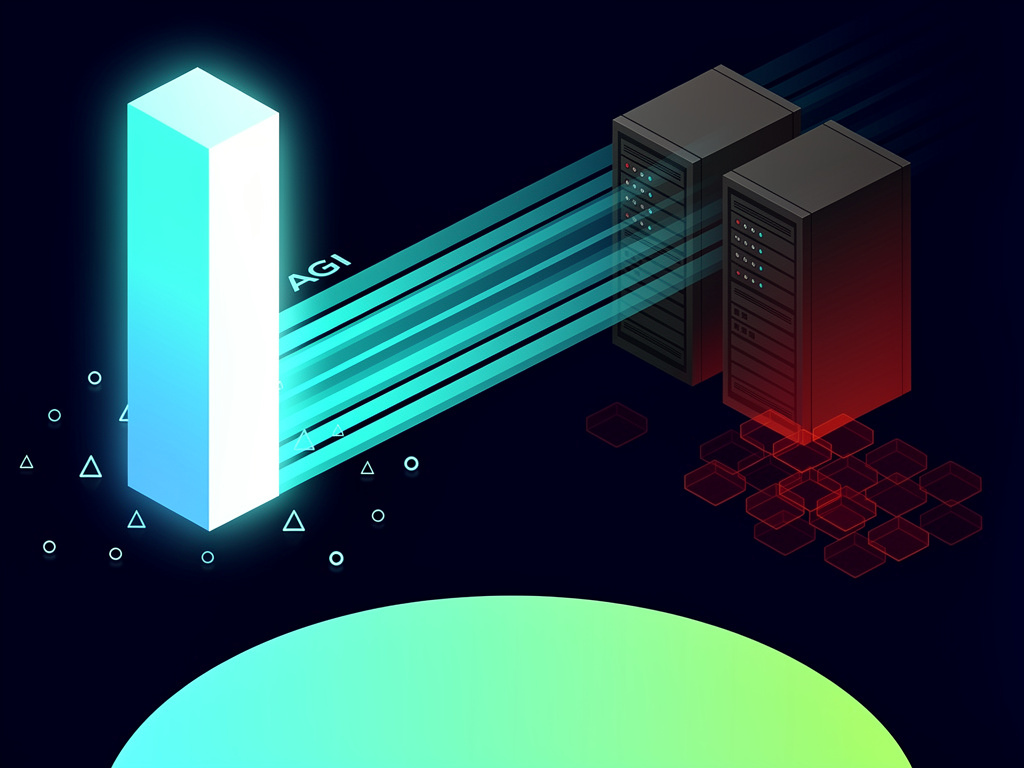
Rene Haas sees trouble ahead for the old guard. The Arm Holdings chief executive delivered a pointed message on the company’s recent earnings call. Its first production silicon for data centers promises more than double the performance per rack versus x86 platforms. The potential savings? Up to $10 billion in capital expenditure per gigawatt of AI infrastructure.
That claim lands like a challenge. Intel and Advanced Micro Devices have ridden AI demand to massive stock gains. AMD shares climbed 300% over the past year. Intel posted even steeper returns. Both companies report strong data-center revenue. Yet Arm now positions itself as the more efficient alternative at a time when power constraints threaten to throttle expansion.
Haas didn’t mince words. The first production silicon product for the data center will deliver more than two times the performance per rack compared with x86 platforms, with the potential to reduce AI data center capital expenditure by up to $10 billion per gigawatt. (The Motley Fool, May 15, 2026)
Those numbers reflect more than marketing. Arm reported an explosion of demand for its CPU architecture tied to AI workloads. Orders doubled to $2 billion in just five weeks. Customers include Meta Platforms as the lead partner on the AGI CPU, alongside OpenAI, Cerebras Systems, Cloudflare and SK Telecom. “We are seeing huge demand,” Haas told Bloomberg Television. (East Bay Times, May 7, 2026)
The shift marks a departure for Arm. For 35 years the company licensed intellectual property and collected royalties. Now it designs and sells its own silicon. The AGI CPU targets agentic AI and inference tasks that run efficiently on Arm’s architecture. Meta co-developed the chip to optimize gigawatt-scale infrastructure and complement its custom MTIA accelerators. The company plans to open-source board and rack designs through the Open Compute Project.
But power realities loom large. Without major efficiency gains, AI data centers could consume 20% to 25% of U.S. power requirements by decade’s end. Current usage sits far lower. Hyperscalers scramble for energy solutions. Some explore nuclear restarts, others eye natural gas or renewables. Arm’s pitch centers on doing more with less electricity and fewer servers.
Market momentum builds even as execution risks remain.
Arm closed its fiscal 2026 with record quarterly revenue of $1.49 billion. The company forecasts its new CPU will generate more than $2 billion across fiscal 2027 and 2028. Haas expressed confidence in reaching $15 billion in annual AGI CPU sales by fiscal 2031. That would represent an entirely new revenue stream. The broader data-center CPU market could hit $100 billion by 2030. Plenty of room exists for multiple winners. Still, Intel’s data-center and AI segment brought in $5.1 billion in its latest quarter. AMD reported $5.8 billion. Current leaders hold clear advantages in scale.
Supply questions surfaced quickly. Arm has capacity secured for the first $1 billion in demand. Beyond that, wafers, testing equipment and manufacturing slots at Taiwan Semiconductor Manufacturing Co. remain unsecured. The AGI CPU uses a 3-nanometer process with two distinct silicon pieces. “While Arm had enough capacity to fulfill the first $1 billion of demand, it has yet to secure supplies to serve demand beyond that,” Haas said. (Reuters, May 7, 2026)
Shares reacted with volatility. They fell about 5% after the earnings report as investors weighed smartphone weakness against AI upside. Arm predicted slightly negative growth in smartphones. Memory chip shortages slowed the sector and raised device prices. Yet the AI story dominated conversation on earnings calls and in interviews.
Analysts project Arm-based chips could claim 90% of custom CPUs in AI servers by 2029. Market researcher Counterpoint Research points to hyperscaler adoption as the driver. IDC data shows non-x86 CPU shipments growing faster than x86. Sales of x86 chips rose an estimated 40% in 2025. Non-x86 designs posted stronger momentum at 64% expected growth.
And the efficiency edge matters. Customers can get twice the performance with Arm solutions, Haas noted. That message resonates with operators facing both capital costs and electricity bills. Data centers already strain grids. Projections of multi-gigawatt facilities raise questions about sustainability. Moving some inference tasks to the edge could help. So could smarter silicon.
Arm isn’t alone in this pursuit. Custom silicon from hyperscalers continues to expand. Yet the company’s architecture sits at the center of many designs. Its Neoverse platform underpins the new AGI CPU. Up to 136 cores target rack-scale performance for agentic workloads that combine reasoning, planning and tool use.
Commercial systems from ASRock Rack, Lenovo and Supermicro now accept orders. Deployment partners span cloud providers, networking firms and enterprise software companies. SAP, for instance, sees value in efficient inference for business applications. The list signals broad interest beyond pure hyperscalers.
But challenges persist. Manufacturing complexity on leading-edge nodes demands tight coordination with foundries. Arm must prove it can ramp production without the delays that often plague new silicon entrants. Competition from established x86 vendors includes their own efficiency road maps and custom offerings. AMD and Intel won’t cede ground easily.
So the warning carries weight. Haas highlights a future where power and performance per dollar decide infrastructure winners. Data-center operators listen closely. If Arm delivers on its promises, x86 share in AI servers could erode faster than many expect. The $10 billion per gigawatt savings figure underscores the stakes.
Investors have already priced in optimism. Arm trades at high multiples. Execution over the next several quarters will test whether the pivot to selling silicon justifies the valuation. Demand looks real. Customers line up. The question now centers on delivery. Can Arm secure enough supply to meet hyperscaler scale? Will the efficiency gains hold in production environments?
One thing appears clear. The conversation around AI infrastructure has moved beyond raw compute. Efficiency, density and total cost of ownership now drive decisions. Haas placed that reality front and center. Intel and AMD face a competitor that speaks the language of both performance and power bills. The data-center throne may not change hands overnight. But the pressure just increased.


 WebProNews is an iEntry Publication