
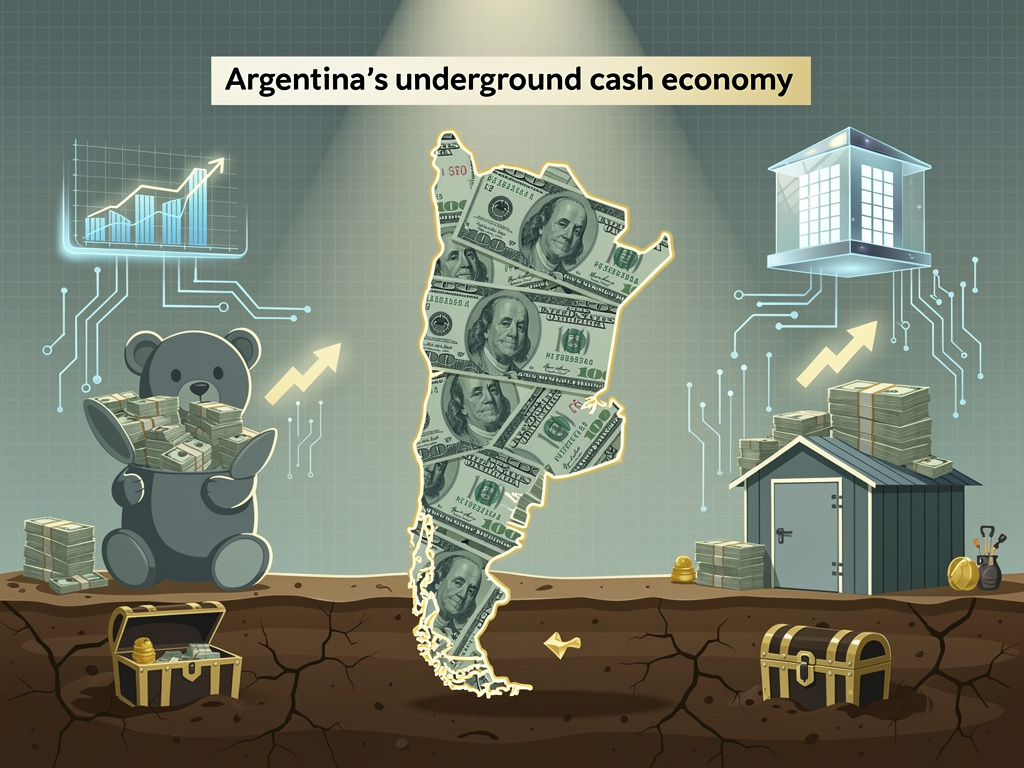
BUENOS AIRES—In the shadowy corners of Argentina’s economy, an estimated $250 billion sits idle—stuffed into children’s toys, buried in backyards, wedged into chair legs, and hidden in countless other improvised vaults across the nation. This staggering sum, roughly six times the country’s central bank reserves, represents decades of financial trauma crystallized into a national obsession with concealment. Now, President Javier Milei faces perhaps his most formidable challenge yet: convincing his compatriots that it’s finally safe to bring their dollars out of hiding.
The libertarian leader’s economic revolution depends on mobilizing this dormant capital. Without it, his ambitious free-market overhaul risks stalling, unable to generate the credit expansion and investment flows necessary to revive South America’s second-largest economy. According to The Wall Street Journal, dollars held in Argentina’s banks by private-sector investors reached a record $37 billion at the end of last year—a 160% increase since Milei took office in December 2023. Yet this represents merely a fraction of the total hoard, suggesting both the scale of the opportunity and the depth of the trust deficit Milei must overcome.
The Archaeology of Argentine Savings
Along the leafy boulevards of Buenos Aires, evidence of this underground economy surfaces in unexpected ways. Fabian Luciani, a car salesman with 25 years of experience in the capital, has become an inadvertent expert in identifying hidden money by its physical deterioration. More than half his clients pay in cash, he told The Wall Street Journal, sometimes with bills that families admit have been buried in their backyards for years. The telltale signs are unmistakable: yellowish and brownish stains from humidity, the patina of soil and time marking currency that has spent years or even decades outside the formal financial system.
“They’ve got yellowish, brownish stains—you know, from humidity,” Luciani explained, musing about how many dollars now circulating through the U.S. Treasury bear the unique stains of Argentine soil. This phenomenon speaks to a broader cultural practice that has evolved into something approaching a national art form. The phrase “under the mattress” has become shorthand for keeping money outside the formal economy, though as any Argentine will attest, that would be foolishly obvious. “I hid it in a chair, inside the metal tube of the chair leg,” said Héctor Orsenigo, displaying the pride in ingenuity that characterizes this widespread practice. “Everyone has their own little hiding place.”
The hiding places reflect both creativity and desperation. Argentines describe concealing cash in ceilings, toilet tanks, household appliances, window blind covers, and even Bibles—a folklore of concealment born from repeated financial trauma. Patricia Fernández, a public-sector employee, recalls the moment of childhood discovery: “One day we lifted the cover of the window blind and saw a bag stuck there. My dad said, ‘No! Don’t touch that! That’s mine!'” These memories, passed down through generations, form the psychological bedrock of Argentina’s cash-hoarding culture.
The Historical Wounds That Never Healed
Understanding this behavior requires examining the financial catastrophes that created it. The 2001 economic collapse stands as the defining trauma in modern Argentine financial history. When the government froze bank deposits and blocked cash withdrawals—a measure known as the “corralito”—it effectively wiped out families’ life savings overnight. The policy sparked mass protests and left psychological scars that persist more than two decades later. Orsenigo began hoarding dollars immediately after that crisis, and he recalls the stress killing a friend who suffered a fatal heart attack during the turmoil.
But 2001 was merely the most recent in a series of financial disasters stretching back decades. Wild swings in the peso, repeated bank freezes, and various capital controls have systematically destroyed Argentines’ trust in financial institutions. This history has created a rational response to an irrational system: keeping wealth in physical dollars, hidden where no government decree can reach it. The practice has become so ingrained that even young Argentines who never experienced the worst crises maintain the same habits. Milagros Gavilán, a 19-year-old bar worker in downtown Buenos Aires, told The Wall Street Journal that she keeps what little money she can save “between my clothes in the wardrobe,” repeating habits learned from her grandmother, who stuffed bills in her Bible.
The Economic Imperative of Mobilization
For Milei’s government, coaxing these “mattress dollars” back into the banking system represents far more than a symbolic victory. The economic benefits would be transformative. With more dollars available as deposits, Argentine banks could dramatically expand lending for everything from business loans to export credit, potentially catalyzing the economic growth necessary to offset the pain of Milei’s aggressive austerity measures. The multiplier effects could ripple through the entire economy, creating the kind of virtuous cycle that has eluded Argentina for generations.
“Deposit your dollars in the bank…as in any other part of the world!” Economy Minister Luis Caputo recently urged the nation’s savers, a plea that underscores both the opportunity and the challenge. The government understands that without mobilizing this capital, Argentina’s economic transformation will remain incomplete, unable to achieve the scale necessary for sustainable growth. Yet the very fact that such an appeal is necessary—that the finance minister must actively convince citizens to use banks—illustrates the depth of the trust problem.
Juan Truffa, director of consulting firm Outlier and a former bank employee, has witnessed firsthand the extremes of this distrust. He recounted to The Wall Street Journal an incident when a flood nearly destroyed the contents of his bank’s basement safe-deposit boxes, forcing staff to use hair dryers to salvage millions of dollars in cash. Even facing total loss, the owners refused to declare the money or deposit it into accounts, preferring the risk of destruction to the certainty of government scrutiny.
Legislative Carrots and Reduced Sticks
Recognizing that trust cannot be commanded, only earned, Milei’s government has deployed a combination of incentives and legal protections. In December, Congress passed legislation raising the thresholds for tax evasion prosecution, allowing Argentines to use as much as $70,000 in certain cases without declaring the origin of the cash. Previously, they risked prosecution for using more than $1,000—a threshold so low it effectively criminalized normal economic activity for anyone with savings. While implementing the new law will take months, it represents a fundamental shift in the government’s approach to undeclared wealth.
This builds on a 2024 tax amnesty that produced impressive results, coaxing approximately $24 billion back into the financial system and leading Argentines to declare roughly 55,000 properties, according to official figures cited by The Wall Street Journal. Gerardo Keselman, an architect and real-estate developer in Buenos Aires, benefited directly from this program. One of his clients owned a house in Uruguay that the amnesty allowed them to sell, bringing the proceeds to Argentina to invest in Keselman’s new apartment complexes. He expects the latest legislation to generate even more activity in the real-estate market, noting that nervous savers prefer investments they can see and touch: “They’d rather put it in bricks than a bank.”
Why This Time Might Actually Be Different
Argentina has announced dozens of tax amnesties over the years, creating a pattern that breeds cynicism. Previous governments have reversed the rules, sometimes pursuing Argentines for the very assets and cash they had just been encouraged to declare. This history of bait-and-switch has trained citizens to view any government promise with profound skepticism. Yet some analysts believe Milei’s approach contains elements that distinguish it from past failures.
Truffa points to specific provisions that shift the burden of proof onto tax authorities, requiring them to demonstrate wrongdoing rather than forcing savers to prove their innocence. This procedural change, while technical, represents a philosophical departure from the presumption of guilt that has characterized previous regimes. “People are starting to say, ‘Hey, maybe this time really is different,'” Truffa told The Wall Street Journal. The opening of Argentina’s nascent mortgage market adds another dimension, potentially channeling hidden dollars into productive investment rather than mere hoarding.
Still, skepticism runs deep. Gustavo Lazzari, an economist and owner of a small meat-processing company, argues that Argentines are too traumatized to change their saving habits quickly. “That memory is passed down, from parents and grandparents,” he observed, suggesting that the psychological barriers may prove more durable than any legislative fix. The intergenerational transmission of financial anxiety means that even Argentines born long after the worst crises inherit the defensive behaviors of their elders.
The Safe-Deposit Box as Economic Indicator
In downtown Buenos Aires, the steel-reinforced vault of Ingot, a company renting thousands of safe-deposit boxes, serves as an unlikely barometer of public confidence in government. Business had boomed over the past decade amid widespread distrust in banks, according to Juan Piantoni, the company’s chief executive. The proliferation of private vault services reflects the same impulse that drives mattress-stuffing: a desire to maintain physical control over assets while keeping them outside the reach of banks and, by extension, government.
Now, however, Ingot predicts as much as a 15% decline in business this year—a potential leading indicator of shifting sentiment. The company is adapting by encouraging Argentines to store items other than cash in its boxes. “Maybe someone has a former girlfriend and keeps letters or photos,” Piantoni suggested to The Wall Street Journal. “It’s just not appropriate for it to be in the house.” The pivot speaks to a broader recognition that the business model built on financial paranoia may be facing headwinds if Milei succeeds in rebuilding trust.
The Global Context and Investor Implications
Milei’s hunt for hidden dollars unfolds against a backdrop of improving international sentiment toward Argentina. The president has cultivated relationships with global leaders, including President Trump, and has wooed international investors with his commitment to free-market reforms and fiscal discipline. His government’s aggressive austerity measures and deregulation agenda have won praise from market-oriented economists and investors who see Argentina as a potential turnaround story after decades of mismanagement.
Yet the domestic challenge of mobilizing hidden capital may ultimately prove more consequential than any amount of foreign investment. The $250 billion in mattress dollars dwarfs the typical flows of foreign direct investment or portfolio capital that emerging markets compete for. If even a fraction of this domestic capital can be channeled into productive use—whether through bank deposits that enable lending, real-estate investment that drives construction, or equity purchases that capitalize businesses—the economic impact could exceed that of any plausible foreign capital inflow.
The real-estate sector offers a particularly clear window into this dynamic. Keselman, the Buenos Aires developer, reports increasing boldness among clients willing to deploy previously hidden cash. The combination of tax amnesty, higher thresholds for prosecution, and the tangible nature of property investment creates conditions that may finally overcome decades of defensive behavior. The nascent mortgage market, virtually nonexistent in Argentina for years due to chronic inflation and instability, represents another potential channel for mobilizing dormant capital.
Cultural Inertia Versus Economic Incentives
The tension between rational economic incentives and deeply embedded cultural practices lies at the heart of Milei’s challenge. From a purely economic perspective, keeping large sums of cash hidden in one’s home is irrational—the money earns no return, faces risks of theft or destruction, and cannot contribute to family or national prosperity. Yet from the perspective of Argentine historical experience, the behavior is entirely rational, a logical response to a system that has repeatedly betrayed savers.
The discovery of hidden money in family heirlooms left by deceased relatives continues to occur with surprising frequency, suggesting that some portion of the $250 billion may be effectively lost, its location known only to people who have died without sharing the information. These accidental time capsules represent not just individual family tragedies but also dead weight in the national economy—capital that could be working but instead sits inert, sometimes literally rotting from moisture damage.
Young Argentines face a particular cognitive dissonance. Those like Gavilán, the 19-year-old bar worker, have little memory of the 2001 crisis but maintain the same defensive behaviors as their grandparents. This suggests that changing the culture of concealment will require not just policy reforms but sustained stability over a period long enough to allow new habits to form and new trust to develop. Whether Milei’s government can maintain its reforms long enough to achieve this cultural shift remains an open question.
The Path Forward and Remaining Obstacles
As Milei’s government moves forward with implementation of the new legislation, several factors will determine success or failure. The administrative capacity to process declarations without creating bureaucratic nightmares will be crucial—past amnesties have sometimes foundered on practical difficulties that discouraged participation. The government’s ability to maintain consistency and resist the temptation to later pursue those who come forward will be equally important, as any perception of betrayal would likely poison the well for generations.
The broader economic context also matters. If Milei’s austerity measures produce a deep or prolonged recession, Argentines may become even more defensive about their savings, hoarding dollars as a hedge against uncertainty. Conversely, if the economy begins to grow and inflation remains controlled, the opportunity cost of keeping cash hidden will increase, potentially creating a virtuous cycle where confidence begets investment, which begets growth, which begets more confidence.
The international dimension cannot be ignored either. Argentina’s hidden dollars exist not just in domestic hiding places but also in offshore accounts and foreign safe-deposit boxes. Mobilizing this external capital may require different approaches, including credible commitments about exchange-rate policy and capital controls. The government’s decision to soften financial controls represents a step in this direction, but the legacy of previous governments’ sudden policy reversals creates understandable caution.
For now, the early indicators suggest cautious optimism. The 160% increase in dollar deposits since Milei took office, the surge in property declarations during the 2024 amnesty, and the predicted decline in private vault rentals all point toward a gradual thawing of Argentina’s frozen capital. Yet the gap between $37 billion in bank deposits and $250 billion in total hidden wealth illustrates how far the journey remains. Milei’s success in this endeavor may ultimately determine whether his broader economic revolution succeeds or joins the long list of failed Argentine reform efforts. The dollars hidden in teddy bears and toilet tanks represent more than just money—they embody the accumulated distrust of generations, a challenge that cannot be overcome with legislation alone but requires the patient rebuilding of something far more elusive: faith in the future.


 WebProNews is an iEntry Publication