
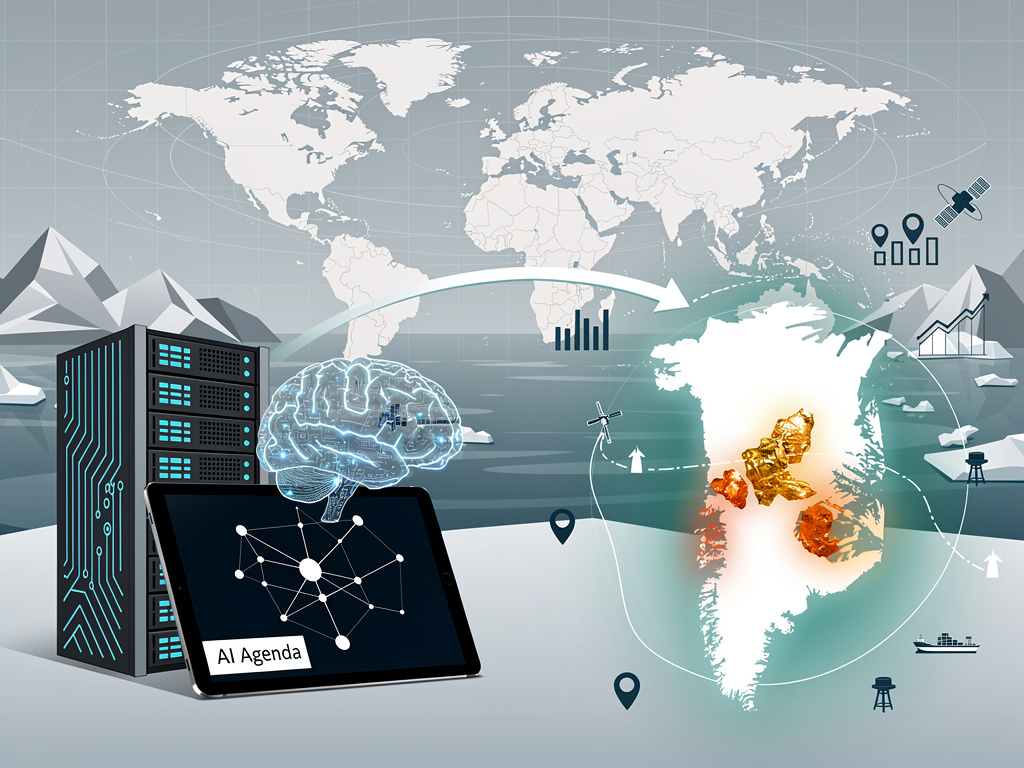
The World Economic Forum’s annual gathering in Davos arrived with an expected agenda: artificial intelligence, technological disruption, and the future of digital transformation. Yet by the time private jets departed the Swiss Alps, the conversation had pivoted dramatically toward something far more tangible—frozen tundra, rare earth minerals, and the geopolitical chess match unfolding across Greenland’s 836,000 square miles of strategic territory.
What began as hushed corridor conversations about President Donald Trump’s renewed interest in purchasing Greenland evolved into the dominant narrative of the forum, eclipsing even the most sophisticated discussions about large language models and generative AI applications. According to CNBC, investors who arrived expecting to network about neural networks instead found themselves debating Arctic sovereignty, critical mineral supply chains, and the intersection of energy security with national defense.
The shift reflects a broader recalibration happening across global capital markets, where the theoretical promise of artificial intelligence is colliding with the immediate reality of resource scarcity, geopolitical tension, and the physical infrastructure required to power humanity’s digital ambitions. Greenland sits at the nexus of these concerns, possessing substantial deposits of rare earth elements essential for everything from electric vehicle batteries to advanced semiconductor manufacturing, while simultaneously occupying a strategic military position between North America and Europe.
The Resource Equation Behind the Arctic Pivot
Greenland’s geological wealth has long been documented but recently gained urgency as supply chain vulnerabilities exposed during the pandemic continue to reverberate through industrial planning. The autonomous Danish territory holds significant deposits of neodymium, praseodymium, dysprosium, and other rare earth elements currently dominated by Chinese production. These materials form the backbone of modern technology infrastructure, from the permanent magnets in wind turbines to the components in smartphones and military guidance systems.
The convergence of AI development and resource politics became impossible to ignore at Davos, where technology executives found themselves in unexpected conversations with mining industry veterans and defense strategists. The computational demands of training large language models require massive data centers, which in turn require stable power supplies and sophisticated cooling systems—creating downstream demand for the very minerals Greenland possesses in abundance. This circular dependency between digital innovation and physical resources transformed what might have been a purely technological conference into a forum on economic security and territorial control.
Energy requirements emerged as a critical subtext throughout the discussions. Advanced AI systems consume extraordinary amounts of electricity, with estimates suggesting that training a single large language model can require as much power as several hundred American homes use in a year. Greenland’s potential for renewable energy production through hydroelectric and geothermal sources, combined with its mineral wealth, positions the territory as a potential linchpin in the infrastructure required to sustain AI development at scale.
Trump’s Territorial Ambitions Meet Musk’s Industrial Vision
President Trump’s public statements about acquiring Greenland, which initially seemed like diplomatic provocations, gained new context at Davos as participants connected the dots between territorial control and technological supremacy. The presence of Elon Musk in Trump’s orbit added another dimension to these discussions, given Musk’s simultaneous involvement in AI development through xAI, electric vehicle manufacturing through Tesla, and space exploration through SpaceX—all industries with acute dependencies on rare earth minerals and reliable energy sources.
The geopolitical implications extend beyond simple resource extraction. Greenland’s geographic position offers strategic advantages for satellite communications, early warning systems, and Arctic shipping routes that are becoming increasingly navigable due to climate change. As ice coverage diminishes, the Northwest Passage could emerge as a commercially viable shipping corridor, potentially reducing transit times between Asian manufacturing centers and North American markets by thousands of miles compared to traditional routes through the Panama or Suez canals.
Danish officials, while publicly dismissing any possibility of selling Greenland, have found themselves navigating increasingly complex political waters. The territory’s 57,000 residents maintain substantial autonomy under Danish sovereignty, and Greenlandic politicians have expressed interest in greater independence—creating a potential opening for external powers to expand influence through economic development partnerships rather than outright territorial acquisition.
China’s Arctic Strategy Looms Over Western Deliberations
Behind much of the Davos discussion sat an unspoken concern about Chinese strategic positioning in the Arctic region. Beijing has declared itself a “near-Arctic state” despite being located thousands of miles from the Arctic Circle, and has invested heavily in Greenlandic infrastructure projects, scientific research stations, and mining exploration over the past decade. This economic diplomacy has raised alarms in Washington and Brussels about the potential for Chinese influence over critical mineral supplies and strategic territory.
The competition for Arctic influence mirrors broader tensions over technology supply chains and economic security. China currently controls approximately 70% of global rare earth element production and an even higher percentage of processing capacity, giving Beijing significant leverage over industries ranging from consumer electronics to defense manufacturing. Western efforts to diversify supply chains have accelerated since trade tensions escalated, but developing alternative sources requires massive capital investment and years of development time.
Greenland represents one of the few viable alternatives to Chinese rare earth dominance, but exploiting these resources faces significant challenges. Environmental concerns about mining in pristine Arctic ecosystems, the high costs of operating in extreme climates, and the limited existing infrastructure all complicate development timelines. Yet the strategic imperative has grown sufficiently urgent that investors at Davos demonstrated willingness to accept longer development horizons and higher capital requirements than typical mining projects would warrant.
The AI Infrastructure Reality Check
The pivot from AI enthusiasm to resource pragmatism at Davos reflects a maturing understanding of what artificial intelligence deployment actually requires. Early excitement about AI capabilities has given way to hard questions about the physical infrastructure needed to support these systems at scale. Data centers require not just electricity but also cooling systems, which in turn require water or other coolants—resources that are increasingly constrained in many developed regions.
Greenland’s climate offers natural advantages for data center cooling, potentially reducing the energy overhead associated with maintaining optimal operating temperatures for server farms. Several technology companies have explored Arctic data center concepts, though none have yet deployed at significant scale in Greenland specifically. The combination of cooling advantages, potential renewable energy sources, and proximity to transatlantic fiber optic cables creates a compelling case for Arctic digital infrastructure development.
However, the practical challenges remain formidable. Greenland lacks the electrical grid capacity, telecommunications infrastructure, and skilled workforce that data center operations require. Building this infrastructure would require investments measured in billions of dollars and development timelines extending across years or decades. The gap between strategic vision and operational reality became a recurring theme in Davos discussions, tempering some of the more ambitious proposals with recognition of implementation difficulties.
Sovereign Wealth and Strategic Autonomy
The financial community’s interest in Greenland extends beyond immediate resource extraction to longer-term questions about sovereign wealth creation and economic development models. Several sovereign wealth funds and private equity firms engaged in discussions about potential investment vehicles focused on Arctic development, though most acknowledged that current political uncertainties make immediate large-scale commitments difficult.
Greenland’s path toward greater autonomy from Denmark depends substantially on developing economic self-sufficiency, which currently seems distant given the territory’s reliance on annual subsidies from Copenhagen totaling approximately $600 million—representing roughly one-third of Greenland’s GDP. Mining royalties and infrastructure development could theoretically provide alternative revenue sources, but the timeline for such development remains uncertain, and the environmental and social impacts of large-scale resource extraction face significant local opposition.
The tension between economic development and environmental preservation emerged repeatedly in Davos conversations. Greenland’s appeal as a pristine wilderness and its value as a resource repository exist in fundamental tension, creating difficult tradeoffs for local populations and potential investors alike. Some participants suggested that technology-focused development, such as data centers or renewable energy projects, might offer paths toward economic development with lower environmental impacts than traditional extractive industries.
Redefining Strategic Competition in the Digital Age
The Greenland discussions at Davos ultimately reflect a broader shift in how business and political leaders conceptualize strategic competition in an era of digital transformation. The assumption that technological advancement could proceed independently from physical geography and resource constraints has proven naive. Instead, digital capabilities and territorial control have become increasingly intertwined, with implications extending from corporate strategy to national security policy.
This realization carries profound implications for capital allocation decisions across multiple industries. Technology companies must now factor geopolitical risk and resource security into their strategic planning in ways that seemed unnecessary during the globalization era. Mining companies find themselves positioned as critical enablers of digital transformation rather than legacy industrial operations. And governments face pressure to develop comprehensive strategies that integrate economic development, environmental protection, and security considerations across Arctic territories.
The conversations that dominated Davos 2025 suggest that the next phase of technological competition will be won not just in Silicon Valley laboratories or Chinese AI research centers, but in remote territories like Greenland where the physical resources and strategic positioning required for digital supremacy actually exist. As one investor noted in hallway conversations, the future of artificial intelligence may depend less on algorithmic breakthroughs than on who controls the rare earth elements, energy sources, and geographic positions that make deployment possible at scale. In this context, Greenland transformed from a curiosity into a potential kingmaker—explaining why it captured attention that artificial intelligence, for all its transformative potential, could not sustain.


 WebProNews is an iEntry Publication