
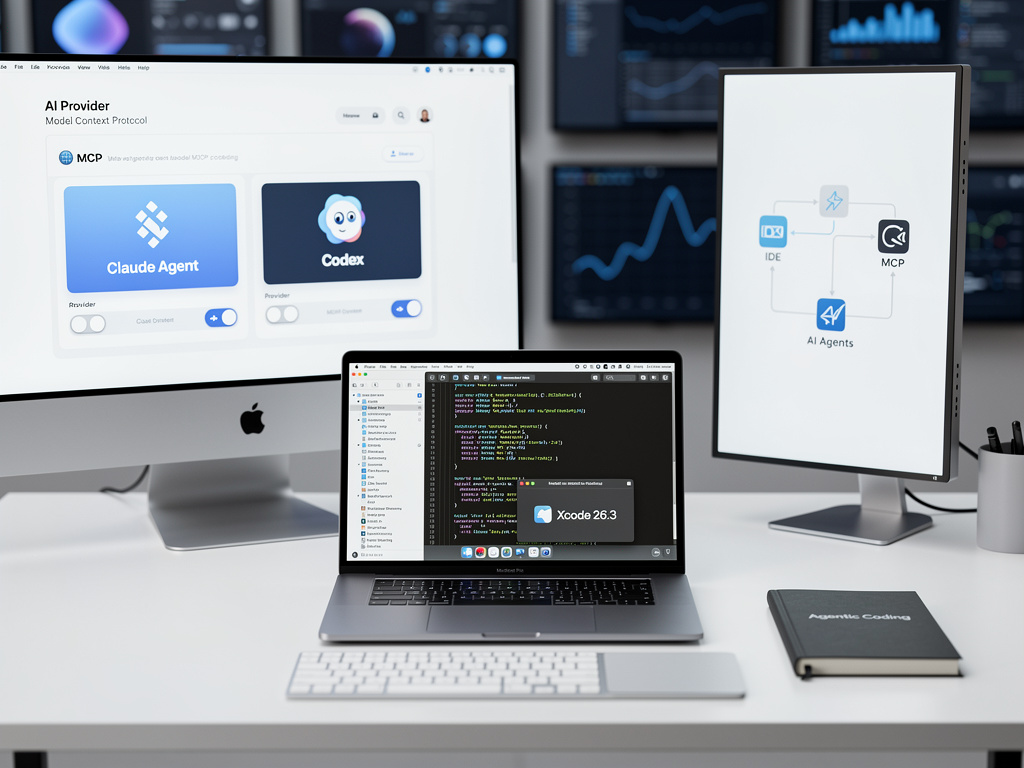
Apple has fundamentally altered the trajectory of software development with the release of Xcode 26.3, introducing agentic coding capabilities that allow developers to harness the power of Anthropic’s Claude Agent and OpenAI’s Codex directly within the integrated development environment. The announcement, made Tuesday, represents a significant departure from traditional code completion tools, offering developers autonomous AI assistants capable of understanding context, writing complex code, and executing multi-step programming tasks with minimal human intervention.
The integration marks Apple’s most aggressive move yet into AI-assisted development, positioning the company at the forefront of a rapidly evolving sector where artificial intelligence increasingly handles substantial portions of the coding process. According to Apple’s official announcement, the new release incorporates support for the Model Context Protocol (MCP), an open standard that enables seamless communication between development environments and AI models. This architectural decision allows developers to choose between multiple AI providers rather than locking them into a single ecosystem, a move that industry observers say reflects Apple’s recognition of the diverse needs within the developer community.
The timing of this release coincides with mounting pressure on Apple to demonstrate its commitment to artificial intelligence after competitors like Microsoft and Google have made significant strides in AI-powered development tools. By embracing both Anthropic and OpenAI technologies, Apple is hedging its bets while providing developers with best-in-class options for different use cases. Anthropic confirmed that Claude Agent’s integration with Xcode represents the first time its agentic capabilities have been embedded directly into a major IDE, calling it “a watershed moment for AI-assisted software development.”
Understanding Agentic Coding’s Transformative Potential
Unlike traditional code completion tools that suggest the next line or function based on pattern recognition, agentic coding systems operate with a degree of autonomy that fundamentally changes the developer’s role. These AI agents can understand high-level instructions, break down complex programming tasks into manageable steps, write code across multiple files, debug errors, and even refactor existing codebases to improve performance or readability. The agents work iteratively, testing their own code and making adjustments based on compiler feedback or runtime errors, mimicking the problem-solving approach of experienced human developers.
The distinction between conventional autocomplete features and true agentic systems lies in their ability to maintain context across an entire project and execute tasks that require multiple decision points. When a developer instructs an agentic tool to “implement user authentication with OAuth 2.0,” the system doesn’t merely suggest code snippets—it analyzes the existing project structure, creates necessary files, writes the authentication logic, updates configuration files, and generates corresponding test cases. This level of autonomy represents a quantum leap from the incremental suggestions offered by earlier AI coding assistants.
Industry analysts have noted that the shift toward agentic coding could reduce development time for routine tasks by up to 60%, allowing human developers to focus on architectural decisions, user experience design, and complex problem-solving that still requires human creativity and judgment. However, this efficiency gain comes with new challenges around code review, security verification, and maintaining coding standards when significant portions of a codebase are generated by AI systems with varying levels of oversight.
The Model Context Protocol: Apple’s Strategic Framework
The inclusion of MCP support in Xcode 26.3 represents perhaps the most strategically significant aspect of Apple’s announcement. Developed as an open standard for AI model integration, MCP allows development environments to communicate with multiple AI providers through a unified interface, eliminating the need for custom integrations for each AI service. Ars Technica reported that Apple’s adoption of MCP could accelerate the protocol’s acceptance across the industry, potentially establishing it as the de facto standard for AI integration in development tools.
By supporting MCP, Apple has created a framework that allows developers to switch between different AI models based on specific needs or preferences without changing their workflow. A developer might use Claude Agent for complex reasoning tasks and architectural planning while employing OpenAI’s Codex for rapid prototyping or generating boilerplate code. This flexibility addresses a key concern among professional developers who have been reluctant to commit to single-vendor AI solutions given the rapid pace of innovation in the field.
The protocol also establishes standardized methods for context sharing, allowing AI agents to access project files, documentation, and development history in a controlled manner. This standardization addresses security concerns that have plagued earlier AI coding tools, where unclear data handling practices raised questions about intellectual property protection and code confidentiality. Apple has emphasized that MCP implementations in Xcode include granular permission controls, allowing developers to specify exactly what information AI agents can access and ensuring that sensitive code never leaves the local development environment unless explicitly authorized.
Anthropic’s Claude Agent: Reasoning-First Development
Anthropic’s Claude Agent brings a distinctive approach to agentic coding, emphasizing reasoning and planning before code generation. The system is designed to engage in what Anthropic calls “constitutional AI” development, where the agent follows explicit principles about code quality, security, and maintainability. When tasked with implementing a feature, Claude Agent first outlines its approach, identifies potential issues, and proposes solutions before writing a single line of code. This methodology aligns well with enterprise development practices where planning and documentation are as important as the code itself.
The integration allows Claude Agent to access Xcode’s entire development context, including project files, compiler output, and runtime diagnostics. This comprehensive access enables the agent to make informed decisions about code architecture and implementation details. For instance, when adding a new feature to an existing iOS application, Claude Agent can analyze the current codebase to ensure consistency with established patterns, identify dependencies that need updating, and even suggest refactoring opportunities that would improve overall code quality.
Developers who have tested the Claude Agent integration report that its strength lies in handling complex, multi-step tasks that require careful consideration of trade-offs. The agent excels at scenarios where there isn’t a single correct answer but rather multiple valid approaches with different implications for performance, maintainability, or scalability. By presenting its reasoning process transparently, Claude Agent allows developers to understand why specific implementation choices were made, facilitating more effective code review and knowledge transfer within development teams.
OpenAI’s Codex: Speed and Versatility in Code Generation
OpenAI’s Codex, the AI system that powers GitHub Copilot and has now been integrated into Xcode 26.3, brings proven capabilities in rapid code generation across dozens of programming languages. Codex’s training on billions of lines of publicly available code gives it broad knowledge of common programming patterns, frameworks, and libraries. This extensive training allows Codex to quickly generate functional code for routine tasks, translate code between languages, and provide multiple implementation alternatives for developers to choose from.
The Codex integration in Xcode supports both Swift and Objective-C, Apple’s primary development languages, while also offering assistance with related technologies like JavaScript for web components, Python for data processing scripts, and SQL for database operations. This multilingual capability proves particularly valuable in modern iOS and macOS development, where applications often integrate with web services, process data from various sources, and interact with databases—each potentially using different programming languages or query syntaxes.
What distinguishes Codex in the Xcode environment is its ability to learn from a developer’s coding style over time, adapting its suggestions to match individual or team preferences. If a development team consistently uses specific naming conventions, architectural patterns, or code organization strategies, Codex recognizes these patterns and generates code that conforms to them. This adaptive capability reduces the friction often associated with AI-generated code, which can feel generic or inconsistent with a project’s established conventions.
Developer Reaction and Industry Implications
The developer community’s response to Xcode 26.3 has been overwhelmingly positive, with particular enthusiasm for the choice and flexibility that multiple AI provider support offers. Dan Shipper, commenting on the announcement via social media, noted that “Apple’s decision to support both Anthropic and OpenAI shows they understand that different AI models excel at different tasks—this isn’t about picking winners, it’s about giving developers the best tools for each job.” His observation reflects a broader sentiment among professional developers who have grown skeptical of vendor lock-in and appreciate platforms that preserve their ability to choose optimal tools for specific contexts.
Rudrank, a prominent developer and AI researcher, highlighted on X that the MCP integration could fundamentally change how developers interact with AI tools: “We’re moving from ‘AI as a feature’ to ‘AI as infrastructure.’ When your IDE speaks a common language with any AI model, you’re not choosing a tool—you’re choosing a capability.” This perspective underscores the architectural significance of Apple’s approach, which treats AI integration as a fundamental platform capability rather than a proprietary feature designed to create competitive advantage.
CNBC’s coverage emphasized the competitive dynamics at play, noting that Apple’s move puts pressure on Microsoft’s Visual Studio Code and JetBrains’ IDEs to expand their own AI capabilities or risk losing developer mindshare. The report cited unnamed industry sources suggesting that the integration could accelerate enterprise adoption of AI-assisted development, as Apple’s involvement lends credibility to technologies that some organizations have viewed with skepticism due to concerns about code quality, security, and intellectual property.
Enterprise Adoption Considerations and Challenges
For enterprise development teams, the introduction of agentic coding in Xcode presents both opportunities and challenges that extend beyond the technical capabilities of the AI systems themselves. Large organizations must consider how AI-generated code fits within existing quality assurance processes, security review procedures, and compliance frameworks. The autonomous nature of agentic systems raises questions about accountability when AI-generated code contains bugs or security vulnerabilities—questions that many organizations are still working to answer through updated development policies and review processes.
Security teams at major corporations have expressed particular interest in Apple’s implementation of local processing options for sensitive projects. Unlike cloud-based AI coding assistants that send code to remote servers for processing, Xcode 26.3 allows organizations to run AI models locally on developer machines or private cloud infrastructure. This architecture addresses data residency requirements and intellectual property concerns that have prevented some enterprises from adopting earlier generations of AI development tools. However, local processing requires significant computational resources, potentially necessitating hardware upgrades for development teams working on large-scale projects.
The integration also raises workforce development questions as organizations consider how to train developers to work effectively with agentic AI systems. The skills required for AI-assisted development differ from traditional programming skills—developers must learn to write effective prompts, evaluate AI-generated code critically, and understand the strengths and limitations of different AI models. Some organizations are establishing new roles, such as “AI coding specialists,” who focus on optimizing the use of AI tools across development teams and establishing best practices for human-AI collaboration in software development.
Technical Architecture and Performance Considerations
The technical implementation of agentic coding in Xcode 26.3 required significant architectural changes to Apple’s development environment. The IDE now includes a new agent management framework that handles communication between Xcode and external AI services, manages context sharing, and provides real-time feedback on agent activities. This framework operates asynchronously, allowing developers to continue working while AI agents process requests in the background, with results appearing in dedicated panels that don’t interrupt the primary coding workflow.
Performance optimization proved critical given the computational demands of running sophisticated AI models alongside the already resource-intensive Xcode environment. Apple has implemented intelligent caching mechanisms that store frequently used code patterns and AI responses locally, reducing latency for common requests. The system also includes predictive loading capabilities that anticipate which AI capabilities a developer might need based on their current task and pre-load relevant models or context to minimize wait times when assistance is requested.
Network bandwidth considerations also influenced the architecture, particularly for developers working with cloud-based AI services. Xcode 26.3 includes compression algorithms optimized for code and context transmission, reducing the data transfer required for AI interactions by up to 70% compared to naive implementations. For teams working in bandwidth-constrained environments or regions with limited internet connectivity, this optimization makes cloud-based agentic coding practical where it might otherwise be prohibitively slow.
Privacy and Security Framework
Apple’s approach to privacy and security in Xcode 26.3 reflects the company’s broader commitment to user data protection, adapted for the unique challenges of AI-assisted development. The system implements a tiered permission model where developers explicitly authorize what information AI agents can access, with different permission levels for different types of data. Source code, for instance, can be classified as public, internal, or confidential, with corresponding restrictions on whether it can be sent to cloud-based AI services or must be processed locally.
The implementation includes audit logging that tracks all interactions between AI agents and project files, creating a transparent record of what code was generated, what context was accessed, and what modifications were made. This audit trail proves valuable both for security review and for understanding how AI-generated code evolved over time. Organizations can export these logs to integrate with existing security information and event management systems, ensuring that AI-assisted development activities are subject to the same oversight as other development processes.
Encryption plays a central role in the security architecture, with all communications between Xcode and cloud-based AI services protected by end-to-end encryption. For organizations with heightened security requirements, Apple offers the option to use customer-managed encryption keys, ensuring that even Apple cannot access code transmitted to AI services. This capability addresses concerns from financial services firms, healthcare organizations, and government contractors who face strict regulatory requirements around code confidentiality and data protection.
Impact on Development Workflows and Team Dynamics
The introduction of agentic coding capabilities is reshaping how development teams organize their work and collaborate on projects. Early adopters report that AI agents are most effective when integrated into specific points in the development workflow rather than used continuously throughout the coding process. Many teams are establishing patterns where AI agents handle initial implementation based on specifications, human developers review and refine the generated code, and then AI agents assist with testing and documentation—a collaborative approach that leverages the strengths of both human and artificial intelligence.
Code review practices are evolving to accommodate AI-generated code, with teams developing new checklists and review criteria specific to AI assistance. Reviewers are learning to look for patterns that indicate over-reliance on AI suggestions, such as code that works but doesn’t align with project architecture or implementations that solve immediate problems without considering long-term maintainability. Some organizations are experimenting with “AI code review” where one AI system reviews code generated by another, providing an additional layer of automated quality assurance before human review.
Team dynamics are also shifting as the role of junior developers evolves in an AI-assisted environment. While some feared that AI coding tools would reduce opportunities for junior developers to learn through hands-on coding, many teams are finding the opposite—junior developers can focus on understanding architectural decisions and code quality principles rather than spending time on syntax and routine implementation details. The AI agents effectively serve as always-available mentors that can explain code, suggest improvements, and demonstrate best practices, potentially accelerating the learning curve for new team members.
Economic Implications for the Software Development Industry
The widespread adoption of agentic coding tools like those now available in Xcode 26.3 carries significant economic implications for the software development industry. Productivity gains from AI assistance could reduce the time required to bring products to market, potentially lowering development costs and enabling smaller teams to tackle more ambitious projects. However, these efficiency improvements also raise questions about the future demand for developers and how the profession might evolve as AI systems take on increasingly sophisticated coding tasks.
Some analysts project that agentic coding could lead to a bifurcation in the developer job market, with increased demand for senior developers who can architect systems, evaluate AI-generated code, and make high-level technical decisions, while demand for developers who primarily write routine code may decline. This shift could accelerate the already pronounced trend toward higher compensation for experienced developers while potentially creating challenges for those entering the profession without strong foundational knowledge of software architecture and design principles.
The integration also has implications for software development tools vendors, who must now compete in an environment where AI assistance is becoming a standard feature rather than a differentiator. Companies that built businesses around code completion or refactoring tools face pressure to evolve their offerings or risk obsolescence as AI agents incorporate similar capabilities as baseline functionality. This competitive pressure is likely to drive consolidation in the developer tools market as smaller vendors struggle to match the AI capabilities that platform providers like Apple can offer.
Looking Forward: The Future of Human-AI Collaboration in Development
The release of Xcode 26.3 represents an inflection point in software development, but industry observers caution that it’s just the beginning of a longer transformation. Future iterations of agentic coding tools are expected to incorporate more sophisticated reasoning capabilities, enabling AI agents to participate in architectural discussions, propose alternative approaches to technical challenges, and even identify potential business implications of technical decisions. Some researchers are exploring AI systems that can learn from an organization’s entire development history, understanding not just code patterns but also the reasoning behind past architectural choices and the outcomes of different technical approaches.
The evolution toward more capable AI agents also raises important questions about the nature of software development as a profession. As AI systems handle more of the routine aspects of coding, the definition of what constitutes “development work” may shift toward activities that require uniquely human capabilities: understanding user needs, making ethical judgments about technology applications, and solving novel problems that AI systems haven’t encountered before. This shift could ultimately elevate the profession, but it requires developers to continuously expand their skills beyond pure coding ability.
Apple’s embrace of open standards like MCP suggests a future where AI capabilities become increasingly modular and interchangeable, with developers assembling custom AI toolchains tailored to specific projects or organizational needs. This modularity could foster innovation as new AI models can be integrated into existing workflows without requiring wholesale changes to development environments. However, it also creates challenges around maintaining consistency and quality when different AI systems contribute to the same codebase, challenges that the industry is only beginning to address through emerging best practices and governance frameworks.


 WebProNews is an iEntry Publication