
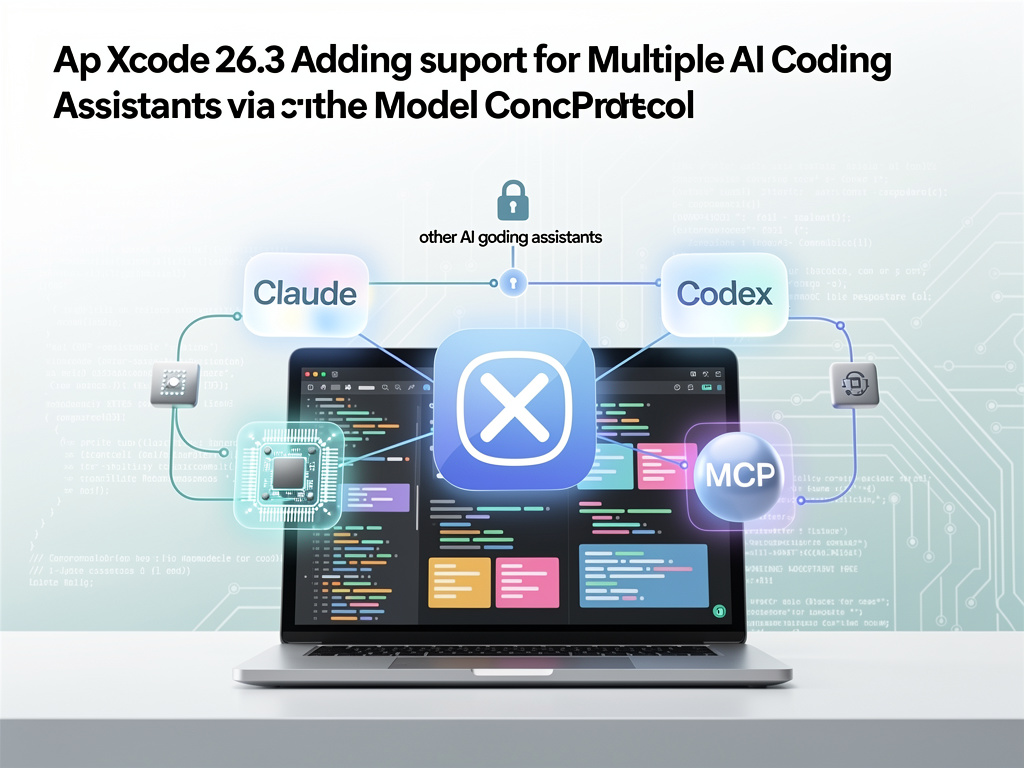
Apple has taken a significant step toward integrating artificial intelligence into its core development environment with the release of Xcode 26.3, which introduces support for Claude, Codex, and other AI-powered coding assistants through the Model Context Protocol (MCP). This move signals a fundamental shift in how the company approaches developer tools and represents Apple’s recognition that AI-assisted coding has evolved from experimental novelty to essential infrastructure for modern software development.
According to Ars Technica, the integration leverages the Model Context Protocol, an open standard that allows AI assistants to communicate with development environments in a standardized way. Rather than building proprietary connections to individual AI services, Apple has opted for an approach that provides developers with flexibility in choosing their preferred AI coding assistant while maintaining a consistent user experience within Xcode.
The Model Context Protocol represents a departure from the walled-garden approach often associated with Apple’s ecosystem. By supporting an open standard, the company enables developers to work with multiple AI models simultaneously, switching between Claude’s sophisticated reasoning capabilities, Codex’s deep understanding of programming patterns, and other emerging agentic tools based on specific project requirements. This interoperability marks a pragmatic acknowledgment that no single AI model excels at every coding task.
Technical Architecture Behind the Integration
The implementation of MCP within Xcode 26.3 required substantial architectural changes to Apple’s integrated development environment. The protocol establishes a standardized communication layer between the IDE and external AI services, handling authentication, context sharing, and response formatting without requiring developers to manage these complexities manually. This abstraction layer ensures that AI assistants receive appropriate context about the codebase, including file structures, dependencies, and coding conventions, while maintaining security boundaries that prevent unauthorized access to sensitive project information.
The MCP framework operates through a client-server architecture where Xcode acts as the client, sending requests to AI service endpoints that implement the protocol’s server specification. These requests can include various types of context: selected code snippets, entire file contents, project configuration files, or even build output and error messages. The AI models process this information and return suggestions, completions, refactorings, or explanations formatted according to the protocol’s response schema, which Xcode then presents to developers through its interface.
Developer Workflow Transformations
The practical implications of AI agent integration extend far beyond simple code completion. Developers can now engage in conversational debugging sessions where they describe problems in natural language and receive context-aware suggestions that consider the entire project structure. When encountering a runtime error, a developer might ask Claude to analyze the stack trace in relation to recent code changes, receiving not just a diagnosis but also proposed fixes that maintain consistency with the project’s established patterns and conventions.
Refactoring workflows have become particularly powerful with agentic AI assistance. Rather than manually identifying every instance where a function signature needs updating or a design pattern should be applied, developers can describe their intent at a high level and allow the AI to propose comprehensive changes across multiple files. The AI assistants understand semantic relationships between code components, enabling them to suggest refactorings that a simple find-and-replace operation would miss while avoiding changes that might introduce subtle bugs.
Code review processes gain new dimensions when AI agents participate as additional reviewers. Before submitting code for human review, developers can request an AI analysis that checks for common pitfalls, security vulnerabilities, performance issues, and style inconsistencies. These AI-generated reviews complement rather than replace human judgment, catching mechanical issues quickly so that human reviewers can focus on architectural decisions, business logic correctness, and maintainability considerations that require deeper understanding.
Enterprise Adoption Considerations
For enterprise development teams, the Xcode 26.3 update introduces both opportunities and challenges around governance and standardization. Organizations must now establish policies regarding which AI models developers may use, how sensitive code should be handled when interacting with external AI services, and what level of AI-generated code requires additional human review before merging. The flexibility of MCP means companies can potentially deploy private instances of AI models behind their firewalls, maintaining control over intellectual property while still benefiting from AI assistance.
The cost structure of AI-assisted development requires careful consideration. While some AI coding assistants offer free tiers, enterprise-scale usage often requires paid subscriptions with pricing based on API calls, tokens processed, or active users. Development managers must evaluate whether productivity gains justify these costs, particularly when teams are still learning to use AI tools effectively. Early adopters report that junior developers see the most dramatic productivity improvements, as AI assistants help them navigate unfamiliar codebases and learn platform-specific conventions more quickly.
Security and Privacy Implications
The transmission of source code to external AI services raises legitimate security concerns, especially for projects involving proprietary algorithms, unreleased features, or sensitive business logic. Apple has implemented controls within Xcode 26.3 that allow developers to specify which files or directories should never be included in AI context, creating a safeguard against accidental exposure of sensitive information. However, the responsibility for configuring these protections correctly falls on individual developers and their organizations.
Data retention policies vary significantly among AI service providers. Some models process code requests ephemerally without storing any information, while others retain interactions to improve model performance over time. Enterprise customers typically negotiate custom agreements that specify data handling requirements, but individual developers and small teams must carefully review the terms of service for their chosen AI assistants. The Model Context Protocol itself does not mandate any particular approach to data privacy, leaving these decisions to service providers and their customers.
Competitive Dynamics in Developer Tools
Apple’s embrace of AI coding assistants through an open protocol reflects broader competitive pressures in the developer tools market. Microsoft’s GitHub Copilot has established AI assistance as a baseline expectation for modern development environments, while JetBrains, Visual Studio Code, and other IDE vendors have rapidly integrated similar capabilities. By supporting MCP rather than building a proprietary Apple AI coding assistant, the company avoids direct competition with established players while ensuring Xcode remains competitive with alternative development environments.
The strategic decision to support multiple AI models through a standardized protocol also hedges against uncertainty about which AI approaches will prove most valuable for different development tasks. As AI capabilities evolve rapidly, with new models and techniques emerging frequently, the flexibility to adopt new tools without waiting for Apple to build specific integrations preserves Xcode’s relevance. Developers can experiment with cutting-edge AI assistants as they become available, incorporating them into their workflows without abandoning the broader Xcode ecosystem.
Performance and Reliability Considerations
Network latency introduces new variables into the development experience when AI assistants operate as cloud services. Developers accustomed to instantaneous code completion from local analysis engines must now contend with delays measured in seconds as requests travel to remote AI models and responses return. Apple has implemented caching strategies and predictive request queuing to minimize perceived latency, but the fundamental constraint of network round-trip time remains, particularly for developers in regions distant from AI service data centers.
Reliability concerns extend beyond simple uptime metrics. AI models occasionally produce suggestions that are syntactically correct but semantically nonsensical, or that introduce subtle bugs difficult to detect through casual inspection. Developers must maintain critical evaluation of AI-generated code rather than accepting suggestions uncritically. The most effective workflows treat AI assistants as knowledgeable but fallible collaborators, similar to pair programming with a junior developer who knows syntax well but may miss contextual nuances.
Future Development Trajectories
The introduction of MCP support in Xcode 26.3 represents an initial implementation that will likely evolve significantly as both the protocol and AI capabilities mature. Future iterations may enable AI assistants to execute code in sandboxed environments to verify suggestions before presenting them, or to access project documentation and issue trackers to understand requirements more completely. The boundary between IDE and AI assistant may blur as these tools become more deeply integrated into every aspect of the development workflow.
The long-term implications for developer skills and education remain subjects of active debate. Some educators worry that excessive reliance on AI assistance may prevent junior developers from developing deep understanding of programming fundamentals, while others argue that AI tools enable developers to focus on higher-level problem-solving by automating mechanical coding tasks. The reality likely involves both effects, with the profession evolving to emphasize skills that complement rather than compete with AI capabilities: system design, requirement analysis, and the human judgment necessary to evaluate whether AI-generated solutions actually address real problems effectively.


 WebProNews is an iEntry Publication