
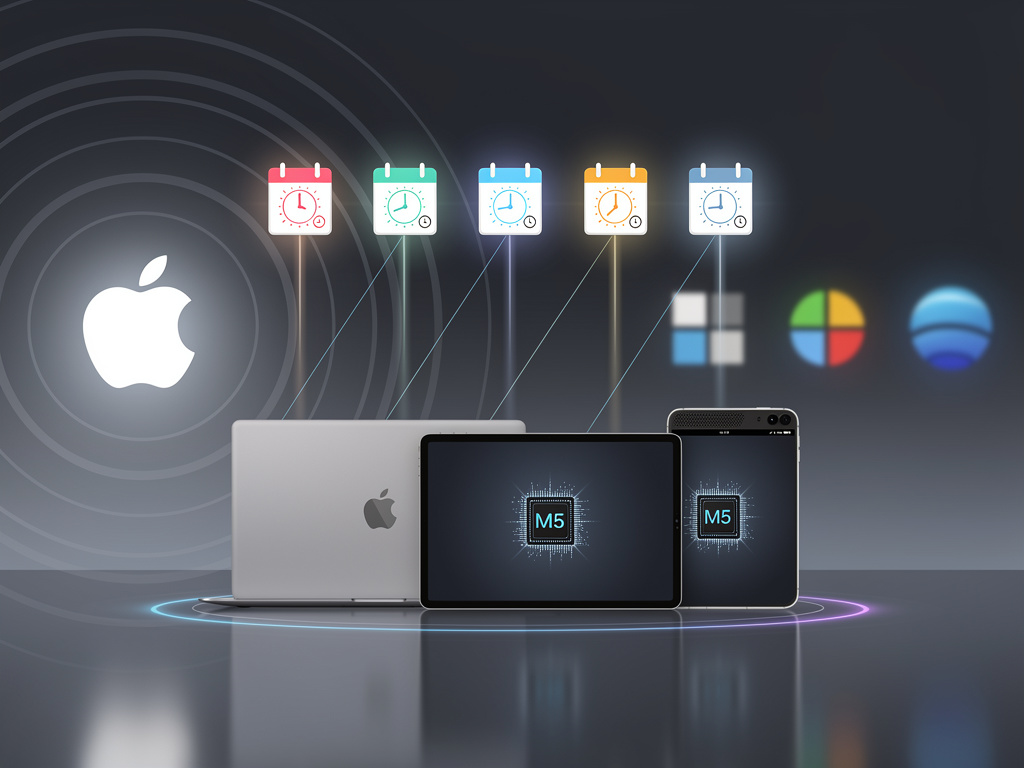
Apple Inc. is gearing up for what may be one of its most aggressive product-announcement stretches in recent memory. On Sunday, CEO Tim Cook took to social media to confirm that the company would be unveiling new products every day for an entire week, beginning Monday and running through Friday. The announcement, made via a post on X (formerly Twitter), set off a wave of speculation among analysts, developers, and consumers about what exactly Cupertino has in store — and why the company chose this unusual drip-feed approach rather than a single keynote event.
Cook’s post was characteristically understated but unmistakable in its intent. “This is going to be the best week of the year for Mac lovers,” he wrote, alongside a short teaser video. The message was clear: Apple is not holding a single splashy event but instead spreading its announcements across five consecutive days, a format the company has rarely employed with this level of ambition. As Engadget reported, the strategy appears designed to keep Apple in the news cycle continuously rather than allowing the excitement of a single event to dissipate within hours.
A Departure From the Traditional Apple Keynote Playbook
For years, Apple has relied on tightly choreographed keynote presentations — whether live at Steve Jobs Theater or pre-recorded during the pandemic era — to announce major hardware and software updates. The decision to break with that tradition is significant. Industry observers have noted that a week-long rollout allows Apple to give each product its own moment in the spotlight, avoiding the problem of one announcement overshadowing another. When Apple launches a new MacBook Pro alongside an updated iPad in the same hour-long event, for instance, one product inevitably receives less attention from the press and public.
The approach also carries strategic marketing value. By dominating headlines for five straight days, Apple can sustain consumer attention in a way that a single event cannot. Each day’s reveal becomes its own news cycle, generating fresh social media discussion, analyst commentary, and retail anticipation. It is a tactic more commonly associated with the entertainment industry — think of a streaming service releasing episodes weekly rather than all at once — and it signals Apple’s growing sophistication in managing public attention.
What Products Are Expected to Drop This Week
While Apple has not published an official schedule of announcements, leaks and supply-chain intelligence have given the tech press a reasonably clear picture of what to expect. According to Engadget, the week is expected to include new Mac hardware powered by Apple’s next-generation M5 family of chips. Bloomberg’s Mark Gurman, one of the most reliable sources on Apple’s internal plans, has reported that updated MacBook Air models, a refreshed Mac Studio, and potentially a new Mac Pro are all in the pipeline for mid-2025 announcements.
Beyond the Mac lineup, iPad updates are also widely anticipated. Apple last refreshed its iPad Air and base-model iPad in 2024, and a new iPad with an M-series chip could arrive this week. There has also been persistent speculation about updates to Apple’s smart home strategy, including a refreshed HomePod or a new home hub device that would tie into the company’s push toward ambient computing and Apple Intelligence, its on-device AI framework. Whether all of these products land this week or some are held for WWDC in June remains to be seen, but the sheer volume of expected announcements is notable.
The M5 Chip: Apple Silicon’s Next Chapter
Central to this week’s reveals is the expected debut of the M5 chip, the latest in Apple’s custom silicon line that began with the M1 in late 2020. Apple’s transition away from Intel processors has been one of the most consequential hardware decisions in the personal computing industry over the past decade, and each new generation of Apple Silicon has delivered measurable gains in performance and power efficiency. The M5 is expected to be fabricated on TSMC’s latest 3-nanometer process node, which should yield improvements in both raw computational speed and battery life.
For professional users — video editors, software developers, music producers, and data scientists — the M5’s performance characteristics will be closely scrutinized. Apple has been steadily closing the gap with high-end desktop processors from AMD and Intel in multi-threaded workloads, and the M5 Pro and M5 Max variants (expected later this year or in early 2026) could further erode the case for traditional x86 workstations. The base M5 chip, likely to appear first in consumer-grade MacBooks and iPads, will set the baseline for what the rest of the lineup can deliver.
Apple Intelligence and the Software Layer
Hardware is only part of the story. Apple has been aggressively expanding Apple Intelligence, its branded suite of AI-powered features that run on-device rather than relying entirely on cloud processing. Introduced at WWDC 2024, Apple Intelligence includes writing tools, image generation, notification summaries, and a significantly upgraded Siri. New hardware powered by M5 chips would provide the computational headroom needed to run more sophisticated AI models locally, a differentiator Apple has emphasized in its competition with Google, Microsoft, and Samsung.
The timing of this week’s announcements may also be connected to Apple’s broader AI ambitions. Reports from Engadget and other outlets suggest that Apple is preparing to expand Apple Intelligence capabilities with new features that require the processing power of M5-class hardware. If true, this week’s product launches would serve a dual purpose: refreshing the hardware lineup while also giving Apple a platform to demonstrate new AI capabilities ahead of WWDC 2025, where the software roadmap for iOS 19, macOS 16, and other platforms will be formally unveiled.
The Competitive Landscape Apple Faces in 2025
Apple’s aggressive announcement cadence does not exist in a vacuum. Microsoft has been pushing its Copilot+ PC initiative hard, partnering with Qualcomm, Intel, and AMD to bring AI-capable Windows laptops to market. Google’s Chromebook Plus line, powered by Gemini AI features, has gained traction in education and enterprise. Samsung’s Galaxy Book series, running Windows with Samsung’s own AI integrations, has also been eating into Apple’s market share in certain segments.
In the tablet market, Apple still dominates with the iPad, but competition from Samsung’s Galaxy Tab S series and a growing number of Android tablets from Chinese manufacturers like Xiaomi and Lenovo has intensified. Apple’s response has been to push the iPad further into laptop-replacement territory, equipping it with desktop-class chips, Stage Manager multitasking, and professional software support. New iPads with M5 chips would further that strategy, potentially blurring the line between iPad and MacBook even more than current models do.
Wall Street’s Read on Apple’s Product Strategy
Investors have generally rewarded Apple’s product cadence. The company’s stock has performed well in 2025, buoyed by strong iPhone sales in China and growing services revenue. Analysts at Morgan Stanley and JPMorgan have both maintained overweight ratings on Apple shares, citing the upcoming hardware refresh cycle as a catalyst for continued growth. The logic is straightforward: new Macs and iPads drive not only hardware revenue but also pull users deeper into Apple’s services business — iCloud storage, Apple Music, Apple TV+, AppleCare, and the App Store.
However, some analysts have expressed caution. The global macroeconomic environment remains uncertain, with consumer spending under pressure from persistent inflation in key markets. Enterprise IT budgets, while recovering, are being allocated with more scrutiny than during the pandemic-era spending boom. Apple’s ability to command premium prices for its hardware depends on demonstrating clear value over less expensive alternatives, and the M5 chip’s performance benchmarks will be critical in making that case to both consumers and corporate buyers.
What This Week Means for Apple’s Broader Trajectory
The decision to stage a week-long product reveal is about more than just marketing. It reflects Apple’s confidence in the depth of its product pipeline and its willingness to experiment with how it communicates with the public. For years, the Apple keynote was treated as a near-sacred ritual in the tech industry — a carefully produced spectacle that generated billions in free media coverage. By breaking that mold, Apple is signaling that it believes its products can speak for themselves, one day at a time.
The week ahead will be closely watched not just for the specific products announced but for what they reveal about Apple’s priorities. Is the company doubling down on professional users with high-end Mac hardware? Is it pushing the iPad further into productivity territory? Is Apple Intelligence ready to become a genuine selling point rather than a marketing promise? The answers will come in daily installments, and for the industry insiders tracking Cupertino’s every move, this week promises to be one of the most consequential stretches on Apple’s 2025 calendar.


 WebProNews is an iEntry Publication