
Apple has begun quietly approaching semiconductor startups and holding talks with investment bankers about potential acquisitions. The moves signal a sharp turn for a company long known for building its own chips from the ground up. But the demands of modern artificial intelligence have changed the math.
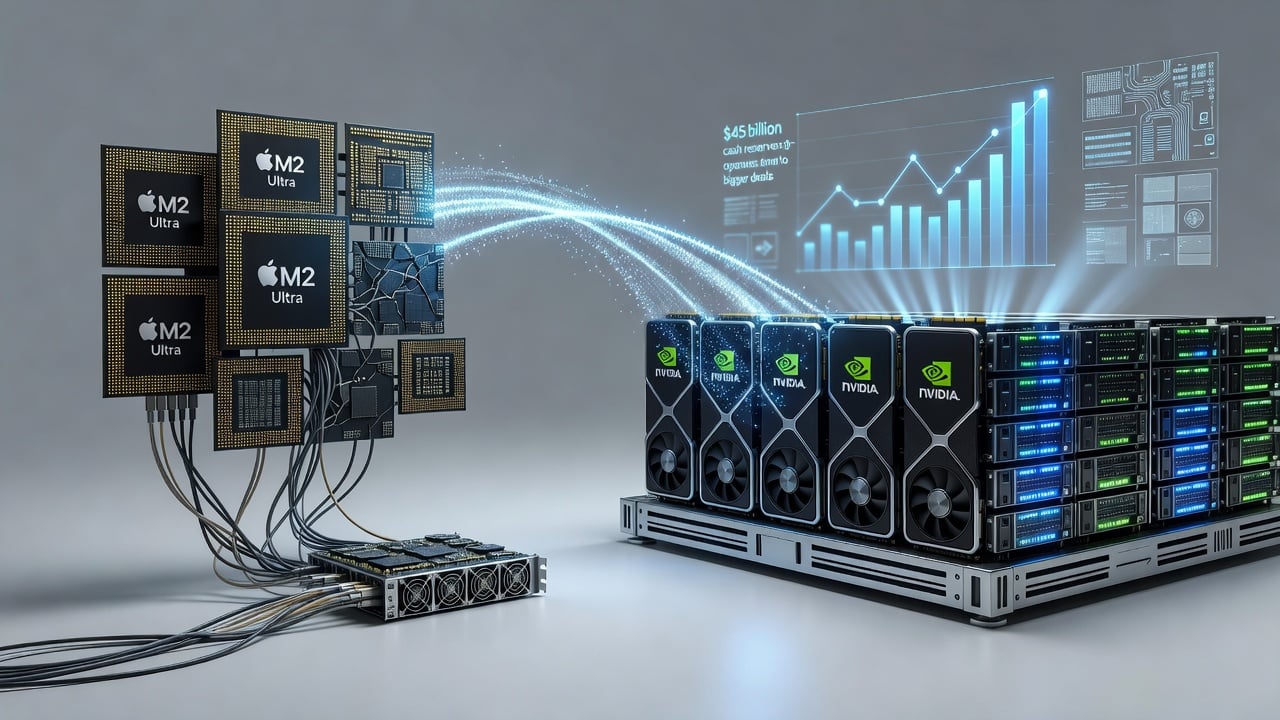
Its current server infrastructure falls short. The M2 Ultra chips powering some of Apple’s AI workloads struggle with larger models. So the company routes demanding tasks to Nvidia GPUs hosted in Google Cloud. That arrangement lets the new Siri draw on Google’s Gemini technology. Yet it leaves Apple dependent on two fierce rivals for core artificial intelligence capabilities. And that dependence stings.
According to a report published today by Yahoo Finance, Apple has engaged bankers in recent months to explore chip deals. The company has also reached out directly to several semiconductor startups to test their openness to a sale. These discussions come as Apple’s in-house project for a dedicated AI server chip, known internally as Baltra, has slipped past its original schedule.
Plans for an M7 Ultra-based server chip have been pushed back even further. Bloomberg first reported that version might not arrive until 2029. In the meantime Apple intends to refresh its server fleet with M5 Ultra processors. The upgrades buy time. They do not solve the underlying gap in specialized AI acceleration at scale.
Tim Cook addressed the broader push during an earnings call last summer. “We’re very open to M&A that accelerates our roadmap,” he told analysts. “We are not stuck on a certain size company, although the ones that we have acquired thus far this year are small in nature.” Tech Startups covered those remarks in detail. Apple had bought roughly seven companies by that point in 2025. Not every deal targeted artificial intelligence, yet the message was unmistakable. The Cupertino giant stands ready to spend when the right technology appears.
This willingness marks a departure. Apple historically favors smaller transactions. Its 2008 purchase of PA Semi for $278 million laid early groundwork for the custom silicon that now defines iPhones and MacBooks. The $3 billion acquisition of Beats in 2014 still ranks as the company’s most expensive deal. But earlier this year Apple paid close to $2 billion for Israeli startup Q.ai. The deal, one of its largest ever, brought in expertise for AI-driven audio processing. CNBC confirmed the transaction in January.
Those past moves focused mainly on consumer-facing features. The current search targets something different. Apple wants silicon that can handle the ferocious compute loads of large language models inside its own data centers. Without it, the company risks falling behind Microsoft, Google, Meta and Amazon. Those four have poured hundreds of billions into AI infrastructure. Apple sat on the sidelines longer than most. Now it must catch up fast.
Recent social media chatter reflects the shift. One analyst noted on X that Apple’s own AI server chip is late and the M2 Ultras cannot carry the workloads. “Buying your way off Nvidia is a new look for a company that builds everything in-house,” the post observed. Another highlighted the irony. The most vertically integrated technology firm on earth now rents critical AI compute from competitors. The pressure shows.
Leadership changes add another layer. John Ternus is set to become chief executive in September. Hardware veteran Johny Srouji recently gained expanded oversight of all chip design and engineering. The timing aligns with the intensified focus on acquisitions. Srouji’s team built the A-series and M-series processors that transformed Apple’s products. Extending that success to data-center scale presents a steeper challenge.
The company already maintains a massive cash reserve. It held $45.6 billion in cash and equivalents at the end of March. That war chest gives Apple flexibility to pay premiums for the right assets. Yet competition for AI talent runs hot. Startups specializing in efficient inference, high-bandwidth memory integration or novel accelerator architectures command high valuations.
Apple’s $30 billion multiyear agreement with Broadcom offers one bridge. Announced last year, the pact covers custom silicon produced in the United States. It underscores Apple’s desire to reduce reliance on foreign manufacturing for strategic components. Still, design expertise remains the prize. Acquiring a startup brings not just intellectual property but the engineers who created it. Those teams can accelerate development cycles that might otherwise stretch years.
Industry watchers point to Apple’s history of successful integration. After buying PA Semi, the company folded the talent into its silicon group. The result helped launch the first iPad and set the stage for the Apple silicon revolution in Macs. Similar logic applies today. A well-chosen AI chip acquisition could speed the arrival of on-device and data-center models that preserve the privacy focus central to Apple’s brand.
But success is not guaranteed. Chip design at AI scale involves complexities far beyond mobile processors. Power efficiency, thermal management and interconnect bandwidth all matter more when thousands of accelerators run together. Apple’s consumer chips excel at running inference on battery-powered devices. Training and serving frontier models demands different trade-offs.
Recent reports suggest Apple may broaden its search beyond pure hardware. Some discussions have touched on companies that compress large models so they run efficiently on existing silicon. One startup backed by Khosla Ventures demonstrated shrinking an open-source model dramatically enough to fit on an iPhone. Such technology could complement new chips rather than replace them.
Meanwhile the competitive dynamic keeps evolving. Nvidia dominates the AI accelerator market. Its GPUs power the majority of training clusters worldwide. Hyperscalers have begun developing their own alternatives. Amazon, Google and Meta all field custom silicon. Apple now appears ready to join that group in earnest. The difference lies in its late start and its traditional reluctance to make large acquisitions.
Wall Street has taken notice. Apple’s shares have climbed this year on optimism around its artificial intelligence features. Yet analysts caution that execution matters more than announcements. Delivering a compelling on-device AI experience without compromising battery life or privacy will test the company’s engineering culture. Acquiring the right pieces could shorten that path.
One post on X captured the moment succinctly. “The AI race is becoming an acquisition race.” Short. Direct. And increasingly accurate. Apple no longer bets solely on internal invention. It now hunts for external innovation to fill critical gaps. The coming months will reveal which targets it pursues and how quickly those deals translate into products users can see and feel.
The original report that first highlighted Apple’s shopping effort appeared in Engadget back in 2024. That piece outlined many of the same pressures now resurfacing with fresh urgency. Engadget noted the performance shortfalls of M2 Ultra servers and the heavy reliance on Nvidia and Google infrastructure. Little has changed on that front. The need has only grown.
So Apple adapts. It talks to bankers. It courts startups. It prepares to spend. The company that once prided itself on controlling every layer from silicon to software now recognizes limits. In artificial intelligence, speed sometimes matters more than sovereignty. And right now speed is in short supply.


 WebProNews is an iEntry Publication