
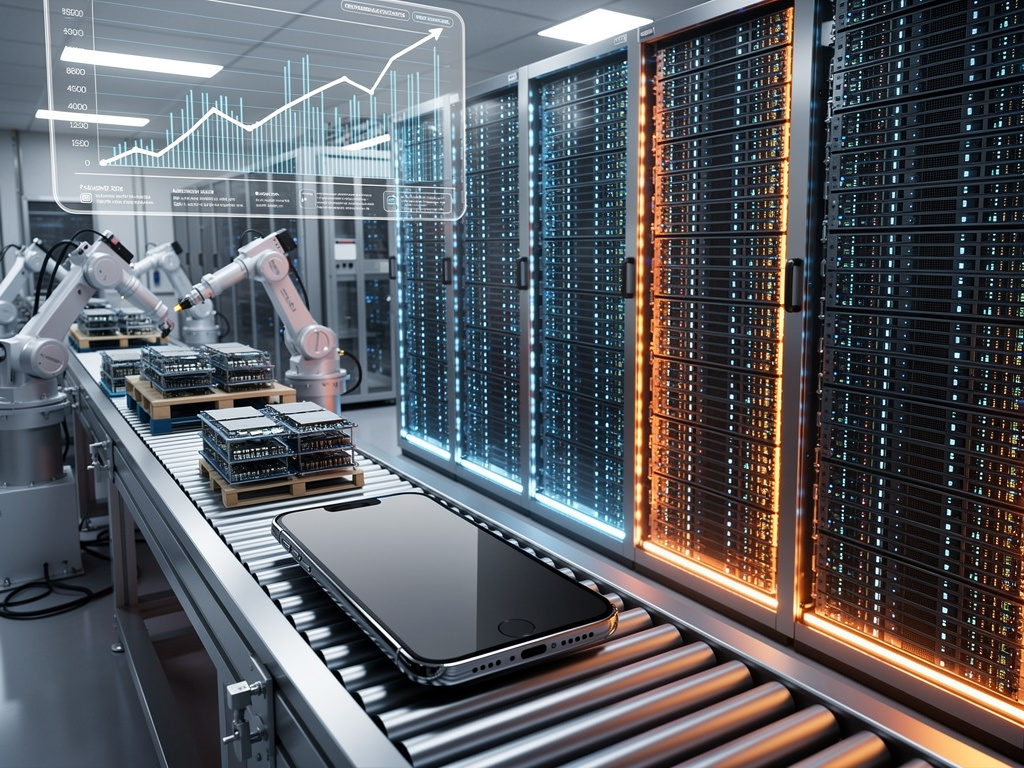
For nearly two decades, Apple has wielded unmatched power over the global electronics supply chain, dictating terms to manufacturers from Taipei to Seoul with the confidence of a company that could make or break suppliers with a single contract. That era is ending. The artificial intelligence revolution has spawned a new class of buyer with deeper pockets, longer time horizons, and an insatiable appetite for the same components that power iPhones—and these AI-focused companies are rewriting the rules of engagement that Apple spent years perfecting.
The shift became undeniable when Nvidia CEO Jensen Huang revealed on a podcast that his company had surpassed Apple as Taiwan Semiconductor Manufacturing’s largest customer, according to The Wall Street Journal. For years, TSMC had built its roadmap around Apple’s predictable, massive orders for iPhone processors. Now the world’s premier chipmaker is realigning its priorities around AI accelerators, a category that barely existed in its current form five years ago. This represents more than a changing of the guard—it signals a fundamental restructuring of how advanced semiconductor capacity gets allocated across the technology industry.
Apple CEO Tim Cook acknowledged the problem during the company’s Thursday earnings call, stating that Apple was experiencing constraints in chip supplies and witnessing significant increases in memory prices, as reported by The Wall Street Journal. Despite record company profits and blowout iPhone sales, Apple shares traded flat following these comments, suggesting investors recognized the longer-term implications of eroding supply chain dominance. The market’s muted response reflected a growing understanding that Apple’s legendary profit margins—long sustained by ruthless supply chain management—face structural headwinds that cannot be easily overcome through operational excellence alone.
Memory Markets Enter Unprecedented Price Spiral
The memory chip market has become ground zero for this supply chain battle. According to Mike Howard, an analyst at TechInsights cited by The Wall Street Journal, the rate of price increases in memory is unprecedented. DRAM prices are expected to quadruple from 2023 levels by the end of this year, while NAND flash memory prices will more than triple over the same period. These aren’t marginal cost increases that Apple can absorb through efficiency gains or minor design changes—they represent a wholesale repricing of critical components that account for a substantial portion of an iPhone’s bill of materials.
Howard’s analysis, reported by The Wall Street Journal, estimates that Apple could pay $57 more for the two types of memory that go into the base-model iPhone 18 due this fall compared with the base model iPhone 17 currently on sale. For a device retailing at $799, this represents a significant compression of profit margins. Apple has historically enjoyed gross margins in the 38-40% range, cushioning the company against component price fluctuations. A $57 increase in memory costs alone—before accounting for potential increases in processors, displays, or other components—could force Apple into difficult decisions about either accepting lower margins or passing costs to consumers.
The memory shortage stems from AI companies’ voracious appetite for both high-bandwidth memory (HBM) used in AI accelerators and conventional DRAM and NAND used in servers. Companies including OpenAI, Alphabet’s Google, Meta, and Microsoft are collectively spending hundreds of billions of dollars to build AI computing capacity, as noted in The Wall Street Journal reporting. Unlike smartphone upgrades, which follow predictable annual cycles, AI infrastructure buildouts represent a multi-year investment wave that shows no signs of cresting. Samsung Electronics and SK Hynix, the dominant memory manufacturers, are raising prices for Apple while offering preferential terms to AI companies willing to make upfront payments and long-term commitments.
Apple’s Legendary Negotiating Power Meets Its Match
Apple’s approach to supply chain management has long been studied in business schools as a masterclass in leveraging scale and sophistication. The company signs long-term contracts for memory but has historically used its heft to squeeze suppliers, according to people familiar with Apple’s supply chain cited by The Wall Street Journal. These contracts empowered Apple to negotiate prices as often as weekly and even refuse to buy any memory from a supplier if Apple didn’t view the price as favorable. This asymmetric relationship worked because suppliers needed Apple’s business more than Apple needed any individual supplier.
That calculus has changed. AI companies are writing checks that dwarf even Apple’s substantial procurement budget, and they’re willing to commit to multi-year contracts with guaranteed volumes and upfront payments. For memory manufacturers operating fabs that require billions of dollars in capital investment, the certainty offered by AI companies is more valuable than Apple’s week-to-week price negotiations. “Apple is getting squeezed for sure,” Sravan Kundojjala, an analyst with research firm SemiAnalysis, told The Wall Street Journal. The squeeze extends beyond pricing to allocation—when supply is constrained, manufacturers are prioritizing customers who offer the best combination of price, volume certainty, and strategic value.
In an unusual move that signals the severity of the situation, Apple began stocking more inventory of memory to boost leverage with suppliers, according to people familiar with its memory purchases cited by The Wall Street Journal. This represents a significant departure from Cook’s operational philosophy. As Apple’s chief operating officer before becoming CEO, Cook built his reputation on just-in-time inventory management that minimized capital tied up in components. His willingness to hold more memory inventory—sacrificing cash flow efficiency—demonstrates that Apple recognizes it can no longer rely solely on its purchasing power to guarantee supply at favorable prices.
Engineering Talent Follows the Money and the Challenge
The competition extends beyond dollars to include something potentially more valuable: engineering attention. Glass scientists who previously focused on developing the smoothest and lightest smartphone displays are now also spending time on specialized glass for packaging advanced AI processing chips, according to industry executives cited by The Wall Street Journal. This shift in engineering priorities reflects where suppliers see the most promising growth opportunities and technical challenges. For decades, smartphone innovation drove the bleeding edge of materials science, display technology, and miniaturization. Now AI hardware is claiming that mantle.
The reallocation of engineering resources has implications beyond the immediate supply constraints Apple faces. When suppliers’ best engineers spend less time optimizing components for smartphones and more time solving problems for AI hardware, the pace of innovation in mobile devices could slow. Apple has relied on suppliers to continuously improve component performance, reduce size and weight, and lower costs. If those suppliers are directing their top talent toward AI applications, Apple may need to invest more heavily in its own component development or accept slower improvement curves in future iPhone generations.
Makers of sensors and other components inside the iPhone are winning new business from AI companies such as OpenAI that are developing their own hardware, The Wall Street Journal reported. This diversification benefits suppliers by reducing their dependence on Apple, but it further erodes Apple’s negotiating position. When a sensor manufacturer’s revenue from AI hardware rivals or exceeds its iPhone business, Apple loses the ability to threaten walking away from a supplier as a negotiating tactic. The relationship becomes more balanced, with suppliers able to push back on Apple’s traditionally aggressive pricing demands.
TSMC’s Shifting Allegiances Force Strategic Recalibration
Taiwan Semiconductor Manufacturing Company has been Apple’s most critical supplier for over a decade, producing the custom-designed processors that power iPhones, iPads, and Macs. TSMC built successive generations of its most advanced manufacturing processes with Apple as its lead customer, relying on the predictable, massive demand for iPhones to justify billions in capital expenditures for new fabs. This partnership gave Apple access to the world’s most advanced chip manufacturing capacity, often with a 12-18 month lead over competitors. That exclusive advantage is evaporating as TSMC redirects capacity toward AI chips.
Now that TSMC is doing more business with Nvidia and other AI companies, people with knowledge of the chip supply chain told The Wall Street Journal that Apple is exploring whether some lower-end processors could be made by someone other than TSMC. This represents a significant strategic shift. Apple has historically concentrated its chip production at TSMC to maximize its influence over the foundry’s roadmap and ensure the tightest integration between Apple’s chip designs and TSMC’s manufacturing processes. Diversifying to other foundries—likely Samsung or potentially Intel—would reduce Apple’s dependence on TSMC but could also mean accepting inferior performance or yields, at least initially.
The exploration of alternative foundries also reflects a broader reality: Apple may no longer be able to command TSMC’s full attention for its most advanced nodes. When Nvidia is ordering AI accelerators that generate higher margins and require more advanced packaging than smartphone processors, TSMC has economic incentives to prioritize those orders. Apple’s chips, while sophisticated, are ultimately destined for consumer devices with price constraints. AI accelerators sell into data centers where performance matters more than cost, allowing Nvidia to pay premium prices that Apple cannot match without destroying its own margins.
The Price Premium Playbook Faces Limits
Apple has historically offset component cost increases through strategic product positioning rather than across-the-board price hikes. One of Apple’s biggest profit-spinners is selling extra memory for far more than the memory chips cost the company, The Wall Street Journal noted. Last fall, Apple discontinued the iPhone Pro model with 128 gigabytes of storage, forcing customers who want that model to start at 256 gigabytes and pay $100 more. Craig Moffett, an analyst at Moffett Nathanson, wrote in an investor note cited by The Wall Street Journal that this type of move could be repeated this year to help Apple offset higher costs.
However, there are limits to how far Apple can push this strategy. The company has carefully cultivated a premium brand that justifies prices above competitors, but that premium is not infinite. If memory costs force Apple to either eliminate lower-priced configurations or raise prices across the board, the company risks pushing price-sensitive customers toward competitors. The smartphone market has matured, with upgrade cycles lengthening as improvements between generations become more incremental. In this environment, a $100 price increase could convince consumers to hold onto their existing phones for another year rather than upgrade.
Ming-chi Kuo, an analyst with TF International Securities cited by The Wall Street Journal, said Apple isn’t expected to raise the price of its next iPhone models over similarly equipped iPhone 17s. This suggests Apple plans to absorb much of the cost increase through margin compression rather than risk demand destruction through higher prices. For a company that has reported record profits, accepting lower margins might seem like a manageable trade-off. But investors have valued Apple’s stock based on its ability to maintain premium margins even as it has grown to enormous scale. A sustained period of margin compression could force a revaluation of the company’s worth.
AI Companies Rewrite Supply Chain Economics
The fundamental challenge Apple faces is that AI infrastructure operates under different economic rules than consumer electronics. Smartphone manufacturers are acutely price-sensitive because they sell into competitive markets where consumers compare specifications and prices across brands. A $50 increase in component costs might force a smartphone maker to either accept lower margins or raise prices and risk losing market share. AI companies, by contrast, are building infrastructure to support services that could generate revenue for decades. They can afford to pay premium prices for components if those components enable faster training of AI models or more efficient inference.
This willingness to pay premium prices creates a ratchet effect in component markets. Once memory manufacturers discover they can sell HBM to AI companies at prices far above conventional DRAM, they have incentives to convert production capacity from conventional memory to HBM. This reduces the supply of conventional DRAM available for smartphones and PCs, driving up prices for those components as well. Even if AI demand were to suddenly collapse—an unlikely scenario given current investment trajectories—memory prices might not return to previous levels because manufacturers have restructured their production capacity around higher-margin products.
The shift is also temporal. Apple’s iPhone business, while massive, is ultimately constrained by the number of humans on Earth willing and able to buy premium smartphones. That’s a large market, but it’s a finite one with growth rates that have slowed to single digits. AI infrastructure, according to its proponents, is in the early innings of a multi-decade buildout comparable to the construction of the internet itself. Suppliers making strategic decisions about where to invest in new capacity are naturally gravitating toward the market they believe offers decades of growth rather than the one approaching maturity.
The Demanding Customer Loses Its Unique Appeal
Suppliers interviewed by The Wall Street Journal said they were far from giving up on business with Apple, noting that working with Apple is a form of education because it remains one of the most demanding and disciplined customers in the industry. This has been a key part of Apple’s value proposition to suppliers: the company’s exacting standards and sophisticated engineering push suppliers to improve their capabilities, which they can then leverage to win business from other customers. A supplier that can meet Apple’s quality standards can generally satisfy any customer in the electronics industry.
However, AI companies are proving to be equally demanding in different ways. Nvidia’s requirements for memory bandwidth, chip packaging, and thermal management push the boundaries of what’s physically possible. The engineering challenges involved in building AI accelerators that consume 700 watts of power while maintaining reliability are at least as complex as those involved in building a smartphone that weighs 200 grams. Suppliers are discovering they can get the same educational benefits from working with AI companies that they previously obtained exclusively from Apple, reducing one of Apple’s key sources of leverage.
Moreover, AI companies often bring a collaborative approach that contrasts with Apple’s more adversarial supplier relationships. While Apple is known for squeezing suppliers on price and playing them against each other, AI companies have shown willingness to form longer-term partnerships with guaranteed volumes and shared technology development. For suppliers, this represents not just better economics but also more predictable revenue streams that justify capital investments. The combination of higher prices, longer commitments, and collaborative relationships makes AI companies attractive customers in ways that go beyond simple dollar amounts.
Implications for the Broader Technology Sector
Apple’s supply chain challenges offer a preview of pressures facing the entire consumer electronics industry. If Apple—with its unmatched scale, cash reserves, and supply chain sophistication—is struggling to secure components at favorable prices, smaller smartphone manufacturers, PC makers, and consumer electronics companies face even steeper challenges. The industry could see a bifurcation where AI infrastructure receives priority allocation of the most advanced components while consumer devices are relegated to older process nodes and previous-generation memory technologies.
This bifurcation could slow the pace of innovation in consumer devices. Smartphones have improved dramatically over the past fifteen years partly because manufacturers had access to the most advanced semiconductor manufacturing processes and component technologies. If those technologies are now reserved for AI accelerators and data center hardware, consumer devices might see smaller year-over-year improvements. The industry has already seen this dynamic play out in recent years, with smartphone improvements becoming more incremental as the technology matures. Competition from AI for cutting-edge components could accelerate this trend.
The shift also raises questions about the sustainability of current AI infrastructure investments. Companies are spending hundreds of billions of dollars on AI data centers based on assumptions about future revenue from AI services that remain largely unproven at scale. If those revenue assumptions prove optimistic, the current AI infrastructure boom could give way to a bust that leaves manufacturers with excess capacity and falling component prices. However, even if that scenario unfolds, it likely remains years away. In the meantime, companies like Apple must navigate a market where AI companies have unlimited appetites and deep pockets.
Strategic Options for Apple in a New Era
Apple is not without options for responding to these challenges. The company has been increasing its investment in custom silicon design, reducing dependence on off-the-shelf components where possible. Apple’s M-series processors for Macs and custom iPhone chips demonstrate the company’s ability to design sophisticated semiconductors that optimize for its specific needs. Expanding this approach to other components—potentially including memory controllers, display drivers, or sensor fusion chips—could give Apple more control over its supply chain and reduce exposure to market price fluctuations.
The company could also leverage its massive cash reserves to secure supply through long-term contracts with upfront payments, matching the tactics AI companies are using. Apple’s balance sheet can support multi-billion dollar prepayments to memory manufacturers or chip foundries in exchange for guaranteed capacity at fixed prices. This would represent a departure from Apple’s traditional approach of maintaining flexibility and negotiating leverage, but it might be necessary in a market where other customers are willing to make such commitments. The trade-off would be reduced financial flexibility in exchange for supply certainty.
Another option involves closer vertical integration. Apple has already brought chip design in-house and could potentially invest in manufacturing capacity, either through acquisitions or partnerships. The company has reportedly explored building its own display manufacturing capabilities and could consider similar moves in other component categories. However, semiconductor and component manufacturing requires enormous capital investments and expertise that takes years to develop. Even if Apple began such investments today, they would not address the immediate supply constraints the company faces.
The End of an Era in Technology Supply Chains
What’s unfolding represents more than a cyclical shift in component pricing or temporary supply constraints. The AI revolution is fundamentally restructuring how advanced technology components get allocated across the industry. For fifteen years, Apple sat atop this system, using its combination of scale, sophistication, and brand power to command priority access to the best components at favorable prices. That era is ending not because Apple has weakened, but because AI companies have emerged as an even more powerful force in component markets.
The companies now pushing the boundaries of engineering are ones like Nvidia, Ming-chi Kuo told The Wall Street Journal. This represents a philosophical shift in the technology industry. The cutting edge of innovation has moved from devices people carry in their pockets to the massive computers that power AI services. Suppliers are following that shift, redirecting their best engineering talent and most advanced manufacturing capacity toward the new frontier. Apple remains enormously profitable and successful, but it must now compete for components rather than command them.
For consumers, the implications may take time to materialize but are likely inevitable. If Apple cannot pass component cost increases to customers without damaging demand, the company will need to find other ways to maintain margins. That could mean fewer features in base models, more aggressive upselling to higher-priced configurations, or slower improvement in capabilities between generations. Alternatively, if Apple decides that maintaining margins requires price increases, consumers may face the choice of paying more for new iPhones or holding onto existing devices longer. Either way, the era of steadily improving smartphones at stable prices faces new headwinds.
A Market Reordering With Lasting Consequences
The battle for components between Apple and AI companies will shape the technology industry for years to come. In the near term, Apple faces margin pressure and supply constraints that could affect product planning and financial performance. The company’s response—whether through vertical integration, long-term supply contracts, or acceptance of lower margins—will influence how other technology companies navigate similar challenges. Apple’s experience demonstrates that even the most powerful and sophisticated companies are not immune to market forces when a new category emerges with deeper pockets and longer time horizons.
The broader question is whether the current AI infrastructure boom represents a permanent shift or a temporary bubble. If AI services generate the revenues their proponents expect, the current investment levels could be justified and component demand could remain elevated for years. In that scenario, Apple and other consumer electronics companies would need to permanently adjust to a world where they no longer receive priority access to cutting-edge components. Alternatively, if AI revenues disappoint, the current infrastructure buildout could slow, releasing component supply back to consumer electronics makers. However, even in that scenario, the supply chain relationships and pricing precedents established during the current boom would likely persist.
What seems certain is that Apple’s dominance of the electronics supply chain—a dominance so complete that suppliers built entire business models around serving the company—has ended. The iPhone will remain one of the most successful products in business history, and Apple will continue to be a massive buyer of components. But the company must now share the spotlight with AI companies whose appetites are just as voracious and whose willingness to pay is even greater. For an industry that has revolved around Apple’s orbit for fifteen years, this reordering represents a fundamental shift in the balance of power—one whose full implications are only beginning to unfold.


 WebProNews is an iEntry Publication