
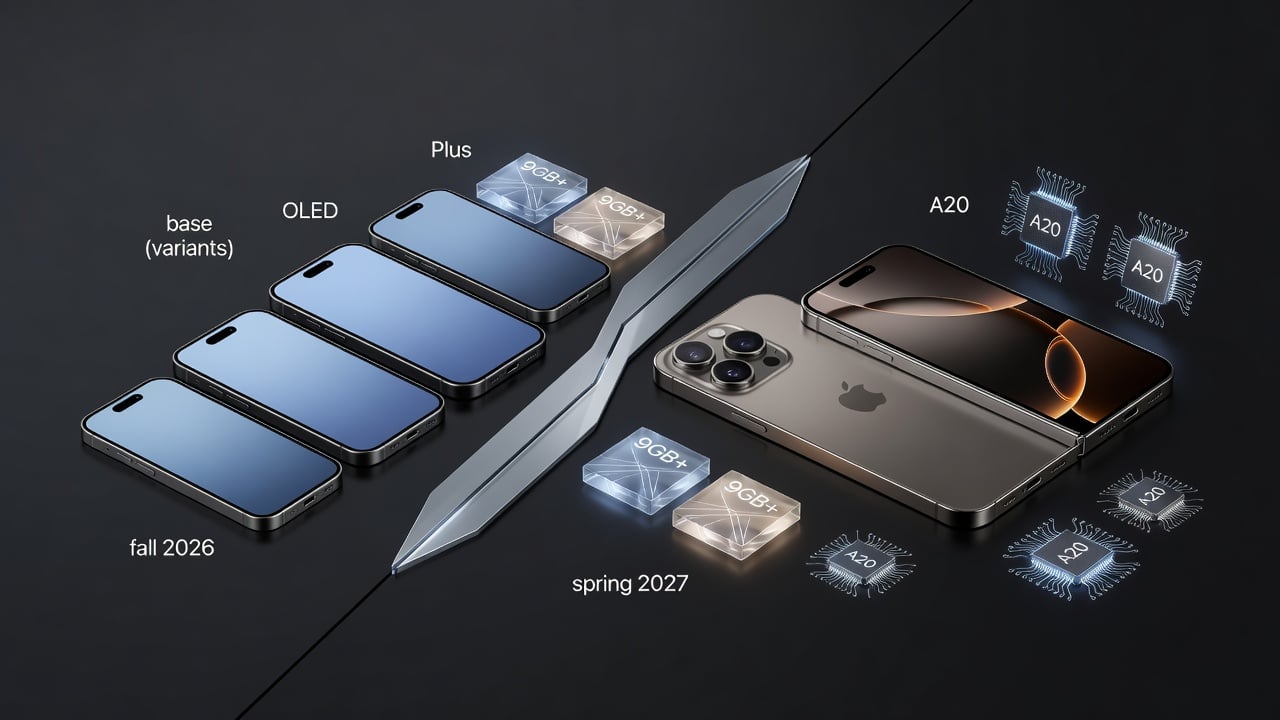
Apple stands at a crossroads with its smartphone plans. The company that perfected the annual September refresh now eyes a staggered schedule. Six distinct models will roll out across late 2026 and early 2027. Some buyers will wait months longer than usual for their preferred device. Others may pay more to get the latest hardware sooner.
A fresh leak shared Monday outlines the breadth of that lineup. 9to5Mac reported details from Weibo user Digital Chat Station. The post lists screen sizes and display types for three lower-cost devices slated for spring 2027. It also notes mold testing progress on higher-end units for the following fall.
The shift marks a clear break from tradition. Fall 2026 brings the iPhone 18 Pro, iPhone 18 Pro Max and the first foldable iPhone. Spring 2027 follows with the standard iPhone 18, a budget iPhone 18e and the second-generation iPhone Air. Analysts see the move as a bid to maximize revenue from premium sales before flooding the market with more affordable options. But it carries risks. Customers loyal to base models could delay upgrades or defect.
Supply chain signals back the timeline. A partner comment captured in mid-June appeared to rule out a 2026 release for the standard iPhone 18. MacRumors highlighted those remarks. They align with earlier reports from Bloomberg’s Mark Gurman. The pattern holds. Pro models and the foldable ship on the usual cadence. Everything else slips six months.
Memory constraints explain part of the strategy. Industry shortages have forced trade-offs. The base iPhone 18 may receive downgrades in display brightness and graphics cores. Yet recent updates point to upgrades elsewhere. Analyst Ming-Chi Kuo expects 9GB of RAM in the iPhone 18 and iPhone 18e. That represents a bump from 8GB. The devices should also run on an A20 chip built on a 2nm process. MacRumors detailed those specifications just days ago.
Higher RAM counts could unlock smarter on-device AI features. Separate reporting suggests the entire iPhone 18 family might pack as much as 12GB in some configurations to support advanced Siri capabilities. The numbers matter. Apple has tied future software intelligence closely to hardware muscle. A modest increase helps future-proof the cheaper phones without matching Pro-level specs.
Display plans vary sharply by tier. The iPhone Air 2 should measure 6.55 inches with 1.5K resolution, 120Hz LTPO OLED. The iPhone 18 sticks close at 6.3 inches using identical panel technology. The iPhone 18e drops to 6.12 inches and 60Hz LTPS. No ProMotion there. That decision keeps costs in check. It also maintains clear separation between product tiers. Digital Chat Station’s post confirmed those parameters. The leaker added that mold testing has wrapped for the 2027 Pro series and that work continues on a wider foldable screen for the Ultra 2.
Design changes promise more drama at the top. The iPhone 18 Pro models could adopt a radical new look tied to the product’s 20th anniversary. Slimmer bezels, under-display Face ID and a smaller Dynamic Island appear likely across the board. CNET reported potential variable aperture lenses on the Pro Max for better control over depth of field. Battery capacities may exceed 5,000mAh in larger variants. A 24-megapixel front camera would improve selfies and video calls.
Colors remain subject to change. Leaks mention light blue, dark cherry and dark gray options for Pro finishes. Earlier concepts of coffee brown have apparently been dropped. These visual cues help Apple differentiate generations in stores and marketing.
The foldable device looms largest in the conversation. Expected to carry a $2,000-plus price tag, it joins the Pro duo in fall 2026. Early units may ship in limited volumes. Production hurdles for the hinge and crease remain real. Still, the device represents Apple’s first major new iPhone form factor in years. Success could open fresh market segments. Failure would sting.
But the split schedule creates its own complications. Shoppers who buy a new iPhone every autumn will face an odd year. No standard model in September 2026. They must choose between last year’s base unit, a jump to Pro pricing or waiting until March. That gap spans roughly six months. Some analysts question whether the strategy will confuse consumers or simply push them toward higher-margin Pro models.
Recent supplier data reinforces the delay. Trial production for the standard iPhone 18 appears aligned with early 2027 volumes. No comparable activity shows for a 2026 launch. The pattern matches what Gurman has described for months. Apple wants to stretch its innovation cycle and extract more value from flagship buyers first.
Software ties everything together. iOS 27, previewed at WWDC in June, will run on these devices. On-device AI features will demand the extra RAM and efficient chips. A smaller Dynamic Island might even change shape for certain Siri interactions. One report suggested the pill shape could give way to a circle in select scenarios. Details like these show how hardware and software choices now intertwine more than ever.
Camera Control could see simplification too. Future versions may rely solely on pressure sensing rather than capacitive touch. The change would cut complexity and cost. It fits the pattern of targeted downgrades on non-Pro models to offset component shortages.
Modem upgrades add another layer. Apple continues its shift away from Qualcomm with an in-house C2 chip. Support for mmWave 5G and new privacy features around location tracking should arrive. These moves reduce reliance on third parties while giving Apple tighter control over performance and power consumption.
Pricing pressure builds. The iPhone 18 could cost more than its predecessor despite some compromises. Pro models may see increases of $100 or more in certain markets. The foldable sits in its own stratosphere. Such jumps reflect rising component costs and Apple’s confidence in brand strength. Whether buyers accept them remains the open question.
Digital Chat Station’s leak adds useful specificity to the 2027 picture. The three spring devices keep display technology familiar. That continuity reduces risk on the entry-level side. The fall trio carries the heavier lifting with new designs and the foldable bet. Mold testing completion for the Pro series signals steady progress toward production.
Yet uncertainties linger. Exact release windows inside those seasons could shift. Battery and camera specifications might evolve as yields improve. Color options often change late in development. The memory situation could ease or worsen. Apple has navigated supply crunches before. This time the company appears willing to stagger its calendar to buy time.
Industry watchers will track reaction closely. A successful split could become the new normal. It might allow more frequent refreshes without cannibalizing sales. Or it could frustrate enough customers to erode loyalty. The foldable’s reception will color perceptions of the entire generation. Deliver a compelling device at a palatable price and the conversation changes. Miss the mark and questions about Apple’s innovation pace will intensify.
For now the roadmap looks set. Three premium devices this fall. Three more accessible ones next spring. Six new iPhones. One company betting that choice and timing can drive growth in a mature market. The coming months will test that thesis in stores and earnings calls alike.


 WebProNews is an iEntry Publication