
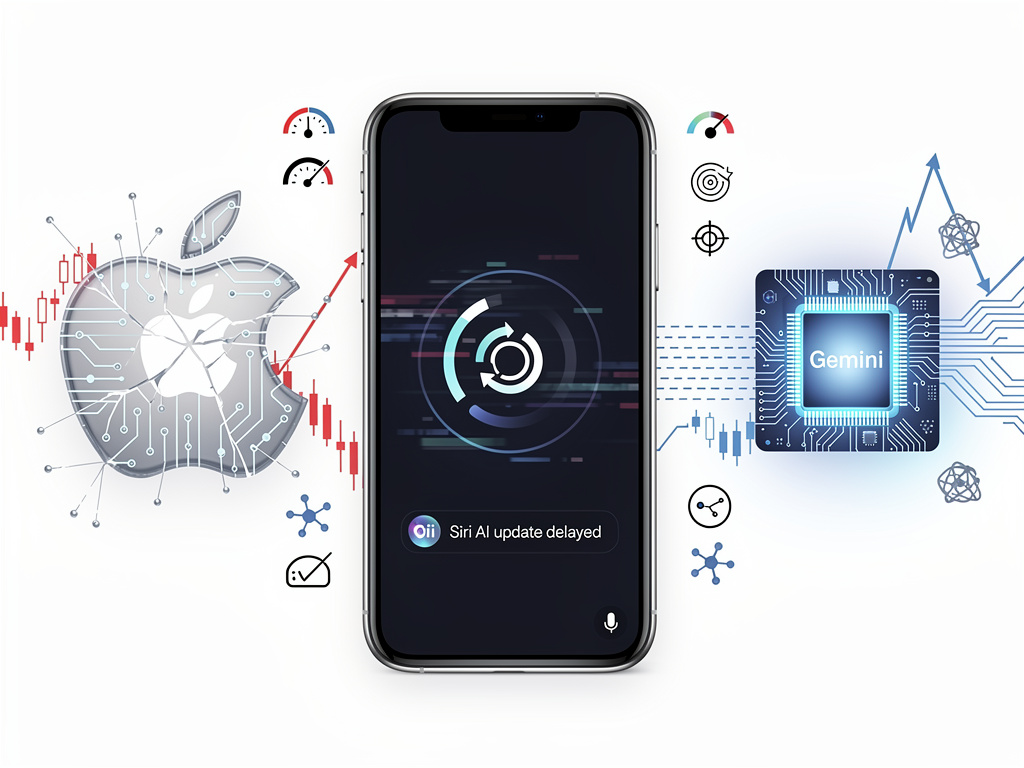
For a company that has long prided itself on delivering polished, seamless experiences, Apple Inc. finds itself in an increasingly uncomfortable position: its flagship virtual assistant, Siri, continues to fall short of the ambitious overhaul the company has been promising for more than a year. Internal testing of the next-generation Siri — powered in part by Google’s Gemini large language model — has reportedly hit significant roadblocks, forcing Apple to consider pushing key personalized features from the upcoming iOS 26.4 release to iOS 26.5 or even later, according to a report by Bloomberg.
The delays underscore a growing tension at the heart of Apple’s artificial intelligence strategy. While competitors like OpenAI, Google, and Microsoft have raced ahead with increasingly capable AI assistants, Apple has struggled to transform Siri from a basic voice-command tool into the intelligent, context-aware assistant that CEO Tim Cook and software chief Craig Federighi have repeatedly teased at developer conferences and product launches.
What Went Wrong in Testing
According to Bloomberg’s Mark Gurman, the snags emerged during internal testing over recent weeks. Engineers found that the revamped Siri was slow to respond and, more critically, produced inaccurate results at rates that Apple’s quality-assurance teams deemed unacceptable for a consumer release. The problems reportedly affect some of the most anticipated features: on-device personalization capabilities that would allow Siri to understand individual user habits, integrate deeply with third-party apps, and perform multi-step tasks across the operating system. As Gizmodo noted, the new Siri functions “are reportedly being delayed once again because they’re slow and inaccurate” — a damning assessment for a feature set that Apple first previewed at WWDC 2025.
The technical challenges appear to be multifaceted. Integrating a powerful large language model like Gemini into Siri’s existing architecture while maintaining Apple’s stringent privacy standards — much of the processing must occur on-device rather than in the cloud — creates enormous computational demands. The iPhone’s Neural Engine, even in its latest iteration, must balance performance, battery life, and thermal constraints, all while delivering responses that feel instantaneous to users. AppleInsider reported that testing “isn’t going well” and that new features “probably won’t ship in iOS 26.4,” painting a picture of a development team grappling with fundamental engineering trade-offs.
A Pattern of Postponement
This is not the first time Apple has delayed its Siri overhaul. The company originally signaled that a dramatically improved Siri would arrive with iOS 26 in the fall of 2025. When that timeline slipped, Apple indicated that iOS 26.2 would bring the first wave of major enhancements. That deadline, too, came and went. Then iOS 26.4, expected in March or April 2026, became the new target. Now, as TechCrunch reported, even that timeline appears to be in jeopardy, with some features potentially sliding to iOS 26.5 — due in May — or even iOS 27, which wouldn’t arrive until the fall.
Macworld captured the growing frustration among Apple watchers with a headline that cut to the chase: “Apple just can’t get Siri working right.” The publication noted that each successive delay erodes confidence not just in Siri but in Apple’s broader AI competence. For a company that commands a nearly $4 trillion market capitalization and employs some of the world’s most talented engineers, the repeated postponements have become a source of genuine bewilderment among industry analysts and investors alike.
Wall Street Reacts to the News
The market response was swift and telling. Apple shares slid in trading following the Bloomberg report, reflecting investor anxiety about the company’s ability to execute on what has become the defining technology race of the decade. Veteran Apple analyst Gene Munster of Deepwater Asset Management offered a pointed assessment. As reported by Benzinga, Munster said the stock slide “highlights the low bar investors have for the iPhone maker” — suggesting that the market has already priced in modest AI expectations for Apple, and that even falling short of those diminished expectations is enough to rattle shareholders.
The financial implications extend beyond a single day’s stock movement. Apple has been counting on AI-powered features to drive iPhone upgrade cycles, particularly as the smartphone market matures and hardware improvements alone become insufficient to compel consumers to purchase new devices. A Siri that can truly understand context, anticipate needs, and execute complex tasks across apps would represent a compelling reason to upgrade. Without it, Apple risks ceding the AI assistant arms race to Samsung’s Galaxy AI, Google’s Gemini-native Android experience, and a growing ecosystem of third-party AI applications that bypass Siri entirely.
The Gemini Factor
Central to Apple’s Siri strategy is its partnership with Google to integrate Gemini’s large language model capabilities. As Livemint reported, the “Gemini-powered upgrade” has been a cornerstone of what some internally refer to as “Siri 2.0.” The arrangement allows Apple to leverage Google’s frontier AI research while maintaining its own privacy-first approach to data handling — a delicate balancing act that has proven more difficult to execute than either company may have anticipated.
The partnership itself is not without strategic complexity. Apple and Google are simultaneously collaborators and fierce competitors. Google pays Apple billions annually to remain the default search engine on Safari, a deal that faces ongoing antitrust scrutiny. Layering a Google AI model into Apple’s most personal software feature — one that has access to messages, calendars, health data, and app usage patterns — requires extraordinary care around data governance. The Mac Observer highlighted that Apple “struggles to ship Gemini-powered Siri,” suggesting that the integration challenges go beyond simple performance tuning and into the realm of architectural compatibility between two fundamentally different approaches to AI deployment.
Meanwhile, iOS 26.3 Ships Without Fanfare
In a coincidence of timing that only amplified the narrative of Siri’s troubles, Apple released iOS 26.3 to the public on the same day the delay reports surfaced. As 9to5Mac detailed, the update included incremental improvements — bug fixes, security patches, and minor feature refinements — but conspicuously lacked any of the transformative Siri capabilities that users have been anticipating. The juxtaposition was stark: here was the world’s most valuable company shipping a routine maintenance update while simultaneously acknowledging, through leaks and reports, that its most important software initiative remained unfinished.
Business Standard reported that Apple’s revised plans now envision a phased rollout, with some Siri features arriving in iOS 26.5 and more advanced capabilities — including the deepest levels of app integration and personalized intelligence — potentially reserved for iOS 27. This staggered approach would allow Apple to ship what works while continuing to refine the more ambitious elements, but it also means that the full Siri vision presented at WWDC 2025 may not materialize until late 2026 or even 2027, a timeline that would represent a delay of more than a year from the original promise.
The Competitive Pressure Mounts
Every month that Siri’s overhaul remains incomplete, Apple’s competitive position in AI erodes further. Google’s Gemini assistant, running natively on Pixel and Samsung devices, can already perform many of the multi-step, context-aware tasks that Apple has only demonstrated in controlled keynote presentations. OpenAI’s ChatGPT, integrated into Microsoft’s ecosystem and available as a standalone app on iPhone, has become the de facto AI assistant for millions of Apple users who have grown tired of Siri’s limitations. Meta’s AI assistant, embedded across WhatsApp, Instagram, and Facebook, reaches billions of users daily with increasingly sophisticated conversational capabilities.
As CNET advised Apple fans, patience remains the operative word, with the Siri AI upgrade now delayed “to late 2026 or beyond.” The publication’s framing captured a broader sentiment: Apple loyalists, long accustomed to the company delivering best-in-class experiences, are being asked to wait indefinitely for a feature that competitors have already shipped in various forms. The risk is not just that users will adopt alternative AI assistants — many already have — but that the perception of Apple as a technology leader will suffer lasting damage.
What Apple Must Get Right
Industry insiders note that Apple’s cautious approach is not without merit. Shipping an AI assistant that hallucinates — generating confident but incorrect responses — could be far more damaging to Apple’s brand than a delay. Unlike a chatbot that users understand to be experimental, Siri occupies a position of trust within the Apple ecosystem. It handles sensitive tasks: sending messages, making phone calls, accessing health records, controlling smart home devices. An inaccurate Siri isn’t just annoying; it’s potentially dangerous. Apple’s quality bar, while frustrating in the context of competitive pressure, reflects a genuine understanding of the stakes involved.
Moreover, Apple’s insistence on on-device processing for many AI tasks — a cornerstone of its privacy narrative — creates technical constraints that cloud-first competitors simply don’t face. Running a large language model locally on an iPhone requires extraordinary optimization. The model must be small enough to fit in the device’s memory, fast enough to deliver real-time responses, and accurate enough to meet Apple’s standards, all while preserving battery life. It is, by most engineering assessments, one of the hardest problems in consumer AI today.
The Road Ahead for Cupertino’s AI Strategy
As MacRumors reported, the delayed Siri features include some of the most eagerly anticipated capabilities: the ability for Siri to take actions within third-party apps, maintain conversational context across sessions, and provide proactive suggestions based on a deep understanding of user behavior. These are not incremental improvements; they represent a fundamental reimagining of what Siri can be. Getting them right matters more than getting them first — but Apple is running out of runway to make that argument convincingly.
The coming months will be critical. If Apple can deliver a meaningfully improved Siri with iOS 26.5 in May, the narrative may shift from chronic delay to deliberate perfectionism. If the features slip again — to iOS 27 or beyond — the company will face increasingly pointed questions about whether its organizational structure, engineering culture, and strategic partnerships are adequate to compete in the AI era. For now, the world’s most valuable company finds itself in an unfamiliar position: playing catch-up, asking for patience, and hoping that when the revamped Siri finally arrives, it will have been worth the wait.


 WebProNews is an iEntry Publication