
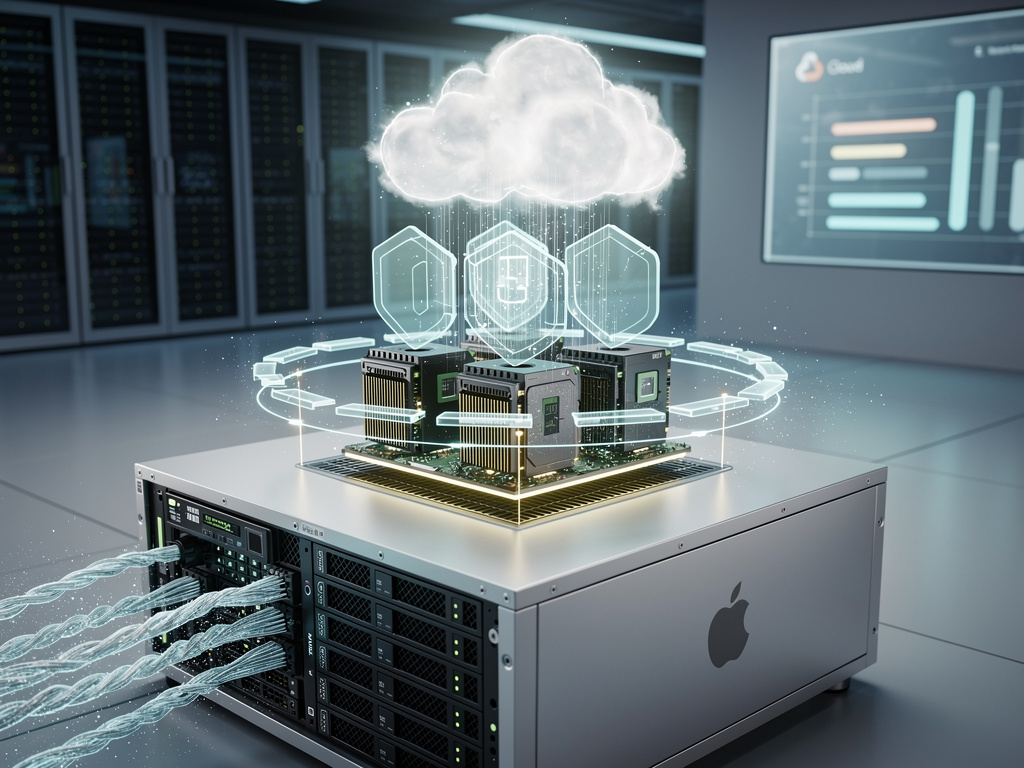
Apple once promised that its most advanced artificial intelligence features would stay locked inside its own silicon. That promise has quietly shifted. The company now plans to direct complex queries from its overhauled Siri to servers running Nvidia chips inside Google data centers. The change comes as Apple prepares one of the biggest updates to its voice assistant since its debut more than a decade ago.
Details surfaced Wednesday in reporting from The Information. According to people familiar with the matter, some user queries to the new version of Siri will run in Google Cloud on a licensed version of the search giant’s Gemini model. Apple recently approved the use of a privacy technology from Nvidia in that setting. The decision happened in recent weeks.
But. The arrangement preserves Apple’s branding. Queries routed this way will still fall under the umbrella of Private Cloud Compute. User data stays encrypted. Neither Google nor Nvidia can peek at the actual prompts or the models processing them. At least that’s the plan.
Nvidia’s confidential compute feature makes it work. The technology encrypts data and AI models while they run on the chip. Performance takes a small hit. Yet the added protection lets Apple maintain its long-standing privacy commitments. Craig Federighi had stressed in 2024 that any cloud processing for Apple Intelligence must happen on Apple servers for security reasons. Those statements came before the deeper Gemini partnership took shape.
Apple tried first to run a distilled version of Gemini on its own Private Cloud Compute infrastructure. The system relies on custom Apple silicon servers announced with fanfare at WWDC in 2024. It proved too slow. The full Gemini model carries trillions of parameters. Apple’s internal setup struggled to deliver responses at acceptable speeds. So the company turned outward.
Google Cloud’s fleet of Nvidia Blackwell B200 chips will now handle the load. These data-center processors arrived as the successor to the Hopper generation. They deliver dramatic gains in both training and inference for large language models. AppleInsider noted the shift, citing the same Information reporting, and highlighted how it raises fresh questions even as Apple continues to tout on-device capabilities for simpler tasks.
Privacy remains the central tension. When a prompt leaves an iPhone or iPad for the cloud under Private Cloud Compute, Apple has pledged that the data cannot be stored or used for training. Prompts stay ephemeral. The new Nvidia layer adds hardware-level encryption during processing. Apple will keep calling the service Private Cloud Compute. The label endures even if the hardware does not.
Industry watchers reacted quickly on X. One analyst observed that a company valued near $4 trillion had to rent compute for its flagship AI product. “The most vertically integrated company on earth just proved the AI moat is no longer the model,” the post read. “It is the chips and the cloud.” Others pointed out the mutual dependence. Google pays Apple roughly $20 billion a year to remain default search. Now Apple pays Google for AI muscle.
The revamped Siri is expected to launch in September. Apple will preview it at WWDC next week. The update aims to fix years of criticism that the assistant feels dated compared with newer chat-based interfaces. Features will blend on-device smarts for quick responses with cloud power for heavier reasoning. A distilled Gemini variant will run locally on supported devices. More demanding tasks head to the cloud.
This hybrid approach marks a pragmatic turn for a company famous for controlling every layer of its stack. Apple once invested heavily in its own AI servers. Rumors in 2025 even suggested purchases of Nvidia NVL72 racks for internal development. Yet when it came time to deliver a responsive, personalized Siri, the math favored outside help.
MacRumors reported that the Blackwell chips can speed inference significantly over prior options. The publication also noted the divergence from Apple’s usual insistence on owning critical ingredients. Exactly how the original Private Cloud Compute servers fit into the final architecture remains unclear. They may still handle some workloads. The Gemini-powered queries simply need more horsepower than Apple silicon alone could supply in time.
9to5Mac added further color days earlier. The site explained that Apple has been distilling Gemini into smaller models suitable for devices. The full version, however, demands the scale that only specialized cloud hardware provides. Nvidia’s confidential compute was the missing piece that let the deal move forward without compromising Apple’s privacy posture.
Security researchers and privacy advocates will examine the setup closely once technical details emerge. Apple’s original Private Cloud Compute white paper from 2024 described custom server nodes built on the same hardware security principles as iPhones. Secure Enclave technology, verified boot, and a locked-down OS all worked together to prevent even Apple engineers from accessing user data. The new cloud path must meet that same standard.
Executives have signaled confidence. Tim Cook has repeatedly said privacy will not bend for AI. The Nvidia encryption layer appears to give Apple enough assurance to proceed. Still, the reliance on a rival’s data centers and another rival’s chips underscores the brutal economics of frontier AI. Training and running models at this scale requires resources few companies can muster alone.
September’s launch will test whether users notice the difference. Faster, more contextual responses could silence critics who called early Apple Intelligence features underwhelming. If the system feels snappy and the privacy story holds, Apple may convert skeptics. Yet any perception that data travels beyond Apple’s direct control could invite backlash.
The move also highlights Nvidia’s commanding position. Even Apple, with its vast cash reserves and custom silicon expertise, leans on Nvidia’s data-center GPUs for this workload. Blackwell’s architecture targets exactly these large-model inference jobs. Demand for such chips shows no sign of slowing. Recent X discussions called the development further proof that AI compute remains a tight bottleneck.
Apple will continue pushing on-device processing wherever possible. Newer iPhones and Macs with more powerful neural engines can handle increasing portions of the workload locally. That reduces latency and keeps data inside the device. The cloud tier exists for the cases that still exceed on-device limits. The balance between the two will define the experience.
So the overhauled Siri represents both continuity and compromise. Continuity in Apple’s focus on privacy. Compromise in its choice of partners. The assistant that once struggled with basic commands now aims to reason across complex tasks. To get there, it borrows brains from Google and iron from Nvidia. The question is whether the finished product feels like Apple at its core or like a careful assembly of borrowed parts.


 WebProNews is an iEntry Publication