
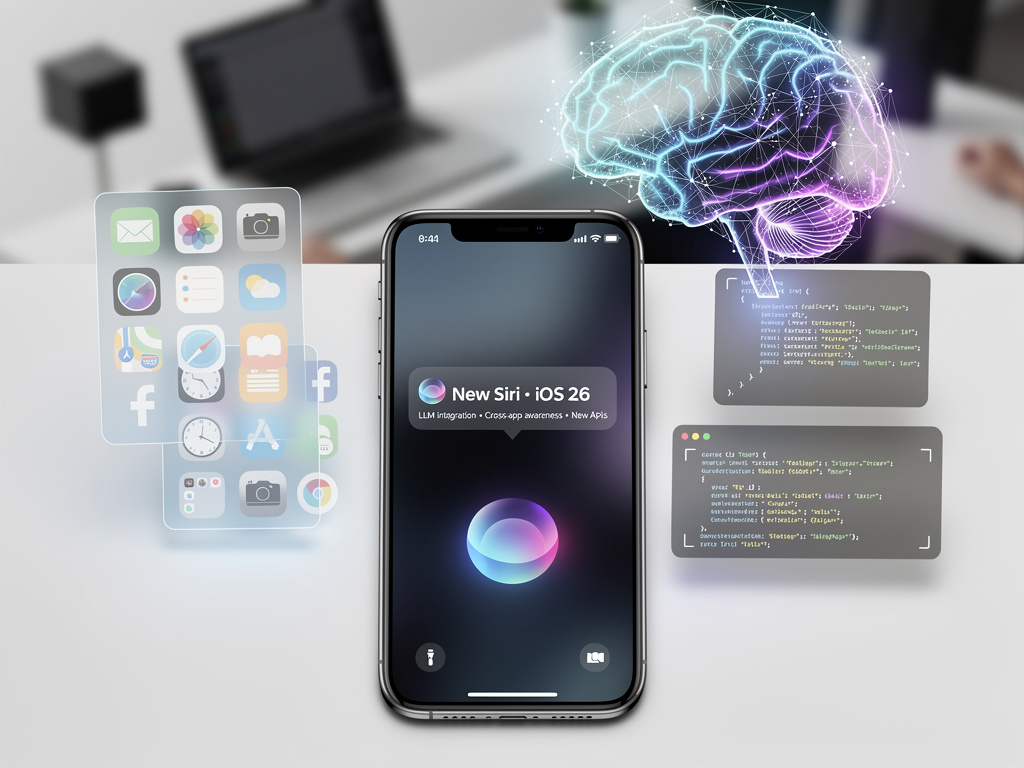
After more than a year of anticipation, delays, and mounting skepticism from industry watchers, Apple has officially confirmed that its dramatically revamped Siri assistant will launch alongside iOS 26 later this year. The announcement marks a pivotal moment for the Cupertino giant, which has faced sustained criticism for falling behind rivals Google and OpenAI in the race to deploy sophisticated artificial intelligence tools directly into consumer devices.
The confirmation, first reported by MacRumors, came during an internal briefing that was subsequently acknowledged by Apple in a statement to select media outlets. According to the report, the new Siri will feature deeply integrated large language model capabilities, contextual awareness across apps, and a fundamentally redesigned conversational interface that Apple executives have been teasing since the company’s Worldwide Developers Conference in 2025.
A Long Road From Promise to Product
Apple first unveiled its vision for an AI-powered Siri at WWDC 2024, when the company introduced Apple Intelligence as its umbrella branding for on-device and cloud-based AI features. At the time, executives including Craig Federighi and John Giannandrea painted an ambitious picture: Siri would evolve from a command-and-response utility into a genuine conversational assistant capable of understanding context, performing multi-step tasks across applications, and maintaining awareness of a user’s personal data without compromising privacy.
But the rollout proved far more difficult than Apple’s polished keynote suggested. Throughout 2024 and into 2025, the advanced Siri features were repeatedly delayed. Apple shipped incremental improvements — better natural language understanding, modest visual redesigns, and expanded Apple Intelligence features like writing tools and image generation — but the core promise of a truly intelligent, context-aware Siri remained unfulfilled. By late 2025, frustration among developers and consumers had reached a fever pitch, with some commentators openly questioning whether Apple could deliver on its AI ambitions at all.
What iOS 26 Siri Actually Promises
According to the details shared in the MacRumors report, the iOS 26 version of Siri represents a ground-up rebuild rather than an iterative update. The new assistant is said to leverage Apple’s proprietary large language models running both on-device and through the company’s Private Cloud Compute infrastructure, which Apple has positioned as its answer to privacy concerns surrounding cloud-based AI processing.
Key features reportedly include full app-level awareness, meaning Siri will be able to understand the content currently displayed on a user’s screen and take actions within third-party apps without requiring developers to build specific Siri integrations. This “ambient intelligence” approach would allow users to issue complex, multi-step commands — such as “find the restaurant my wife mentioned in our Messages conversation last week and make a reservation for Saturday” — and have Siri execute the entire chain of actions autonomously.
The Competitive Pressure That Forced Apple’s Hand
Apple’s urgency in finalizing the new Siri is not difficult to understand when viewed against the competitive dynamics of the AI assistant market. Google has aggressively integrated its Gemini AI models across Android, Search, and its productivity suite, offering capabilities that have made the existing Siri look antiquated by comparison. OpenAI’s ChatGPT, which Apple ironically integrated into its own devices as a stopgap measure in late 2024, has continued to expand its feature set and user base at a remarkable pace. Meanwhile, Samsung has deepened its partnership with Google to bring Galaxy AI features that rival or exceed what Apple offers on iPhone.
The pressure has shown up in Apple’s financial results as well. While iPhone sales have remained robust, the company’s services narrative — which depends in part on the perception that Apple’s ecosystem offers best-in-class software experiences — has been complicated by the widely acknowledged gap between Siri and its competitors. Wall Street analysts have increasingly pressed Apple CEO Tim Cook on AI strategy during earnings calls, and Cook has consistently pointed to a forthcoming Siri upgrade as the company’s answer.
Privacy as a Differentiator — Or a Constraint
One of the most closely watched aspects of Apple’s AI strategy is its insistence on privacy-first architecture. Unlike Google and OpenAI, which process the vast majority of AI queries in centralized data centers, Apple has invested heavily in a hybrid approach. Simple queries and on-device tasks are handled by smaller models running directly on Apple silicon, while more complex requests are routed to Apple’s Private Cloud Compute servers, which the company says are designed so that even Apple itself cannot access user data.
This approach has won praise from privacy advocates but has also raised questions about whether it imposes meaningful limitations on Siri’s capabilities. Running sophisticated AI models on-device requires significant computational resources, and even Apple’s latest A-series and M-series chips face constraints compared to the massive GPU clusters available in cloud data centers. Apple has argued that its custom silicon gives it a unique advantage in on-device AI performance, but independent benchmarks have shown that cloud-based competitors can handle more complex reasoning tasks with greater accuracy.
Developer Ecosystem Implications
Perhaps the most consequential element of the iOS 26 Siri launch is its potential impact on the developer ecosystem. Apple is reportedly introducing a new generation of SiriKit APIs — internally referred to as “Siri Intents 2.0” — that will dramatically expand the range of actions third-party apps can expose to the assistant. Under the current system, developers must explicitly define and code specific intents for Siri to understand. The new framework is said to allow Siri to infer available actions from an app’s interface and data structures, significantly reducing the integration burden on developers.
This shift could fundamentally alter how users interact with their iPhones. If Siri can reliably navigate and manipulate third-party apps without bespoke integrations, it would represent a paradigm shift comparable to the introduction of the App Store itself. Users could increasingly rely on voice and natural language as their primary interface, with traditional touch-based navigation becoming secondary for many tasks. For developers, this creates both opportunity and risk: apps that work well with the new Siri could see increased engagement, while those that don’t could find themselves marginalized.
Skepticism Remains Among Industry Veterans
Despite the official confirmation, not everyone in the technology industry is convinced that Apple will deliver a transformative experience at launch. Siri’s history is littered with ambitious promises that were scaled back or delayed. The original Siri, acquired by Apple in 2010 and launched with the iPhone 4S in 2011, was initially positioned as a revolutionary conversational interface but quickly became the subject of jokes about its limitations. Subsequent updates over more than a decade brought incremental improvements but never the fundamental leap that users and developers hoped for.
Industry analysts have noted that Apple’s track record with cloud-based services — from MobileMe to the rocky early days of iCloud — gives reason for caution. The new Siri’s reliance on Private Cloud Compute infrastructure means that Apple must execute flawlessly not just on the AI model side but also on the server infrastructure side, an area where the company has historically been less dominant than its cloud-native competitors like Google, Amazon, and Microsoft.
What the Timeline Looks Like From Here
If Apple follows its traditional schedule, iOS 26 will be previewed at WWDC in June 2026 and released to the public in September alongside new iPhone hardware. The MacRumors report suggests that Apple may provide early access to the new Siri capabilities to select developers as early as the first iOS 26 beta, a departure from past practice where Siri features were often among the last to be enabled in the beta cycle.
Apple is also said to be planning a dedicated marketing campaign around the new Siri, recognizing that the company needs to actively reshape public perception of its assistant. Internal documents reportedly describe the campaign as emphasizing real-world use cases rather than technical specifications, with a focus on demonstrating how the new Siri can save users time in their daily routines.
The Stakes for Apple Have Never Been Higher
The launch of the revamped Siri in iOS 26 is shaping up to be one of the most consequential product moments in Apple’s recent history. The company has spent billions of dollars on AI research and infrastructure, recruited top talent from across the industry, and staked its reputation on the promise that it can deliver world-class artificial intelligence while maintaining its commitment to user privacy. If the new Siri delivers on even a fraction of its promise, it could reinvigorate the iPhone experience and give Apple a credible answer to the AI capabilities offered by its competitors. If it falls short, the reputational damage could be significant — and the window for Apple to establish itself as an AI leader may narrow considerably.
For now, the technology world watches and waits. Apple has made its commitment clear. The question that remains is whether the company’s engineering prowess can finally match the ambition of its vision for what an intelligent assistant should be.


 WebProNews is an iEntry Publication