
Apple’s Silicon Pivot: The Strategic Implications of the M5’s Triple-Tier Architecture
For the past five years, Apple’s dominance in the semiconductor space has been predicated on a simple, effective bimodal philosophy: Performance cores (P-cores) for heavy lifting and Efficiency cores (E-cores) for background processes. This architecture allowed Cupertino to decouple itself from Intel’s stagnation and deliver battery life figures that competitors are still struggling to match. However, as the physics of transistor scaling becomes increasingly unforgiving at the 2-nanometer node, the bimodal strategy appears to be reaching its theoretical limit. A new report indicates that Apple is preparing to fundamentally alter this structure with the upcoming M5 generation by introducing a third tier of processing core, a move that signals a significant shift in how the company approaches power management and peak throughput.
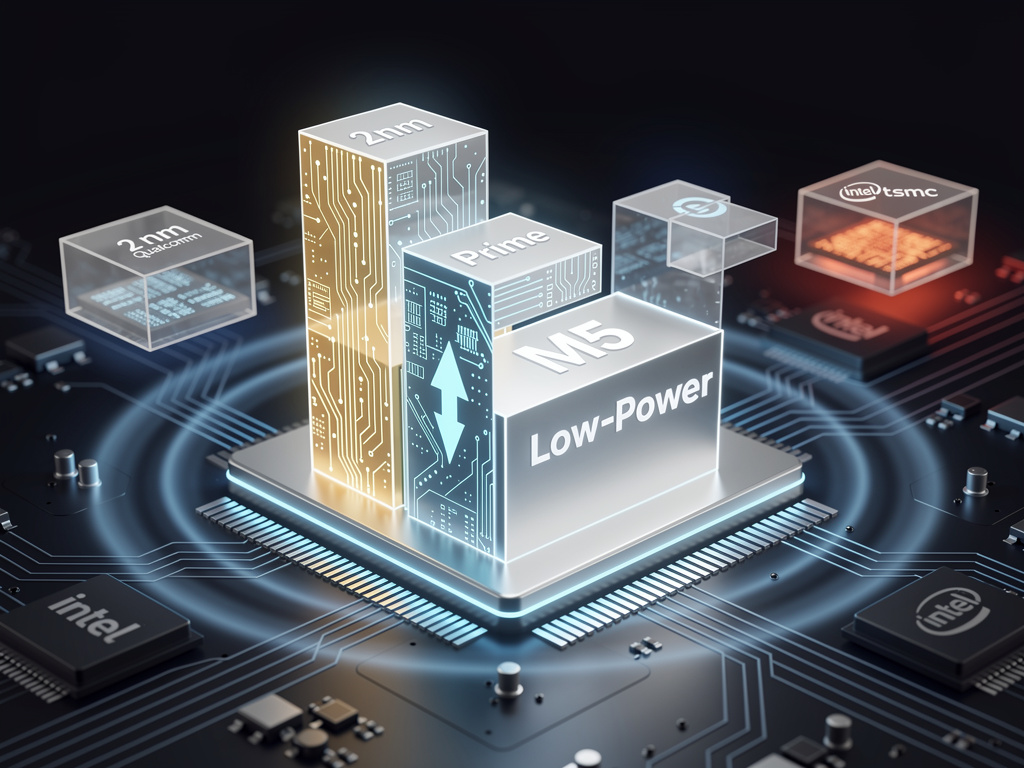
According to a technical analysis by 9to5Mac, the M5 series will likely debut a triple-hybrid architecture. While the specific nomenclature remains internal, the design mirrors the “Prime” core strategy utilized in ARM’s standard designs and recently adopted by rivals in the Windows sector. This development suggests that Apple is no longer content with merely shrinking existing designs; they are re-engineering the thread scheduler to accommodate a dedicated tier for burst performance—or conversely, ultra-low-power sensing—depending on the specific configuration.
The Physics of the 2nm Threshold
The timing of this architectural pivot correlates directly with the manufacturing realities at Taiwan Semiconductor Manufacturing Company (TSMC). The M5 is widely expected to be Apple’s volume debut on TSMC’s N2 (2nm) process node. While N2 offers density improvements, the cost per wafer has skyrocketed, and the power efficiency gains from node shrinking alone are diminishing compared to the jump from 5nm to 3nm. To extract better performance-per-watt, chip architects must rely more on logic design than lithography.
By introducing a third core type—potentially a “Prime” core clocked significantly higher with larger L1 and L2 caches—Apple can target single-threaded dominance without ruining the thermal envelope of the standard P-cores. As noted in recent supply chain reporting by Reuters, TSMC’s N2 process is on track for mass production in late 2025, aligning perfectly with the M5 timeline. The introduction of a third core tier allows Apple to mitigate the thermal density issues inherent in 2nm silicon by offloading tasks more granularly than a two-tier system permits.
Granularity and the Thread Scheduler
The success of a triple-tier architecture rests almost entirely on the operating system’s ability to direct traffic. macOS has spent years optimizing for a binary P/E distinction. Introducing a third variable requires a complete overhaul of the Grand Central Dispatch (GCD) and the kernel-level scheduler. If the third core is indeed a “Prime” core, the OS must instantly recognize user-facing, latency-sensitive threads—such as UI rendering or compiling code—and assign them to the Prime core, while relegating standard active tasks to P-cores and background daemons to E-cores.
Conversely, if the third tier is a “Low-Power Island” (LP-E) similar to Intel’s Lunar Lake architecture, the goal is to allow the main compute tile to power gate completely. A recent deep dive by AnandTech (archived reference) on competitor architectures highlights that the energy cost of waking up a high-performance compute cluster for trivial tasks like checking email or updating widgets is disproportionately high. An LP-E core residing on a separate voltage rail could handle these tasks, drastically extending standby battery life for MacBook users.
Competitive Pressure from the Windows Sector
Apple does not operate in a vacuum, and the gap between Apple Silicon and the rest of the industry has narrowed. Qualcomm’s Snapdragon X Elite and Intel’s Core Ultra series have adopted aggressive heterogeneous computing strategies. Qualcomm, utilizing the Oryon CPU, has already demonstrated that a dense configuration of high-performance cores can rival the M-series in multi-threaded workloads. To maintain its lead, Apple must innovate beyond core count.
A report from Bloomberg earlier this year highlighted Apple’s intent to overhaul the Mac line with AI-focused chips. While the Neural Engine handles matrix math, a specialized third CPU tier could be optimized for scalar AI operations that do not require the full NPU, bridging the gap between general-purpose compute and specialized machine learning tasks. This would allow the M5 to handle on-device LLM (Large Language Model) inference more efficiently than a standard P-core, which is often over-provisioned for such tasks.
Thermal Dynamics and Packaging
The introduction of a third core type also implicates the physical packaging of the chip. Apple has been exploring TSMC’s SoIC (System on Integrated Chips) 3D stacking technologies. A triple-tier design might involve disaggregating the chip, placing the ultra-low-power cores on the base die to handle I/O and always-on sensing, while stacking the Prime and Performance cores on top. This 3D arrangement would allow for independent voltage regulation, further reducing power leakage.
According to semiconductor analysis from Tom’s Hardware, the cost structures of 2nm manufacturing will force designers to be judicious with die area. A specialized “Prime” core takes up significant space. Therefore, we should expect the M5 to feature a conservative number of these new cores—perhaps only one or two—supported by a wider array of E-cores. This creates a pyramid structure rather than the balanced clusters seen in the M1 Pro or Max.
Implications for Professional Workflows
For the industry insider, the question is how this translates to enterprise and creative workflows. In applications like Logic Pro or Xcode, the main bottleneck is often the single fastest thread (the main audio thread or the linker). A Prime core effectively raises the ceiling for these serial bottlenecks. Meanwhile, for video editors using Final Cut Pro or DaVinci Resolve, the P-cores can continue to handle the parallelized rendering pipeline without being interrupted by system interrupts, which would be shunted to the new tertiary tier.
This specialization allows Apple to market the M5 not just on “performance per watt,” but on “responsiveness per watt.” The micro-stutters that occur when a heavy background task momentarily spikes a P-core could be eliminated if the scheduler strictly enforces tier discipline. This results in a computing experience that feels instantaneous, even under load, preserving the “fluid” feel that defines the platform.
The Road Ahead
The shift to a three-tier architecture in the M5 represents a maturity in Apple’s silicon design team. They are moving past the initial explosive gains of the switch from x86 to ARM and entering a phase of hyper-optimization. By acknowledging that not all active tasks require the same voltage and frequency curve, and by physically baking that distinction into the silicon, Apple is preparing the Macintosh for a future where thermal constraints and battery density are the primary limiting factors of mobile computing.


 WebProNews is an iEntry Publication