
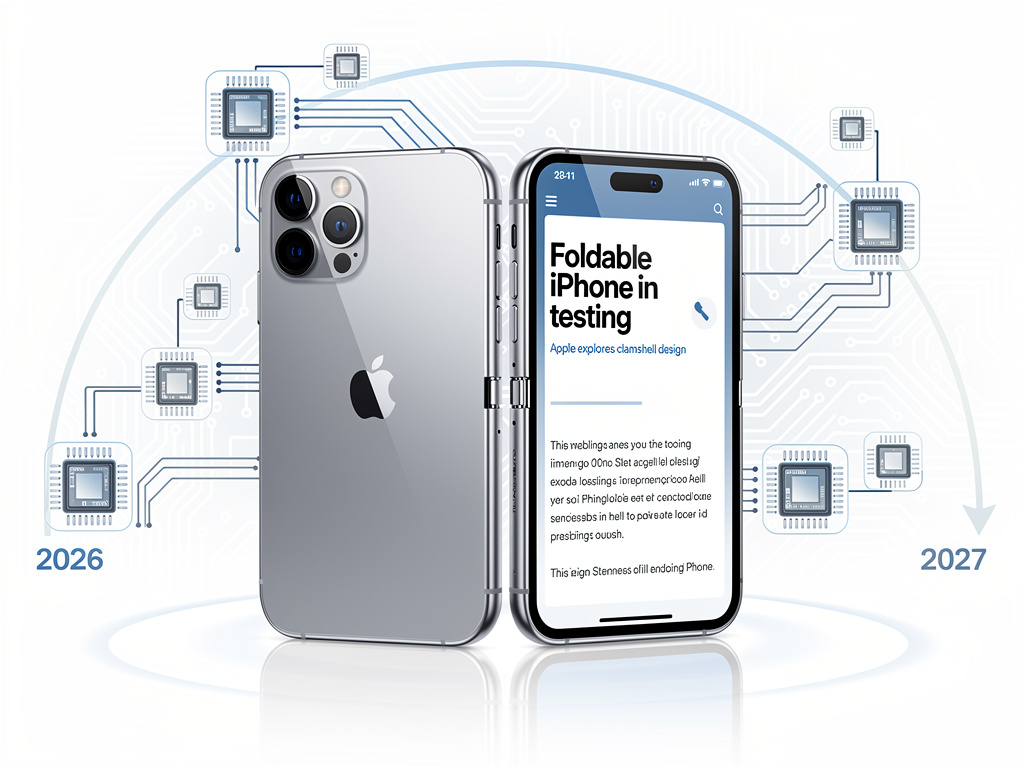
For years, Apple has watched from the sidelines as Samsung, Motorola, and a host of Chinese manufacturers have pushed foldable smartphones into the mainstream. Now, according to a growing chorus of credible leakers and supply chain analysts, Cupertino is no longer content to observe. Apple is actively testing a clamshell-style foldable iPhone — a device that would fold vertically like the iconic Motorola Razr — and the implications for the smartphone industry could be enormous.
The latest intelligence comes from a leaker known as “Jukanlosreve” on the social media platform X, who claims that Apple is currently testing a flip-phone-style foldable iPhone. As reported by AppleInsider, this clamshell form factor would represent Apple’s entry into a product category that rivals have been refining for nearly half a decade. The leaker’s claims have sent ripples through the Apple analyst community, adding yet another data point to what has become one of the most closely watched product development stories in consumer technology.
Why Clamshell? Apple’s Strategic Calculus
The decision to pursue a clamshell design rather than — or perhaps in addition to — a book-style foldable reveals much about Apple’s strategic thinking. Clamshell foldables, which fold a standard-sized phone screen in half to create a more compact device, have proven to be the more commercially successful form factor globally. Samsung’s Galaxy Z Flip series has consistently outsold its larger Galaxy Z Fold counterpart, and Motorola’s revived Razr line has carved out a meaningful niche, particularly in markets where consumers prize portability and fashion-forward design.
Apple’s interest in the clamshell form factor also aligns with the company’s longstanding design philosophy of creating devices that are thin, light, and pocketable. A foldable iPhone that collapses to roughly half its unfolded size would address one of the persistent complaints about modern smartphones: they’ve simply gotten too large. The iPhone 16 Pro Max, for instance, features a 6.9-inch display — a size that many users find unwieldy, particularly when trying to slip the device into a pocket or small handbag.
Corroborating the Claims: A Web of Supply Chain Evidence
While individual leaker claims should always be treated with appropriate skepticism, the clamshell foldable iPhone report does not exist in isolation. Over the past 18 months, a substantial body of evidence has accumulated suggesting that Apple is deep into foldable device development. Ming-Chi Kuo, the well-known Apple supply chain analyst at TF International Securities, has repeatedly indicated that Apple has been working on foldable devices and has been in discussions with multiple display suppliers, including Samsung Display and LG Display, about sourcing flexible OLED panels.
According to AppleInsider, the leaker Jukanlosreve has a somewhat limited but growing track record, having previously shared details about Apple products that later proved accurate. The publication noted that while this particular source doesn’t carry the same weight as established analysts like Kuo or Bloomberg’s Mark Gurman, the claim is consistent with the broader trajectory of Apple’s foldable ambitions. Gurman himself has reported extensively on Apple’s foldable plans, noting that the company has been developing multiple foldable prototypes internally for years.
The Technical Challenges Apple Must Solve
Building a foldable iPhone is not simply a matter of bending an existing display in half. Apple faces a series of formidable engineering challenges that help explain why the company has taken a characteristically deliberate approach to entering this category. The most visible challenge is the crease — the visible fold line that mars the displays of virtually every foldable phone currently on the market. Apple, a company that obsesses over surface finishes and visual perfection, would almost certainly refuse to ship a product with a prominent crease.
Display durability represents another critical hurdle. Early foldable phones from Samsung and other manufacturers suffered from screen failures, debris ingress at the hinge point, and ultra-thin glass covers that scratched easily. Apple would need to ensure that its foldable iPhone meets the durability standards that customers expect from an iPhone — a device that many consumers use without a case and expect to last for years. Recent advances in ultra-thin glass technology from suppliers like Corning and Schott have made this more achievable, but the engineering tolerances remain extraordinarily tight.
The Hinge: Where Industrial Design Meets Mechanical Engineering
Perhaps no single component of a foldable phone is more critical — or more difficult to perfect — than the hinge mechanism. Apple has filed numerous patents related to foldable device hinges over the past several years, describing mechanisms that would allow for smooth folding action while maintaining structural rigidity when the device is open. Samsung’s waterdrop hinge design, now in its sixth generation in the Galaxy Z Flip 6, has significantly reduced the crease problem and improved durability, setting a high bar that Apple will need to match or exceed.
The hinge also has profound implications for the device’s thickness when folded. One of the persistent criticisms of clamshell foldables is that they are noticeably thicker than traditional smartphones when closed, which can negate some of the portability advantages. Apple’s relentless pursuit of thinness — most recently demonstrated by the remarkably slim iPad Pro with M4 chip — suggests the company will invest heavily in minimizing the folded profile of any clamshell iPhone.
Software and the iOS Ecosystem Question
Hardware is only part of the equation. A foldable iPhone would require significant adaptations to iOS, particularly around how apps respond to the folding and unfolding of the display. Apple would need to create new developer APIs and interface guidelines to ensure that the hundreds of thousands of apps in the App Store function gracefully on a foldable screen. The cover display — the small external screen that clamshell foldables typically feature for notifications and quick interactions — would require its own software experience, potentially drawing on Apple’s expertise with the Apple Watch interface and Dynamic Island.
Apple’s tight integration of hardware and software has historically been one of its greatest competitive advantages, and a foldable iPhone would put that integration to the test. Samsung has spent years refining Flex Mode and other software features for its foldable devices, and even now, third-party app support on Android foldables remains inconsistent. Apple’s control over both iOS and the App Store gives it a potential advantage in ensuring a polished software experience from day one, but the scope of the required changes should not be underestimated.
Competitive Dynamics and Market Timing
Apple’s entry into the foldable market would arrive at a pivotal moment for the category. Chinese manufacturers including Huawei, Oppo, Vivo, and Honor have dramatically intensified competition, producing foldable devices that are thinner, lighter, and more affordable than their Samsung counterparts. Huawei’s Mate X5 and Honor’s Magic V3 have pushed the boundaries of what’s possible in foldable design, with the Magic V3 measuring just 9.2mm thick when folded — barely thicker than a conventional smartphone.
This intensifying competition has put pressure on pricing and raised consumer expectations. By the time Apple brings a foldable iPhone to market — which most analysts expect could happen in 2026 or 2027 — the company will be entering a category where rivals have had seven or more years of iteration. However, Apple has a long history of entering established product categories late and redefining them. The company was not first to market with an MP3 player, a smartphone, a tablet, or a smartwatch, yet it came to dominate each of those categories by delivering a superior user experience.
What a Foldable iPhone Means for Apple’s Product Roadmap
The testing of a clamshell foldable iPhone also raises intriguing questions about Apple’s broader product roadmap. If Apple is indeed pursuing a flip-style device, it could potentially coexist with the rumored foldable iPad or book-style foldable that has also been the subject of persistent speculation. A clamshell iPhone would serve a different market need than a larger foldable device — prioritizing compactness and everyday carry convenience over expanded screen real estate for productivity.
There is also the question of pricing. Current clamshell foldables from Samsung and Motorola range from roughly $700 to $1,100, while book-style foldables command $1,400 to $1,800 or more. A foldable iPhone would almost certainly carry a premium over the standard iPhone lineup, potentially creating a new ultra-premium tier above even the iPhone Pro Max. For Apple, which has been seeking new avenues for revenue growth as the smartphone market matures, a foldable iPhone could represent a significant average selling price boost.
The Road Ahead: From Prototype to Product
It is important to note that testing a prototype and shipping a finished product are very different things. Apple is known to develop and test devices that never see the light of day. The company reportedly built functional prototypes of a television set and multiple other products that were ultimately shelved. The fact that Apple is testing a clamshell foldable iPhone is encouraging for those eagerly awaiting such a device, but it is not a guarantee that one will reach consumers.
Nevertheless, the convergence of supply chain reports, patent filings, analyst predictions, and now direct leaker claims paints a compelling picture: Apple is serious about foldable technology, and the clamshell iPhone appears to be a leading candidate for the company’s first foldable product. For an industry that has been waiting years for Apple to make its move, the wait may finally be nearing its end. When Apple does enter the foldable arena, the reverberations will be felt not just in Cupertino, but across every smartphone maker’s product planning office in Seoul, Shenzhen, and beyond.


 WebProNews is an iEntry Publication