
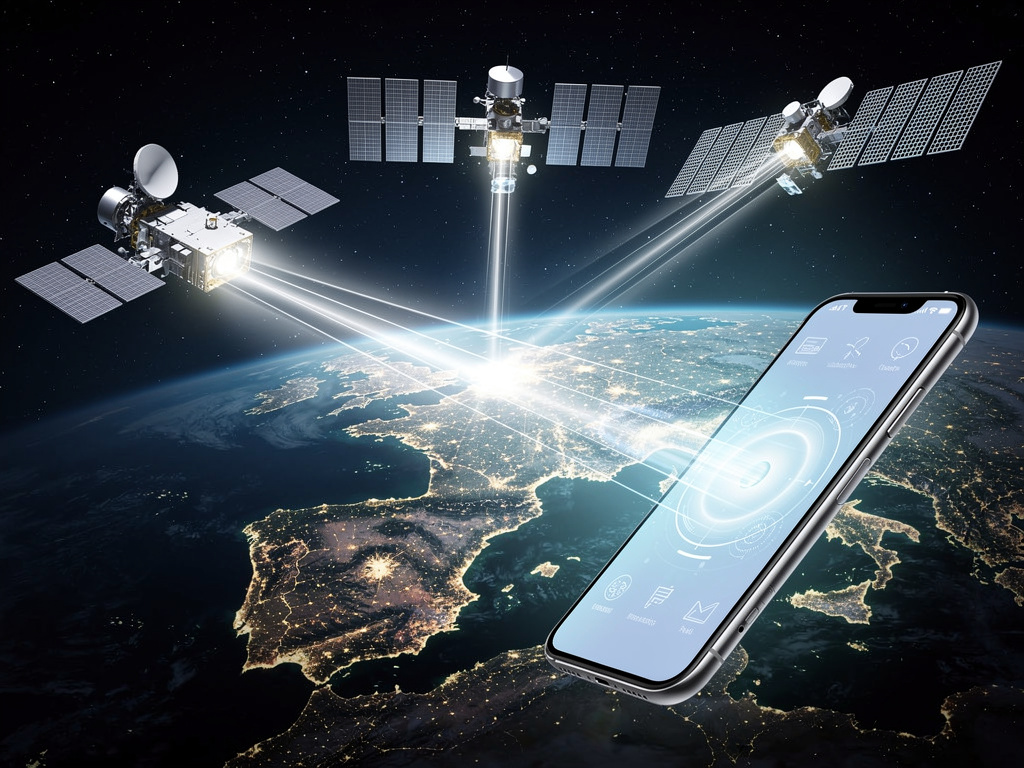
Apple Inc. has spent years quietly building the infrastructure for what may become one of the most consequential shifts in smartphone connectivity since the introduction of 4G LTE. With the iPhone 18 Pro, expected in late 2026, the company appears poised to dramatically expand its satellite communication capabilities — moving well beyond emergency SOS features into territory that could fundamentally alter how consumers and enterprises think about cellular dead zones.
According to a report from Digital Trends, the iPhone 18 Pro is expected to feature Qualcomm’s Snapdragon X85 modem, a next-generation chip that promises significantly enhanced satellite connectivity. The X85 modem supports non-terrestrial network (NTN) capabilities that go far beyond the rudimentary text-based emergency messaging Apple first introduced with the iPhone 14 in 2022. Industry analysts believe this upgrade could enable voice calls over satellite, broadband-like data transmission, and seamless integration with terrestrial cellular networks — a leap that would position Apple at the vanguard of a rapidly evolving sector.
From Emergency SOS to Everyday Connectivity
Apple’s satellite journey began modestly. When the iPhone 14 launched with Emergency SOS via satellite, powered by Globalstar’s constellation, it was a narrowly scoped feature: users in distress could send compressed text messages to emergency services when no cellular or Wi-Fi signal was available. The feature required pointing the phone at a satellite, following on-screen prompts, and waiting for a connection that could take anywhere from 15 seconds to several minutes depending on conditions. It was, by design, a last resort.
With each subsequent iPhone generation, Apple has incrementally expanded what satellite connectivity can do. The iPhone 15 brought roadside assistance via satellite. The iPhone 16 introduced the ability to send and receive iMessages and SMS over satellite through a partnership that leverages Globalstar’s expanded Band n53 spectrum. Apple even invested $1.5 billion in Globalstar to help the satellite operator acquire new satellites and ground infrastructure — a bet that signaled the company’s long-term commitment to the technology.
The Qualcomm X85 Modem: A Technical Inflection Point
The Snapdragon X85 modem represents a meaningful technical leap. Qualcomm has been aggressively developing its NTN capabilities, and the X85 is expected to support 5G NTN standards defined by 3GPP in Release 17 and beyond. These standards enable direct-to-device satellite communication using existing cellular protocols, which means smartphones can connect to satellites without requiring specialized hardware or bulky antennas. The modem is designed to support both low-earth orbit (LEO) and geostationary (GEO) satellite systems, giving Apple flexibility in choosing constellation partners.
As Digital Trends noted, the X85’s enhanced satellite capabilities could enable data speeds sufficient for voice over satellite calls and potentially even low-bandwidth video communication. This is a significant departure from the current paradigm, where satellite features on smartphones are essentially limited to short text exchanges. For hikers, mariners, remote workers, and the hundreds of millions of people globally who live outside reliable cellular coverage, the implications are profound.
A Crowded Field of Competitors Is Closing In
Apple is not operating in a vacuum. The race to bring satellite connectivity to consumer smartphones has attracted some of the most formidable names in technology and telecommunications. T-Mobile and SpaceX have been conducting trials of their direct-to-cell Starlink service, which aims to provide text, voice, and eventually data connectivity to existing T-Mobile smartphones via SpaceX’s massive LEO constellation. The service began beta testing in early 2025, and T-Mobile has indicated that broader availability is expected later this year.
Meanwhile, AST SpaceMobile has been testing its BlueBird satellites, which are designed to connect directly to unmodified smartphones across multiple carrier networks. The company has agreements with AT&T, Verizon, and several international operators. Qualcomm itself has partnered with Iridium on a satellite messaging service called Snapdragon Satellite, though adoption has been limited so far. Samsung has also begun integrating satellite SOS features into its Galaxy S series, and Google has added satellite SOS support to its Pixel 9 lineup. The competitive pressure on Apple to stay ahead — or at least keep pace — is intense.
Apple’s Globalstar Investment Pays Strategic Dividends
What distinguishes Apple’s approach is the depth of its vertical integration. The $1.5 billion investment in Globalstar was not merely a financial transaction; it was a strategic maneuver to secure dedicated satellite capacity and influence the development of ground infrastructure. Globalstar has used the funds to commission new satellites from MDA Ltd. and to expand its ground station network, ensuring lower latency and higher throughput for Apple’s services. This level of supply chain control is characteristic of Apple’s broader strategy — the company prefers to own or deeply influence the critical components of its ecosystem rather than rely on third-party services that competitors can also access.
This approach has trade-offs. By tying itself closely to Globalstar, Apple is betting on a specific constellation architecture and orbital configuration. If SpaceX’s Starlink or AST SpaceMobile’s technology proves dramatically superior in coverage or bandwidth, Apple could find itself at a disadvantage. However, the 3GPP standardization of NTN protocols provides a degree of interoperability that could allow Apple to work with multiple satellite operators in the future, mitigating some of this risk.
Revenue Models and the Business Case for Satellite
The business implications extend well beyond hardware differentiation. Apple currently offers satellite SOS as a free feature, bundled with iPhone ownership — a strategy that serves as a powerful marketing tool and potential lifesaver but generates no direct revenue. As capabilities expand to include voice calls, messaging, and data, Apple will face decisions about monetization. The company could bundle satellite connectivity into Apple One subscriptions, offer it as a standalone service tier, or negotiate revenue-sharing arrangements with carriers.
Wall Street analysts have begun modeling the potential revenue impact. If Apple charges even a modest monthly fee — say $5 to $10 — for enhanced satellite services, the installed base of hundreds of millions of iPhones could generate billions in recurring revenue. Morgan Stanley analysts have previously estimated that Apple’s satellite initiatives could contribute meaningfully to the company’s services revenue segment, which has become an increasingly important growth driver as hardware sales mature in developed markets.
Regulatory and Technical Hurdles Remain
Despite the optimism, significant challenges lie ahead. Satellite-to-smartphone communication operates in spectrum bands that are subject to complex international regulatory frameworks. Coordination between terrestrial mobile operators and satellite providers is necessary to avoid interference, and regulatory approval must be obtained on a country-by-country basis. The Federal Communications Commission in the United States has been broadly supportive of direct-to-device satellite services, granting experimental licenses and encouraging industry collaboration. But the regulatory picture in Europe, Asia, and other regions is more fragmented.
There are also fundamental physics constraints. LEO satellites move rapidly relative to the Earth’s surface, requiring sophisticated handoff protocols to maintain connections. Signal strength from satellites is inherently weaker than from terrestrial cell towers, which means that indoor coverage will remain limited and data speeds, while improved, will not rival 5G or even 4G LTE for the foreseeable future. Apple will need to manage consumer expectations carefully to avoid the kind of backlash that accompanied early 5G marketing, where promised speeds often failed to materialize in real-world conditions.
What the iPhone 18 Pro Signals About Apple’s Longer-Term Vision
The iPhone 18 Pro’s expected satellite upgrades are best understood not as a single product feature but as a chapter in a longer strategic narrative. Apple has historically introduced technologies in constrained form before expanding them over multiple product generations — Touch ID, Face ID, the Neural Engine, and the Ultra Wideband chip all followed this pattern. Satellite connectivity appears to be on the same trajectory: introduced as emergency-only, gradually expanded to messaging, and now potentially moving toward voice and data.
Looking further ahead, industry observers speculate that Apple could eventually integrate satellite connectivity into its full product lineup, including the Apple Watch, iPad, and even MacBook. A world in which every Apple device can maintain some level of connectivity regardless of terrestrial infrastructure would represent a powerful ecosystem advantage — one that could prove particularly valuable in emerging markets where cellular coverage remains spotty and in enterprise applications such as logistics, agriculture, and disaster response.
For now, the iPhone 18 Pro and its Snapdragon X85 modem represent the next concrete step in this evolution. Whether Apple can execute on the promise of ubiquitous satellite connectivity — and whether consumers will pay for it — remains to be seen. But the pieces are falling into place for what could be the most significant expansion of iPhone capabilities in years, one that extends Apple’s reach quite literally beyond the boundaries of Earth-bound infrastructure.


 WebProNews is an iEntry Publication