
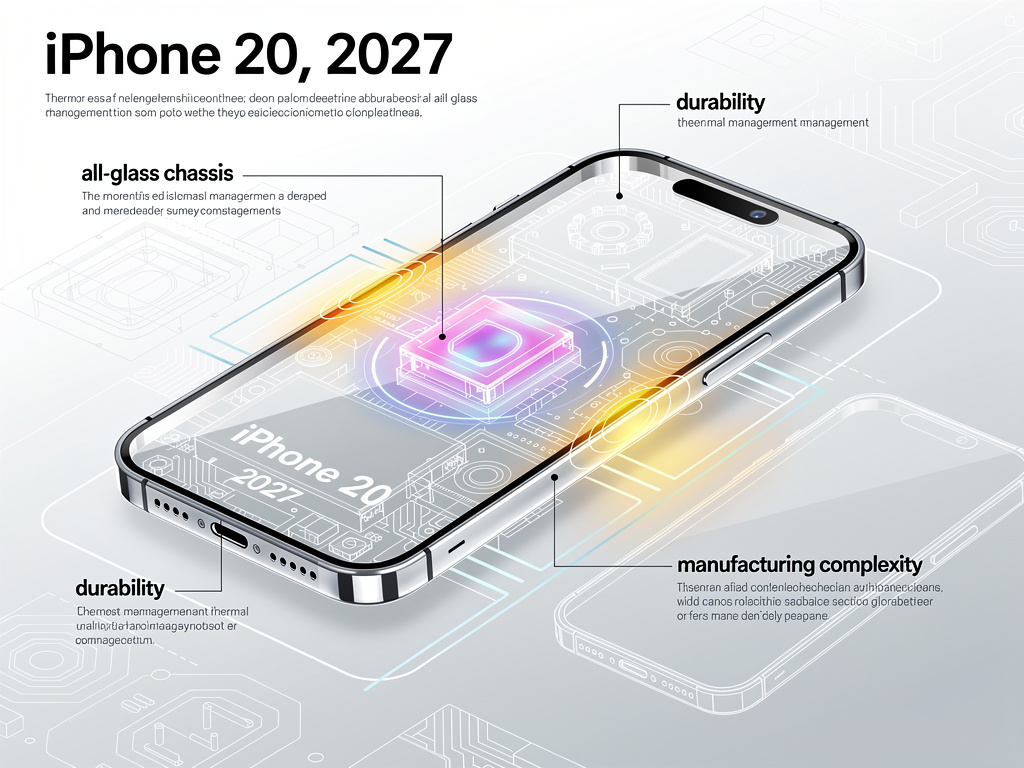
Apple is reportedly developing its most ambitious iPhone redesign in the device’s history, targeting a 2027 release for what industry insiders are calling the iPhone 20. According to recent reports, the tech giant is working on an all-glass enclosure that would eliminate the traditional aluminum or titanium frame entirely, marking a dramatic departure from smartphone design conventions that have dominated the industry for nearly two decades.
The project represents a significant technological gamble for Apple, which has historically balanced innovation with manufacturing practicality. TechRepublic reports that the all-glass design would wrap around the entire device, creating a seamless aesthetic that could fundamentally change how consumers interact with their smartphones. This initiative comes as Apple faces mounting pressure to differentiate its flagship product in an increasingly saturated premium smartphone market where incremental improvements have become the norm rather than revolutionary changes.
Industry analysts suggest this move could be Apple’s response to declining smartphone sales growth globally and the need to justify premium pricing in markets where consumers are holding onto devices longer than ever before. The all-glass iPhone would need to overcome significant engineering challenges, including durability concerns, wireless charging efficiency, and heat dissipation—issues that have plagued previous attempts at extensive glass implementations in mobile devices.
Engineering Challenges That Could Make or Break the All-Glass Revolution
The technical hurdles facing Apple’s engineering teams are substantial and multifaceted. Glass, while aesthetically appealing and excellent for wireless signal transmission, presents inherent structural weaknesses compared to metal frames. Current iPhone models use glass only for the front and back panels, with metal frames providing crucial structural integrity and impact resistance. An all-glass design would require revolutionary advances in materials science, potentially involving chemically strengthened glass far superior to the Ceramic Shield currently used on iPhone displays.
Thermal management represents another critical challenge. Metal frames in current smartphones serve as heat sinks, dissipating warmth generated by increasingly powerful processors. Without metal components, Apple would need to develop alternative cooling solutions that don’t compromise the device’s slim profile or battery life. This could involve advanced vapor chamber technology or entirely new thermal management systems that haven’t yet been deployed in consumer electronics at scale.
Market Positioning and the Premium Smartphone Segment
Apple’s pursuit of an all-glass design reflects broader strategic considerations beyond mere aesthetics. The company has consistently positioned itself at the premium end of the smartphone market, where design differentiation commands significant pricing power. With competitors like Samsung, Google, and Chinese manufacturers closing the technology gap in areas like camera quality and processing power, Apple needs distinctive features that justify its premium pricing structure.
The timing of a 2027 release aligns with Apple’s typical development cycles, which span multiple years for major design overhauls. This timeline also suggests the company is betting on significant advances in materials science and manufacturing techniques that may not yet be commercially viable. Industry sources indicate that Apple has been working with specialty glass manufacturers and materials science laboratories to develop proprietary glass formulations that could withstand the rigors of daily smartphone use while maintaining the pristine appearance consumers expect from Apple products.
Supply Chain Implications and Manufacturing Complexity
The manufacturing challenges associated with an all-glass iPhone cannot be overstated. Apple’s current supply chain, which produces hundreds of millions of iPhones annually, is optimized for devices with metal frames and glass panels. Transitioning to all-glass construction would require substantial retooling of manufacturing facilities, new quality control processes, and potentially entirely new assembly techniques. The precision required to create seamless glass enclosures at scale, while maintaining Apple’s exacting quality standards, represents a manufacturing challenge of unprecedented complexity in the smartphone industry.
Yield rates—the percentage of manufactured units that meet quality standards—could initially be significantly lower than current iPhone production, potentially impacting availability and pricing. Apple has historically been willing to accept lower initial yields for new technologies, as evidenced by the introduction of Face ID and the transition to OLED displays, but an all-glass design might push those tolerances to new limits. The company would likely need to secure multiple suppliers for specialized glass components, diversifying risk but also increasing coordination complexity across its global supply chain.
Durability Concerns and Consumer Acceptance
Perhaps the most significant hurdle facing an all-glass iPhone is consumer perception of durability. Despite advances in glass technology, smartphones with extensive glass surfaces remain vulnerable to drops and impacts. AppleCare+ and similar protection plans have become increasingly popular as iPhone repair costs have risen, but a device perceived as fragile could face consumer resistance regardless of its aesthetic appeal. Apple would need to demonstrate that its all-glass design can withstand real-world usage scenarios without requiring users to encase their expensive devices in protective covers that obscure the very design they paid premium prices to obtain.
The company’s track record with glass durability has been mixed. While Ceramic Shield technology introduced with the iPhone 12 represented a genuine improvement in drop protection, iPhones with glass backs remain susceptible to damage. An all-glass design would need to represent a quantum leap in durability, not merely incremental improvement. This might involve layered glass construction, embedded reinforcement materials, or entirely new composite materials that combine glass’s aesthetic properties with superior impact resistance.
Wireless Technology Advantages and 5G Evolution
One significant advantage of all-glass construction relates to wireless technology performance. Metal frames, while structurally sound, can interfere with radio frequency signals, requiring careful antenna design and placement. An all-glass enclosure would theoretically allow for superior wireless performance across multiple bands, potentially improving 5G connectivity, Wi-Fi performance, and future wireless technologies that may emerge by 2027. This could be particularly important as telecommunications networks continue evolving and bandwidth demands increase with applications like augmented reality and high-definition video streaming.
Apple has invested heavily in custom silicon and wireless technology development, including its own modem chips expected to debut in coming years. An all-glass iPhone could be optimized to work seamlessly with these proprietary technologies, creating performance advantages that competitors using off-the-shelf components and conventional designs couldn’t easily replicate. The elimination of metal components could also facilitate more sophisticated wireless charging implementations, potentially supporting higher power levels or more flexible charging orientations.
Environmental Considerations and Sustainability Messaging
Apple has increasingly emphasized environmental sustainability in its product development and marketing. An all-glass iPhone could align with these initiatives if designed for recyclability and manufactured using environmentally responsible processes. Glass is infinitely recyclable without loss of quality, unlike many plastics and composite materials. However, the energy required to produce and process specialty glass, combined with potential durability issues leading to more frequent replacements, could complicate the environmental calculus.
The company would need to carefully balance sustainability messaging with the realities of producing a device that might be more fragile than its predecessors. Apple’s recent commitments to carbon neutrality and increased use of recycled materials in its products suggest that any all-glass iPhone would need to demonstrate clear environmental benefits or at least neutrality compared to current designs. This might involve using recycled glass in the enclosure, developing repair programs that extend device lifespan, or implementing take-back programs that ensure old devices are properly recycled.
Competitive Response and Industry Implications
If Apple successfully brings an all-glass iPhone to market, the competitive response from other smartphone manufacturers would likely be swift. Samsung, which has its own extensive glass manufacturing capabilities through subsidiaries, could potentially follow with similar designs. Chinese manufacturers, known for rapidly adopting and iterating on design trends, might attempt their own interpretations of all-glass construction. However, Apple’s control over both hardware and software, combined with its manufacturing expertise and supply chain relationships, could provide a sustainable competitive advantage even if the basic design concept is copied.
The broader implications for the smartphone industry could be profound. An all-glass iPhone that achieves commercial success would validate a new design direction, potentially influencing product development across the consumer electronics sector. Conversely, if the design proves problematic—whether due to durability issues, manufacturing challenges, or consumer rejection—it could reinforce conservative design approaches and incremental innovation that currently characterize much of the industry. The stakes extend beyond Apple’s product lineup to influence the direction of smartphone evolution for years to come, affecting everything from materials science research to manufacturing technology development and supply chain strategies across the global electronics industry.


 WebProNews is an iEntry Publication