
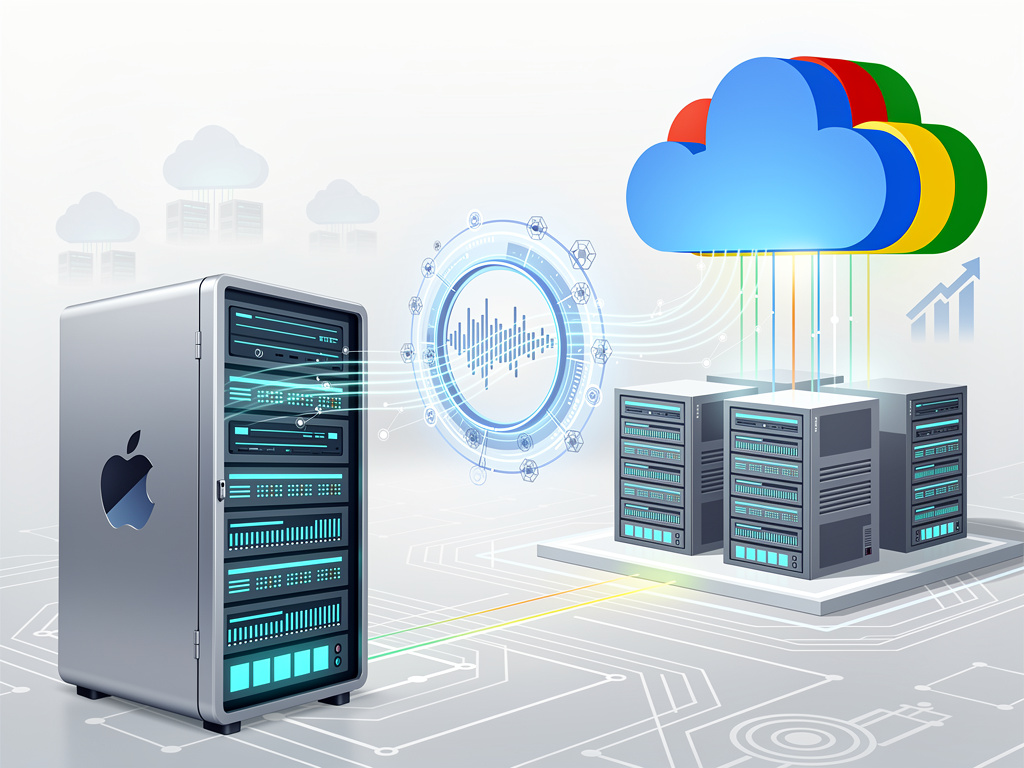
Apple Inc. has been in discussions with Google about hosting key components of a revamped Siri on Google’s cloud infrastructure, a striking acknowledgment that the iPhone maker’s own data centers may not be sufficient to support the artificial intelligence ambitions it has staked its future on. The talks, first reported by The Information, signal a dramatic expansion of an already complex relationship between two of Silicon Valley’s most powerful companies — and raise pointed questions about Apple’s ability to compete independently in the AI race.
According to the report, Apple has explored the possibility of running parts of its next-generation Siri — internally referred to as “LLM Siri” because it is powered by large language models — on Google Cloud Platform servers. The discussions are ongoing and no final agreement has been reached, but the mere existence of such conversations underscores a growing reality: Apple needs outside help to deliver on the AI promises it made to consumers at last year’s Worldwide Developers Conference.
A Company Built on Control Now Faces the Limits of Self-Reliance
For decades, Apple has defined itself by vertical integration. It designs its own chips, builds its own operating systems, and manufactures its own devices in a tightly controlled supply chain. That philosophy extended to its data centers, where Apple has invested billions to support iCloud, Apple Music, the App Store, and other services. But the computational demands of generative AI are of a different magnitude entirely. Training and running large language models requires massive clusters of specialized processors — typically Nvidia’s graphics processing units — and the cooling, networking, and storage infrastructure to support them.
Apple currently relies on a mix of its own data centers and third-party cloud providers, including Amazon Web Services and Google Cloud, for various backend services. But the company’s Private Cloud Compute initiative, announced in 2024, was supposed to represent a new chapter: Apple-designed servers running Apple silicon, processing AI requests in a privacy-preserving environment where even Apple itself could not access user data. The problem, as The Information detailed, is that Apple’s own server capacity appears insufficient for the scale of what it wants to do with the new Siri.
The Google Relationship: Competitor, Partner, and Now Potential Landlord
The Apple-Google relationship is already one of the most financially significant partnerships in technology. Google pays Apple an estimated $20 billion per year to remain the default search engine on Safari, a deal that has come under antitrust scrutiny from the U.S. Department of Justice. Adding a cloud hosting arrangement on top of that payment would deepen the entanglement between the two companies at a moment when regulators are already watching closely.
Google Cloud, led by Thomas Kurian, has been aggressively courting enterprise and technology clients as it seeks to narrow the gap with AWS and Microsoft Azure. Landing Apple as a major AI workload customer would represent a significant win for Google’s cloud division, which reported $11.4 billion in revenue in the first quarter of 2025. For Apple, Google’s infrastructure offers not just raw computing power but also proximity to Google’s own AI research — though Apple would presumably want to keep its proprietary models and user data strictly separated from anything Google could access.
Siri’s Long Decline and Apple’s Belated AI Awakening
The urgency behind these discussions is rooted in Siri’s well-documented struggles. When Apple introduced Siri in 2011, it was the first major voice assistant on a smartphone, predating Google Assistant and Amazon’s Alexa by years. But Apple failed to keep pace. Internal disagreements about Siri’s architecture, leadership turnover on the AI teams, and the company’s intense focus on on-device processing over cloud-based intelligence all contributed to Siri falling behind its rivals in capability and reliability.
Apple attempted a course correction at WWDC 2024, when it announced Apple Intelligence — a broad set of AI features spanning text generation, image creation, notification summarization, and a significantly upgraded Siri capable of understanding context across apps and performing multi-step tasks. But the rollout has been slower than expected. Many of the most ambitious Siri features, including the ability to take actions within third-party apps, have been delayed. Reports from Bloomberg noted that some of the most anticipated capabilities would not arrive until 2025 or later, frustrating users who had expected a more immediate transformation.
Private Cloud Compute and the Privacy Tightrope
One of the most delicate aspects of any deal with Google involves privacy. Apple has built its brand in recent years around the promise that it handles user data more carefully than its competitors. The Private Cloud Compute system was designed specifically to extend that promise to cloud-based AI processing. Apple’s custom servers, running on Apple silicon, were engineered so that user data sent for AI processing would be encrypted in transit and at rest, processed in a secure enclave, and never retained or accessible to Apple employees.
If portions of the new Siri run on Google’s infrastructure instead, Apple would need to ensure that the same privacy guarantees hold. This is technically feasible — cloud providers routinely offer confidential computing environments where even the host cannot inspect the data being processed — but it adds complexity and introduces a trust dependency that Apple has historically been reluctant to accept. Any perception that user queries to Siri might be visible to Google, however unfounded, could undermine one of Apple’s core marketing messages.
The Competitive Pressure Is Mounting From All Sides
Apple is not operating in a vacuum. Microsoft has poured more than $13 billion into OpenAI and integrated its models across Windows, Office, and Bing through its Copilot products. Google itself has been rapidly advancing its Gemini family of models, embedding them into Search, Android, and Workspace. Meta has open-sourced its Llama models, enabling a broad array of developers and companies to build AI applications. Amazon has invested heavily in Anthropic and is weaving AI throughout Alexa and AWS.
Meanwhile, the startup world continues to produce formidable competitors. OpenAI’s ChatGPT has become a household name, and the company is reportedly in discussions to build its own device. Perplexity AI has emerged as a credible alternative to traditional search. Chinese companies like DeepSeek have demonstrated that high-quality AI models can be built at a fraction of the cost previously assumed, further raising the stakes for every incumbent. Against this backdrop, Apple cannot afford a prolonged period where Siri remains visibly inferior to the alternatives available on its own platform — users can already download ChatGPT or Gemini from the App Store.
What a Google Cloud Deal Would Mean for Apple’s Hardware Strategy
Apple has been designing its own AI-focused server chips, an extension of the M-series and A-series silicon that powers its consumer devices. These chips are optimized for the kind of inference workloads — running trained models to generate responses — that Siri and other Apple Intelligence features require. But chip design and manufacturing operate on long timelines. Even if Apple’s server silicon is competitive on a per-chip basis, building out enough capacity to serve hundreds of millions of Siri users worldwide takes years and billions of dollars in capital expenditure.
A deal with Google Cloud could serve as a bridge, giving Apple the capacity it needs in the near term while it continues to expand its own data center footprint. This is not unprecedented in the industry. Many large technology companies use third-party cloud providers for burst capacity or specific workloads even as they maintain their own infrastructure. But for Apple, a company that prizes self-sufficiency as a competitive advantage, the optics of relying on a direct rival for one of its flagship features are uncomfortable at best.
The Financial and Strategic Calculus
The financial terms of any potential arrangement remain unknown, but the deal would likely involve significant spending by Apple. Cloud computing costs for large-scale AI inference can run into hundreds of millions of dollars annually, depending on the volume of queries and the complexity of the models involved. For Google, the revenue would be welcome, but the strategic value might be even greater — having Apple as a dependent customer gives Google a form of influence that extends beyond the existing search deal.
For Apple investors, the discussions highlight a tension at the heart of the company’s AI strategy. Apple’s services business, which includes the App Store, iCloud, Apple Music, and the Google search deal, generated $26.6 billion in revenue in the most recent quarter and carries margins well above 70%. Any significant increase in cloud infrastructure costs — whether paid to Google, Amazon, or invested in Apple’s own data centers — would put pressure on those margins. Wall Street will be watching closely for any indication of how Apple plans to balance AI ambition with financial discipline.
What Comes Next for Siri and Apple Intelligence
Apple’s next major opportunity to set expectations will come at WWDC 2025, scheduled for June. The company is expected to announce the next wave of Apple Intelligence features, including a more capable Siri that can handle complex, multi-step tasks across apps. Whether those features are powered by Apple’s own servers, Google’s cloud, or some combination of the two may not be disclosed publicly — Apple tends to keep its infrastructure arrangements private. But the quality of the experience will speak for itself.
The broader lesson from these discussions is that even the world’s most valuable company cannot will itself into AI leadership through hardware design and brand loyalty alone. The infrastructure demands of generative AI are reshaping competitive dynamics across the technology industry, forcing companies to make partnerships and compromises that would have been unthinkable just a few years ago. Apple’s conversations with Google are not a sign of failure — they are a sign of pragmatism in an era where the cost of falling behind in AI may be greater than the cost of asking a rival for help.


 WebProNews is an iEntry Publication