
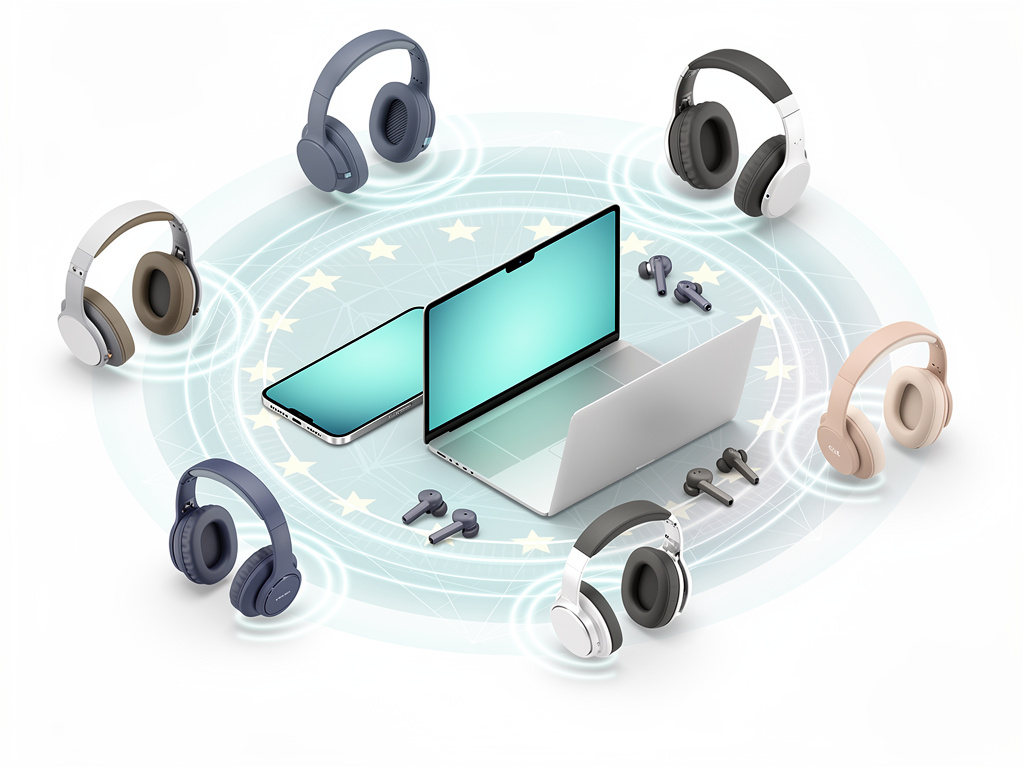
Apple is testing a feature that would allow third-party Bluetooth headphones and speakers to automatically switch between Apple devices — a capability the company has long reserved exclusively for its own AirPods and Beats products. The change, spotted in early beta code, is being developed specifically to comply with European Union interoperability regulations. And it could fundamentally reshape how accessory makers compete in Apple’s tightly controlled hardware world.
The feature, first reported by 9to5Mac, was discovered in internal builds of upcoming Apple software. It would extend the automatic audio handoff behavior — where audio follows a user from iPhone to iPad to Mac without manual re-pairing — to headphones and speakers from companies like Sony, Bose, Sennheiser, and others. Currently, that trick works only with Apple’s own W1, H1, and H2 chip-equipped accessories.
This isn’t a voluntary act of generosity.
The European Union’s Digital Markets Act, which designated Apple as a “gatekeeper” platform in September 2023, includes provisions requiring interoperability with third-party hardware and software. The European Commission has been progressively tightening its interpretation of what interoperability means in practice, and Bluetooth audio switching has emerged as a specific area of regulatory interest. Apple’s proprietary automatic switching, which relies on iCloud account integration and custom silicon handshake protocols, has been cited by EU regulators as an example of platform lock-in that disadvantages competing accessory manufacturers.
For years, this feature has been one of the strongest invisible chains binding users to AirPods. Not because people consciously chose AirPods for automatic switching — most didn’t even know the feature existed until they experienced it. But once they did, going back to manually selecting Bluetooth connections felt primitive. That friction, subtle as it was, made third-party headphones feel like second-class citizens on Apple devices. Which, of course, they were.
The technical implementation Apple is reportedly testing would use a new API framework that allows third-party accessory makers to register their devices for automatic switching behavior across Apple hardware. According to 9to5Mac, the system would require accessory manufacturers to adopt a new protocol layer, though the exact specifications haven’t been finalized. The feature appears to be gated to EU users initially, mirroring Apple’s approach with other DMA-mandated changes like third-party app stores and default browser selection screens.
This pattern — compliance in Europe, resistance everywhere else — has become Apple’s standard playbook. The company opened up NFC payments to third-party apps in the EU before extending the change globally. It allowed alternative browser engines on iOS in Europe months before considering broader rollouts. Sideloading remains an EU-first feature. So the question isn’t whether automatic audio switching for third-party accessories will come to the EU. It’s whether Apple will eventually bring it worldwide, or whether it will maintain a two-tier system indefinitely.
The stakes are significant. Apple’s wearables, home, and accessories segment — which includes AirPods, Apple Watch, and HomePod — generated $39.8 billion in fiscal 2025. AirPods are the dominant force in that category. Strategy Analytics estimated in late 2025 that AirPods commanded roughly 28% of the global true wireless earbuds market by revenue, a figure that balloons past 50% in the United States. Automatic switching has been a key differentiator, one that Apple’s marketing materials highlight prominently.
Accessory makers have been lobbying for this kind of access for years. The Consumer Technology Association and several European trade groups representing audio equipment manufacturers submitted formal complaints to the European Commission in 2024, arguing that Apple’s proprietary switching protocol created an unfair competitive advantage. Sony, which sells its popular WH-1000XM series headphones in the tens of millions annually, has been particularly vocal in industry forums about the disparity.
A Sony spokesperson declined to comment on Apple’s reported testing. Apple did not respond to requests for comment.
The technical challenges are real but not insurmountable. Apple’s current automatic switching relies on a combination of iCloud account verification, proximity detection, and device activity heuristics. When a user picks up their iPhone and starts playing a podcast, the system detects that the iPhone is now the active audio source and routes the Bluetooth connection accordingly. This happens through proprietary firmware on Apple’s audio chips and deep OS-level integration that third-party manufacturers simply cannot access today.
Opening this up means Apple must either share its proprietary protocol — unlikely — or build a new standardized interface that achieves similar results. The beta code suggests Apple is pursuing the latter approach, creating what amounts to a registration system where third-party devices can declare themselves eligible for automatic switching. The switching logic would still run on Apple’s side, but the accessory would participate in the handoff rather than being excluded from it entirely.
There are legitimate concerns about reliability. Apple’s automatic switching, even with its own hardware, isn’t perfect. Users frequently complain about audio jumping to the wrong device or switching at inopportune moments. Adding third-party hardware with varying Bluetooth implementations, firmware quality, and connection stability into the mix could make the experience worse. Apple will almost certainly use this argument in its regulatory discussions, and it’s not entirely wrong.
But the EU has shown little patience for quality-of-experience arguments when they conveniently align with business interests. The Commission rejected similar reasoning when Apple argued that third-party app stores would compromise security and user experience. The regulatory body’s position has been consistent: if a feature creates lock-in, the gatekeeper must open it up, and the gatekeeper bears the engineering burden of making it work well.
The timing matters too. Apple is expected to announce iOS 20 at WWDC in June, with a public release in September. If automatic audio switching for third-party accessories ships as an EU-mandated feature in iOS 20, it would give accessory makers several months to implement the new protocol before the holiday shopping season. That’s a compressed timeline, but major manufacturers like Sony, Bose, Jabra, and Samsung have the engineering resources to move quickly when a market opportunity this large opens up.
And make no mistake — it is a large opportunity. The ability to advertise “works like AirPods with your iPhone” would be a powerful selling point for any headphone maker. Premium wireless headphones from Sony and Bose already match or exceed AirPods Max in sound quality and noise cancellation, often at lower prices. The missing piece has been that deep integration with Apple devices. If that gap closes, even partially, the competitive dynamics of the wireless audio market shift considerably.
Not everyone in the audio industry is celebrating prematurely, though. Smaller manufacturers worry that Apple’s implementation could be designed to favor companies with the resources to adopt complex new protocols quickly, effectively creating a new barrier that replaces the old one. There’s also concern that Apple might impose certification requirements or licensing fees that eat into margins. The DMA prohibits discriminatory terms, but enforcement depends on specifics that won’t be clear until Apple publishes its compliance plan.
Wall Street has largely shrugged at DMA-related changes so far. Apple’s stock has absorbed the impact of third-party app stores, alternative payment systems, and NFC access without meaningful damage. Analysts at Morgan Stanley noted in a February 2026 research note that DMA compliance costs have been “immaterial” to Apple’s financial performance and that the competitive impact of mandated changes has been “limited in practice.” Audio switching could follow the same pattern — a headline-grabbing concession that doesn’t materially dent AirPods sales.
Or it could be different this time. AirPods’ market position depends more heavily on integration advantages than the App Store’s position depends on being the sole distribution channel. If the integration moat narrows, price and audio quality become the primary battlegrounds. Apple doesn’t always win those fights.
The broader implication extends beyond headphones. The DMA’s interoperability provisions could eventually force Apple to open up other proprietary integration features — Handoff for third-party tablets, Universal Clipboard across non-Apple devices, or even Find My network access for competing trackers beyond the limited support already offered. Each of these features creates subtle but powerful incentives to stay within Apple’s product family. Each is a potential target for regulatory action.
Apple has been preparing for this. The company has quietly built internal teams focused on regulatory compliance engineering, separate from its standard product development groups. These teams are tasked with implementing the minimum viable version of mandated changes — functional enough to satisfy regulators, constrained enough to preserve competitive advantages where possible. It’s a delicate balance, and one that the European Commission is watching closely.
For consumers in the EU, the practical impact could be noticeable by late 2026. Imagine picking up your iPad to watch a video and having your Sony headphones automatically switch from your iPhone without touching a single setting. That’s the promise. Whether the reality matches it will depend on how faithfully Apple implements the feature and how quickly third-party manufacturers adopt the new protocol.
For consumers outside the EU, the wait may be longer. But history suggests these changes eventually go global. The engineering cost of maintaining region-specific feature sets is high, and the PR cost of visibly offering European customers a better experience than American or Asian customers is higher. Apple opened up NFC globally within a year of the EU mandate. Default browser selection screens followed a similar path. Automatic audio switching will likely follow.
The walls are coming down. Slowly, reluctantly, and with as many conditions as Apple’s legal team can attach. But they’re coming down.


 WebProNews is an iEntry Publication