
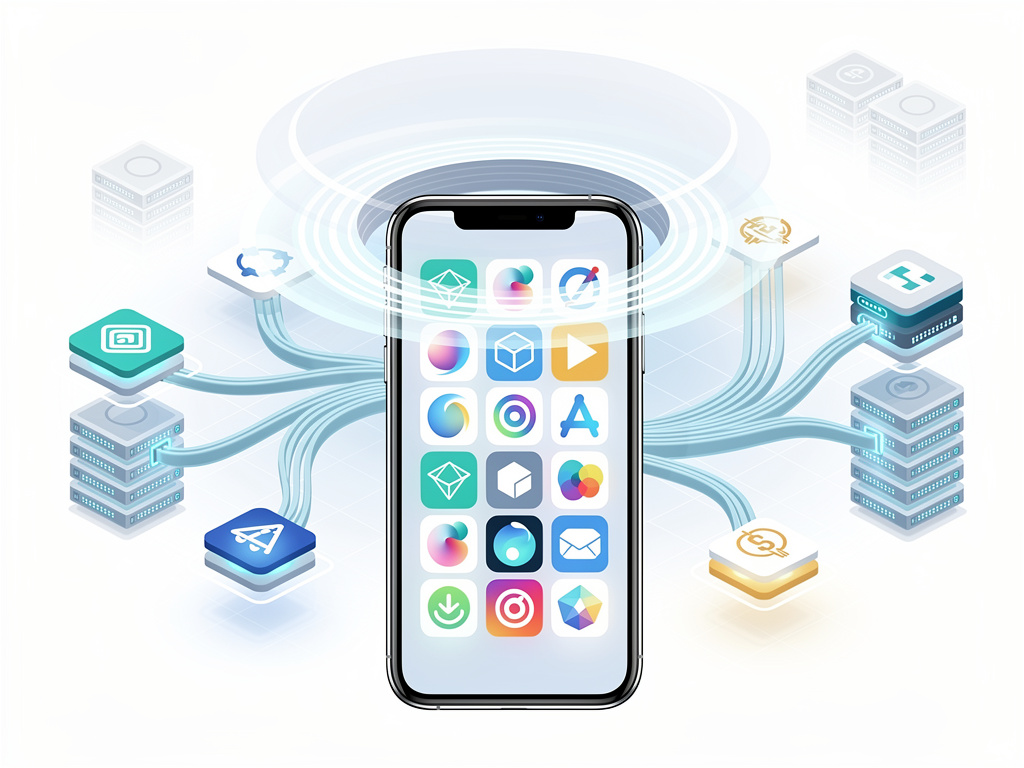
Apple isn’t just upgrading Siri. It’s building an entirely new marketplace around it.
According to a report from Digital Trends, Apple is developing what amounts to an AI-powered app store — a platform where third-party developers can build and distribute intelligent agents that operate through Siri. If that sounds like a modest feature update, it isn’t. This is Apple positioning itself to control the distribution layer for the next generation of software, just as it did with the original App Store in 2008.
The implications are enormous. For developers. For competitors. For the billions of people who carry an iPhone.
The reporting, which draws on details originally surfaced by Bloomberg’s Mark Gurman, indicates that Apple envisions a future where users interact with AI agents the way they currently interact with apps — browsing, downloading, and running them through a centralized storefront. But instead of tapping icons on a home screen, users would invoke these agents through Siri, which would serve as the primary interface layer. The assistant would dispatch tasks to the appropriate agent, whether that’s booking a restaurant, managing a financial portfolio, or troubleshooting a home appliance.
Apple has been quietly assembling the infrastructure for this shift. At WWDC 2025, the company is expected to unveil significant upgrades to Siri’s architecture under iOS 19, including deeper on-device intelligence, more capable natural language processing, and — critically — a framework that allows third-party AI agents to plug directly into the assistant. Think of it as App Intents on steroids, but with conversational AI as the connective tissue rather than simple shortcut actions.
The Store That Sells Intelligence
Apple’s original App Store didn’t just create a distribution channel. It created a tax. The company’s 30% commission on digital goods and services has generated hundreds of billions in revenue and triggered antitrust battles across multiple continents. An AI app store would extend that same economic model into a new domain — one that many in the industry believe will eventually subsume traditional app interactions.
Here’s what makes this different from anything Google, Microsoft, or OpenAI is currently doing: Apple controls the hardware, the operating system, and the distribution point. That vertical integration has always been Apple’s structural advantage, but in an AI context it becomes even more potent. An AI agent running through Siri on an iPhone can access on-device sensors, health data, location history, payment credentials, and communication logs in ways that a cloud-only chatbot simply cannot. The depth of context available to these agents — with user permission, Apple would be quick to note — is unmatched.
And Apple knows it.
The company has spent years building its privacy-first brand into a competitive moat. While OpenAI’s ChatGPT and Google’s Gemini process queries largely in the cloud, Apple has invested heavily in on-device processing through its Neural Engine chips. The AI app store would likely lean on this architecture, allowing agents to perform sensitive tasks locally while reserving cloud computation for heavier workloads. That’s a compelling pitch to users who are increasingly wary of how their data gets handled.
But let’s be clear about what this really is: a platform play. Apple isn’t building these AI agents itself, at least not all of them. It’s building the rails and inviting developers to ride them — for a fee. The same playbook it ran with iOS apps, Apple Music integrations, and in-app purchases. The genius, if you want to call it that, is in the positioning. Apple doesn’t need to build the best AI. It needs to build the best place to find and use AI.
Recent reporting from 9to5Mac reinforces this trajectory, detailing how iOS 19 will introduce what Apple internally refers to as “agentic” capabilities for Siri — the ability to chain together multi-step tasks across apps without requiring the user to switch contexts. Ordering groceries, for instance, might involve Siri coordinating between a recipe agent, a grocery delivery agent, and Apple Pay, all within a single conversational thread. The user never opens an app. They just talk.
That’s the vision, anyway. Execution is another matter entirely.
Why Developers Should Be Both Excited and Nervous
For independent developers and large software companies alike, an AI app store presents a genuine opportunity — and a familiar trap. The opportunity is access. Being featured in an Apple-curated AI storefront, integrated directly into Siri, could drive adoption at a scale that’s difficult to achieve through traditional app discovery. Siri handles billions of requests. Even capturing a fraction of that intent-driven traffic would be significant.
The trap is dependency. Apple’s history with the App Store is littered with examples of developers who built thriving businesses on the platform only to see Apple introduce a first-party competitor — sometimes using data gleaned from the marketplace itself. Screen Time killed several parental control apps. Apple Weather absorbed features from popular third-party weather apps. The pattern is well-documented and, for developers, deeply unsettling.
So the question becomes: if you build an AI agent for Apple’s new store, what happens when Apple decides it wants to offer the same capability natively? The company’s track record suggests the answer isn’t reassuring.
There’s also the question of economics. Apple hasn’t disclosed what commission structure it would apply to AI agent transactions, but if history is any guide, expect the standard 30% cut — or perhaps a modified version under the pressure of ongoing regulatory scrutiny in the EU and elsewhere. The Digital Markets Act has already forced Apple to allow alternative app stores in Europe. Whether those same rules would apply to an AI agent marketplace remains an open legal question, but regulators are watching.
Meanwhile, the competitive dynamics are shifting fast. Google has been aggressively integrating Gemini into Android, with its own vision of AI agents that can perform tasks across apps. Microsoft’s Copilot strategy aims to embed AI assistance into every layer of its productivity stack. OpenAI is building its own consumer-facing agent products. And startups like Rabbit and Humane — despite rocky hardware launches — have at least demonstrated market appetite for AI-first interaction models that bypass traditional apps entirely.
Apple’s advantage isn’t technological superiority in AI. Most observers would rank Apple’s large language model capabilities behind those of OpenAI, Google, and Anthropic. The advantage is distribution. There are roughly 1.5 billion active Apple devices worldwide. If even a modest percentage of those users begin interacting with AI agents through Siri, the volume of transactions flowing through Apple’s marketplace would be staggering.
Distribution wins. It almost always does.
What This Means for the Future of Apps
The deeper story here isn’t about Siri getting smarter. It’s about what happens to the app as a concept. For fifteen years, the smartphone experience has been organized around a grid of icons. You tap an icon, an app opens, you perform a task, you close the app. That model has been remarkably durable, but it’s also fundamentally friction-heavy. Every app is a silo. Every task requires the user to know which app to open and how to operate it.
AI agents promise to dissolve those silos. Instead of opening five apps to plan a weekend trip, you tell Siri what you want and the agents handle the rest — checking your calendar, searching flights, booking hotels, making dinner reservations, and sending the itinerary to your travel companions. The interface becomes conversational. The apps become invisible infrastructure.
This is not a new idea. Google tried it with Google Now nearly a decade ago. Microsoft pitched it with Cortana. Amazon built an entire “skills” marketplace for Alexa. None of them succeeded at the scale their creators envisioned, largely because the underlying AI wasn’t capable enough to handle the ambiguity and complexity of real-world tasks.
But the technology has caught up. Large language models, improved speech recognition, better on-device inference — the pieces are now in place in ways they simply weren’t in 2016 or even 2022. Apple’s bet is that the timing is finally right, and that its integrated hardware-software stack gives it the best shot at making agent-based interaction feel natural rather than frustrating.
There are real risks. Privacy incidents involving AI agents could be catastrophic for Apple’s brand. A rogue agent accessing sensitive health data or making unauthorized purchases would generate headlines that no amount of marketing could offset. Apple will need to build an approval and review process for AI agents that’s at least as rigorous as its current App Store review — and probably more so, given the autonomous nature of agent behavior.
Then there’s the user experience challenge. People have been trained for years to distrust Siri. The assistant’s reputation for misunderstanding commands, delivering irrelevant results, and failing at basic tasks is deeply ingrained. Apple will need to demonstrate a dramatic improvement in Siri’s reliability before users will trust it to coordinate complex, multi-agent workflows. One bad experience — a botched hotel booking, a misinterpreted financial instruction — and users will retreat to the familiar comfort of manual app interaction.
And yet. The strategic logic is sound. Apple has always been at its best when it creates a marketplace, sets the rules, and takes a cut. The App Store generated an estimated $24.6 billion in revenue for Apple in 2023, according to estimates compiled by various analysts. An AI agent store, if it achieves even a fraction of that scale, would represent a massive new revenue stream at a time when iPhone hardware sales have plateaued in key markets.
For those of us who’ve watched Apple operate for decades — I’ve been tracking this company since my first Mac in a small midwestern town — the pattern is unmistakable. Apple doesn’t invent categories. It waits, watches, and then builds the definitive version with distribution advantages no one else can match. The iPod wasn’t the first MP3 player. The iPhone wasn’t the first smartphone. The App Store wasn’t the first software marketplace.
An AI app store won’t be the first attempt at agent-based computing. But if Apple executes it the way it has executed platform launches in the past, it could very well be the one that sticks. And the one that defines how a generation of users — and developers — interact with artificial intelligence on the devices they carry every day.
The announcement is expected at WWDC 2025. The real story will unfold over the next three to five years. Watch the developer terms. Watch the commission structure. Watch which agents Apple decides to build itself.
That’s where the money is. And that’s where the power shifts.


 WebProNews is an iEntry Publication