
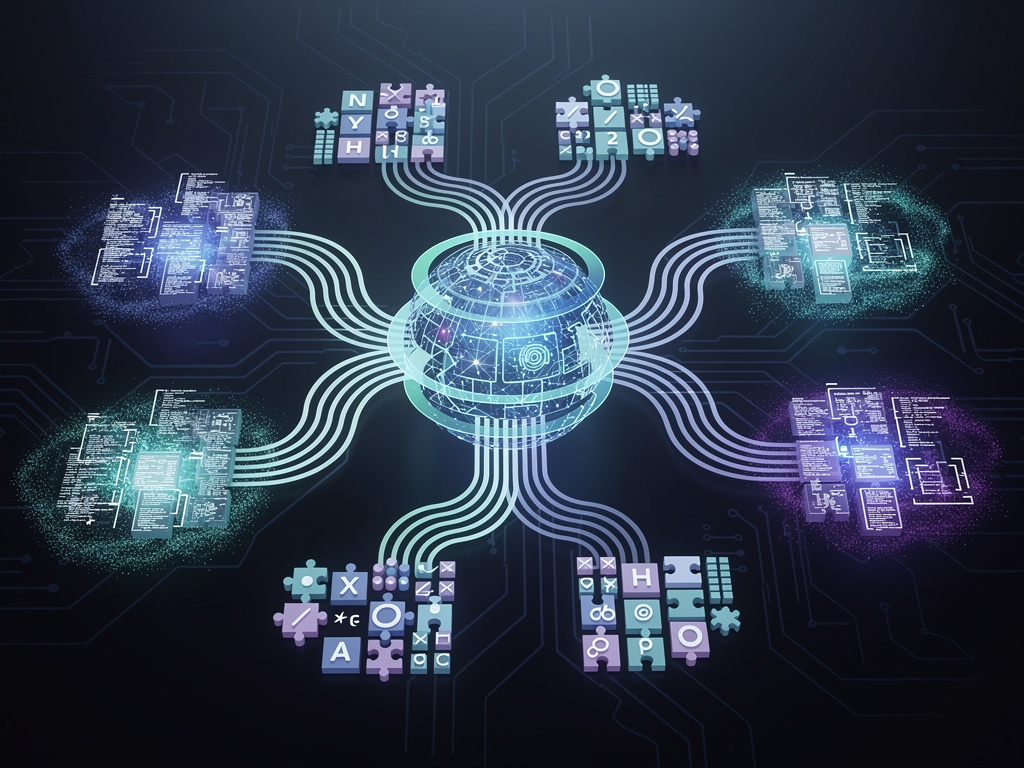
Apple engineers have crafted a system that lets AI chew over several reasoning tracks at once, picking the sharpest path to an answer. It’s called LaDiR, short for Latent Diffusion Reasoner. And it sidesteps the usual pitfalls of language models that lock into one flawed idea early on. 9to5Mac broke the story first, detailing how this framework blends diffusion models with familiar autoregressive generation.
Picture this. Standard large language models spit out tokens one by one, like a chain letter where one bad link dooms the rest. Diffusion models? They start with noise and refine it in parallel across many tokens per step. LaDiR marries the two. It spins up hidden reasoning blocks from random noise. Each block gets denoised step by step into coherent thoughts. Crucially, it runs multiple such paths side by side. A built-in nudge keeps them from all piling onto the same notion too soon. Only then does it switch to autoregressive mode for the clean final output.
Researchers Haoqiang Kang, Yizhe Zhang, Nikki Lijing Kuang, Nicklas Majamaki, Navdeep Jaitly, Yi-An Ma, and Lianhui Qin—from Apple and the University of California, San Diego—laid it out in their paper, LaDiR: Latent Diffusion Enhances LLMs for Text Reasoning. The work builds on existing models like Meta’s LLaMA 3.1 8B for math and puzzles, and Qwen3-8B-Base for code. No need to train giants from scratch. Just plug in the framework at inference time. arXiv hosts the full text, submitted in October 2025 and revised recently.
Results? Impressive on tough turf. For math benchmarks, LaDiR boosted accuracy over baselines, especially on out-of-distribution problems that trip up standard setups. Code generation on HumanEval saw more dependable outputs, beating fine-tuned models handily on hard cases. Take the Countdown game, a puzzle where you hit a target number from six others using arithmetic. LaDiR scoured a broader field of valid solutions than general models, nailing correct answers more often. It lagged a bit behind hyper-specialized rivals on one-shot tries, though. Apple’s Machine Learning Research page links to the study.
But wait. LaDiR isn’t alone in chasing inference-time smarts. It fits a wave of test-time compute tricks, where extra flops at query time yield outsized gains. Diffusion’s parallel nature shines here, refining whole reasoning chunks globally rather than token-by-token. That diversity mechanism? Key. Without it, paths collapse into echoes. With it, you get a buffet of candidates, then pick the winner—perhaps via a simple vote or scorer.
Apple’s prior forays hint at bigger plans. They’ve tapped diffusion for protein folding and speedy code models before. BigGo Finance notes LaDiR’s potential for on-device tools like an upgraded Siri or Xcode helper, prioritizing think-smarter over scale-bigger. Imagine Siri debating routes or diagnoses internally, slashing hallucinations by 30% on complex tasks, as one report claims for parallel setups. Abit.ee pegs fourfold speedups on Apple Silicon, with APIs eyed for devs by 2027.
Skeptics might point to costs. Parallel paths gobble compute—fine for servers, trickier on phones. Yet Apple’s neural engine thrives on such parallelism. Benchmarks show gains precisely where it counts: edges of model ability, those OOD nightmares. And diversity? It boosts interpretability too. Peek inside those paths; you see varied logic trees, not black-box mush.
So. Does this land in iOS 20? No firm word. But the pattern holds. Apple favors frameworks that lift off-the-shelf models, aligning with their on-device push. LaDiR proves you can teach old LLMs new tricks. Run thoughts in parallel. Avoid dead-end tunnels. Deliver answers that stick.
Industry watchers buzz on X. 9to5Mac’s post racked up thousands of views overnight. Posts praise the shift from linear chains to branching exploration. One user noted: it mimics human experts juggling hypotheses. True enough.
Challenges remain. Scaling paths to dozens? Fine-tuning the diversity penalty? Integrating verifiers for safety? All open. Still, LaDiR shifts the field. Inference time becomes the new training frontier. Apple just drew a bold line there.


 WebProNews is an iEntry Publication