
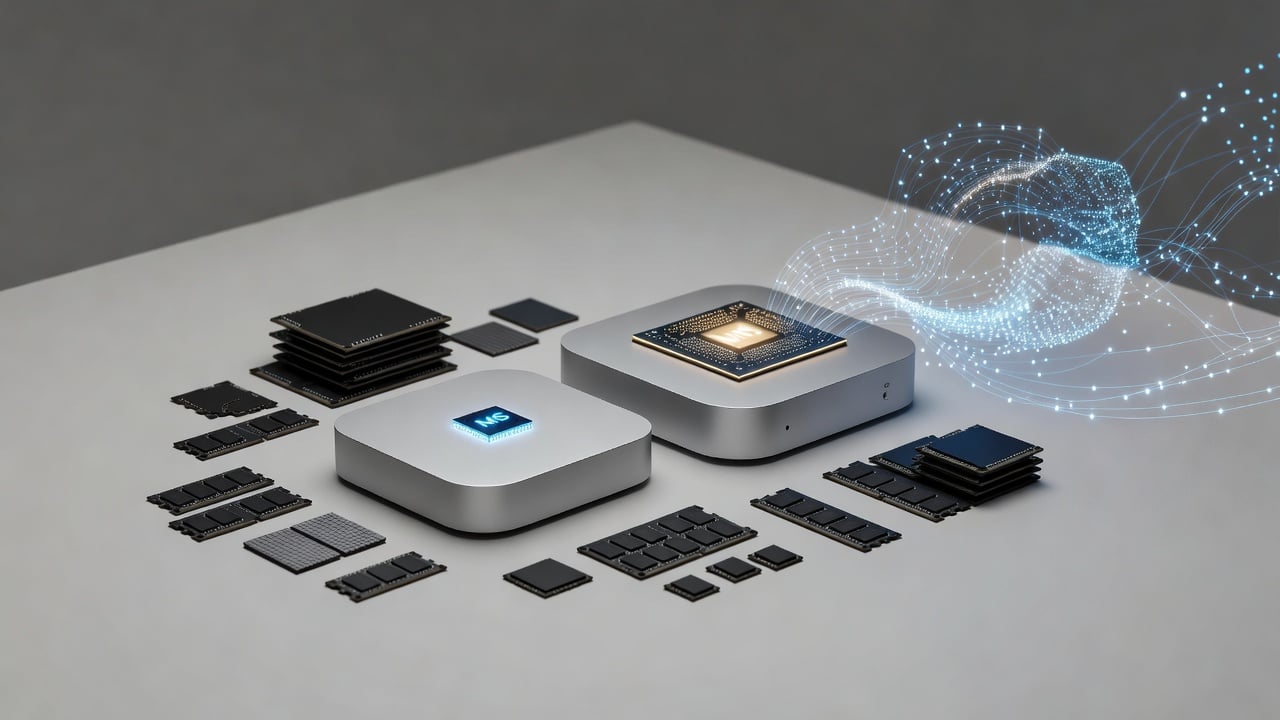
Apple appears ready to break from its usual pattern of synchronized chip generations across a product line. The next Mac Mini could arrive with a base model powered by the yet-unreleased M6 chip paired alongside a higher-end version using the M5 Pro. This unusual combination, reported Tuesday, reflects the intense pressures from memory shortages and surging demand for artificial intelligence features.
Mark Gurman at Bloomberg first disclosed the testing of these mismatched configurations. Current Mac Mini models already face three-month shipping delays. That backlog underscores how supply constraints now dictate release schedules more than technical readiness.
But the approach isn’t entirely new. Last year Apple shipped a Mac Studio that mixed an M4 Max in some units with an M3 Ultra in others. The company made that choice to keep high-end desktops available while it ramped up newer silicon. This time the stakes feel higher. Memory shortages tied to advanced AI workloads have tightened availability across Apple’s entire Mac range.
The M6 chip itself remains something of a mystery. Recent reporting indicates Apple will introduce a standard M6 this fall, likely first in an entry-level 14-inch MacBook Pro. Yet plans for M6 Pro, M6 Max or M6 Ultra variants appear absent or pushed to 2027. MacRumors covered that shift in detail earlier this month, noting the decision breaks a long streak of consistent tiered rollouts.
So why pair an M6 base with an M5 Pro in the desktop? The answer lies in production realities. Gurman noted the configurations and timing remain tied directly to memory supply. Apple raised prices across all Macs in June as component costs climbed. Base MacBook Air models jumped from $1,099 to $1,299. Demand for AI-capable hardware shows no signs of easing.
Analysts expect the refreshed Mac Mini to start with 16GB of unified memory in the M6 version. The M5 Pro model could begin at 24GB and scale higher. Storage may shift from the current 256GB baseline to 512GB minimum. Ports could differ too. Standard editions might stick with Thunderbolt 4 while Pro versions retain Thunderbolt 5 support. Wi-Fi 7 and Bluetooth 6 also surface in early speculation on X, though nothing is confirmed.
Design changes look minimal. The compact aluminum chassis introduced in 2024 with the M4 Mac Mini won praise for its small footprint and quiet operation. No major exterior updates are expected. Focus instead falls on internal performance gains. Faster GPUs, improved neural engines for on-device AI, and better thermal designs could define the new machines.
Release timing stays fluid. Earlier forecasts pointed to first-half 2026. Gurman has since moved that to later in the year. No announcement arrived at WWDC in June. Macworld outlined the delay factors in an article published just hours ago, citing ongoing shortages and high AI-driven demand. A launch before the end of 2026 still looks probable.
Meanwhile the broader Mac roadmap shows sweeping changes ahead. New MacBook Air, iMac, and redesigned MacBook Pro models with touchscreens and OLED displays sit in development. Mac Studio updates with M5 Max and M5 Ultra chips are also in testing. 9to5Mac summarized the full pipeline in its coverage of Gurman’s latest report.
That report paints a picture of an Apple scrambling to meet enterprise and creative professional needs. AI features in macOS demand substantial memory and processing power. On-device models for image generation, coding assistance and data analysis push hardware limits. The memory shortage isn’t abstract. It directly delays shipments today.
Geoff Fagien examined the situation in a YouTube video posted two days ago. He argued the narrative of skipping M5 entirely for the Mac Mini oversimplifies matters. “Apple has not announced a Mac Mini with an M6 processor,” Fagien noted. “There is currently no confirmed report that Apple has also cancelled the Mac Mini with the M5 processor.” His analysis highlights how headlines can distort incomplete supply chain data.
Yet the mismatched approach carries risks. Developers and buyers may question why the base model jumps a generation while the premium one does not. Performance comparisons could confuse the market. Support cycles might diverge. Apple has managed such transitions before, but never under this level of component pressure.
Industry observers on X reacted quickly to the news. Some predicted the M6 base model would “blow the computer market” similar to the original M1. Others focused on pricing concerns. One Japanese account summarized expected specs and ended with a simple lament: price increases will make it expensive.
Supply chain reports suggest Apple continues to invest heavily in domestic manufacturing and new fabrication partnerships. TSMC’s 2-nanometer process is expected to power future M-series chips, bringing efficiency gains critical for sustained AI performance. But those advances won’t arrive fast enough to clear current backlogs.
The Mac Mini occupies a unique spot in Apple’s lineup. It’s the most affordable way to access Mac desktop power. Professionals use it for server duties, video rendering, software development and now local AI inference. Small businesses appreciate its silent operation and low energy draw. Any delay or configuration oddity ripples across those segments.
Competitors watch closely. Windows-based mini PCs from vendors like Intel and AMD have narrowed the performance gap in recent years. They offer competitive AI accelerators and often lower entry prices. Apple’s silicon advantage, built on tight hardware-software integration, has kept it ahead. This next Mac Mini must preserve that edge despite the supply headaches.
Longer term, the absence of higher M6 variants raises questions about Apple’s chip development cadence. The company once refreshed its entire silicon family in lockstep. Now it seems willing to stagger generations to maintain momentum. The M7 Pro and M7 Max could land in high-end MacBook Pros as late as 2027 according to some forecasts.
For buyers the advice grows complicated. Current M4 and M4 Pro Mac Minis deliver strong performance today. Those facing three-month waits might consider alternatives or accept the delay. Early adopters of the next model could gain access to newer AI features first. But they may also pay more and encounter the quirks of a transitional lineup.
Apple has not commented publicly on any of these reports. The company rarely does. Its official roadmap stays hidden until announcement day. That leaves analysts, supply chain sources and journalists to piece together the puzzle from testing logs, prototype identifiers and component orders.
One thing looks clear. The Mac Mini’s next chapter will reflect broader forces shaping the technology industry: insatiable demand for AI capabilities, constrained advanced memory production, and a manufacturer determined to keep its desktop offerings fresh and competitive. How Apple balances those forces will influence not just one small computer but its entire professional product strategy for years ahead.


 WebProNews is an iEntry Publication