
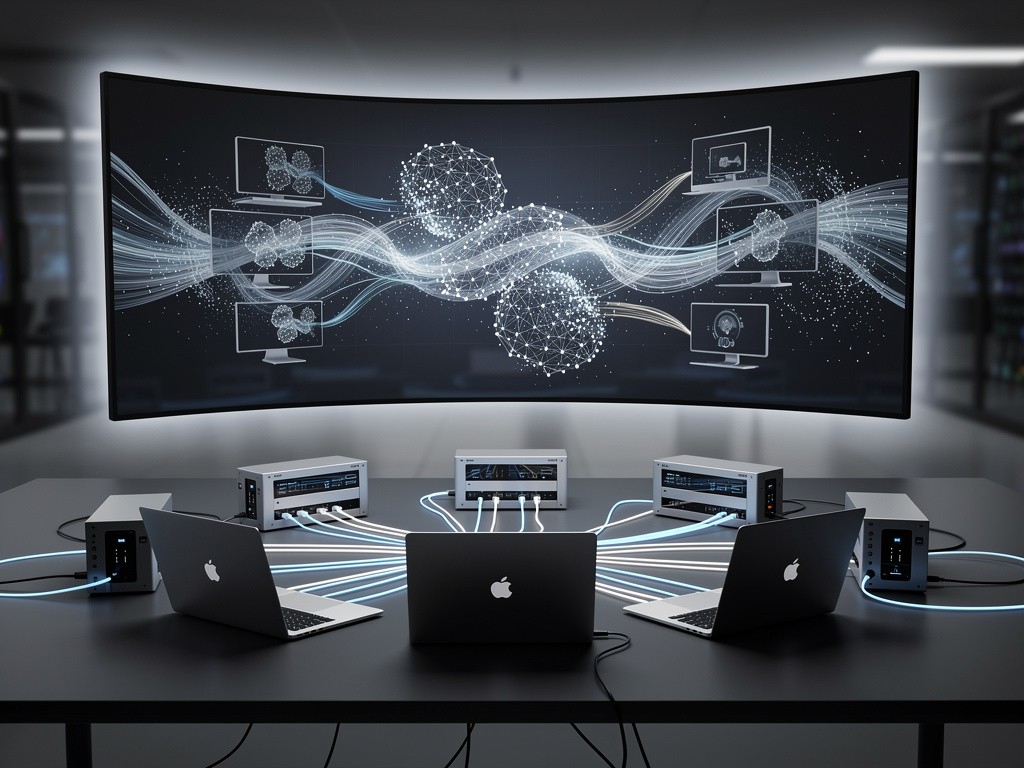
In the ever-evolving realm of high-performance computing, Apple’s latest macOS update is turning heads among developers and AI enthusiasts. The release of macOS Tahoe 26.2 brings a groundbreaking feature: Remote Direct Memory Access (RDMA) over Thunderbolt, enabling users to cluster multiple Macs into powerful, low-latency networks for demanding tasks like AI model training. This isn’t just a minor tweak; it’s a strategic move that positions Apple’s ecosystem as a serious contender in distributed computing, particularly for on-device AI workloads that require blistering speed without relying on cloud infrastructure.
At its core, RDMA allows one computer to directly access the memory of another without involving the operating system or CPU of the target machine. This technology, long a staple in enterprise data centers for its efficiency in handling massive data transfers, is now accessible via Thunderbolt ports on compatible Macs. According to the official documentation from Apple Developer, this implementation leverages Thunderbolt’s high-bandwidth capabilities to bypass traditional networking stacks, reducing latency to levels that make real-time collaboration on large-scale computations feasible on consumer hardware.
For industry insiders, the implications are profound. Imagine linking several M-series Macs—say, a Mac Studio and a couple of MacBook Pros—into a makeshift supercomputer. Data can flow between them at speeds up to 80 Gb/s with Thunderbolt 5, as highlighted in posts on X from tech analysts who have been buzzing about this since the beta releases. This setup isn’t hypothetical; it’s designed for practical applications like running trillion-parameter AI models across devices, something that was previously the domain of specialized hardware clusters.
Unlocking AI Potential with Local Clustering
The push toward RDMA over Thunderbolt aligns with Apple’s broader AI strategy, emphasizing privacy and on-device processing. Unlike cloud-based solutions that raise data security concerns, this feature keeps everything local, appealing to developers in sensitive fields like healthcare and finance. Early adopters, as reported in a Hacker News discussion, are already experimenting with models like Kimi K2, a one-trillion-parameter behemoth that benefits from distributed inference across clustered Macs.
But how does it work under the hood? Apple’s release notes detail that RDMA integrates with the Thunderbolt framework to enable zero-copy data transfers, meaning data moves directly from one device’s memory to another’s without intermediate buffering. This eliminates bottlenecks associated with TCP/IP protocols, which Thunderbolt previously emulated. Insiders note that while Thunderbolt 5 offers peak speeds, real-world performance depends on factors like cable quality and device compatibility—only M4 and later chips fully support this enhanced mode.
Beyond AI, the feature opens doors for creative professionals. Video editors could distribute rendering tasks across multiple machines, or data scientists might simulate complex datasets in real time. However, it’s not without caveats: power consumption spikes during intensive clustering, and thermal management becomes critical, as multiple devices churning at full throttle can generate significant heat.
From Beta Buzz to Public Rollout
The journey to macOS 26.2’s release has been marked by fervent speculation. Beta testers, sharing insights on platforms like X, praised the update’s stability and the seamless integration of RDMA. One post from a developer highlighted clustering M5 Max machines at 80 Gb/s, a leap from the 10 Gb/s limits of earlier Thunderbolt iterations, crediting this to optimizations in the macOS kernel.
News outlets have been quick to cover the rollout. A piece from 9to5Mac detailed the public availability following weeks of beta testing, noting that while RDMA steals the spotlight, the update also includes security patches addressing over 20 vulnerabilities. This dual focus on innovation and safety underscores Apple’s methodical approach to software releases.
Comparisons to competitors are inevitable. While Nvidia’s NVLink dominates in GPU clustering for data centers, Apple’s solution is more accessible, requiring no proprietary hardware beyond standard Thunderbolt cables. Yet, as discussed in a MacRumors article, scalability is limited—clustering is best for small groups of devices, not enterprise-scale farms, making it ideal for indie developers or small teams rather than massive operations.
Technical Deep Dive: Implementation and APIs
Diving deeper into the technical specifics, Apple’s developer documentation explains that RDMA over Thunderbolt is exposed through new APIs in the macOS networking stack. Developers can initialize clusters using Swift or Objective-C calls that negotiate memory mappings directly over the Thunderbolt bus. This is a departure from traditional Ethernet-based RDMA, which relies on Infiniband or RoCE (RDMA over Converged Ethernet), adapting instead to Thunderbolt’s point-to-point topology.
For those building apps, the update introduces protocols for fault-tolerant clustering. If a device drops out—say, due to a disconnected cable—the system can redistribute workloads dynamically, minimizing disruptions. Testing scenarios outlined in the notes suggest latency as low as microseconds for small transfers, rivaling dedicated high-performance computing setups.
Industry experts are already forecasting integrations. Posts on X from figures like Alex Ziskind describe how this could evolve with future hardware, such as the rumored M5 Ultra, potentially enabling clusters that handle exascale computations on a desk. However, challenges remain: bandwidth sharing means that not all ports can sustain peak speeds simultaneously, and software overhead for synchronization could introduce minor delays in unoptimized code.
Broader Ecosystem Impacts and Security Considerations
The introduction of RDMA isn’t isolated; it complements other macOS 26.2 features like Edge Light for video calls, as covered in a Zeera Wireless blog, which uses the Neural Engine for enhanced low-light performance. This synergy highlights Apple’s holistic approach, blending AI acceleration with everyday usability.
Security is paramount in such a powerful feature. Apple’s notes emphasize built-in encryption for RDMA transfers, preventing unauthorized memory access. A separate 9to5Mac report on the update’s patches reveals fixes for kernel vulnerabilities that could have been exploited in clustered environments, ensuring that the feature doesn’t become a vector for attacks.
Looking at adoption, early sentiment on X suggests enthusiasm among AI researchers. One thread discussed collaborative model training, where multiple users contribute compute power via clustered Macs, democratizing access to high-end AI tools. This could disrupt markets dominated by cloud providers, offering cost savings for startups avoiding subscription fees.
Future Horizons and Developer Opportunities
As macOS evolves, RDMA over Thunderbolt sets the stage for more ambitious integrations. Imagine virtual reality simulations distributed across devices or real-time machine learning in autonomous systems. Apple’s history of iterating on features—Thunderbolt itself transitioned from Intel co-development to full Apple control—suggests refinements in upcoming point releases.
For developers, the opportunity lies in creating apps that leverage this capability. The macOS 26.1 release notes laid groundwork with initial networking enhancements, building to 26.2’s full RDMA support. Tools like Xcode now include simulators for testing clustered environments, lowering the barrier to entry.
Critics, however, point out limitations. Not all Macs support the latest Thunderbolt standards, creating a tiered ecosystem where older devices are left behind. Moreover, as noted in a Mac Observer article, while RDMA excels in latency-sensitive tasks, it may not outperform dedicated clusters for sheer throughput in massive datasets.
Pushing Boundaries in Distributed Computing
The real test will come from real-world deployments. Anecdotes from X users experimenting with beta versions describe setups where four Macs collaboratively train models faster than a single high-end server, thanks to aggregated Neural Engine cores. This peer-to-peer model could foster new workflows in fields like genomics or climate modeling, where data locality is key.
Apple’s move also reflects a response to industry trends. With AI workloads exploding, hardware like this bridges the gap between consumer devices and professional gear. References to Arm-based Thunderbolt support, dating back to older posts on X from MacRumors, show Apple’s long-term commitment to this trajectory.
Ultimately, macOS 26.2’s RDMA feature isn’t just about speed—it’s about redefining what’s possible with off-the-shelf hardware. As developers explore its potential, we may see a shift toward more decentralized computing paradigms, empowering individuals and small teams to tackle problems once reserved for tech giants.
Strategic Implications for Apple’s Roadmap
Peering ahead, this update hints at Apple’s ambitions in edge computing. By enabling low-latency clustering, it positions Macs as nodes in larger networks, potentially integrating with iOS devices in future iterations. The iOS 26.2 release notes already mention complementary features, suggesting ecosystem-wide enhancements.
For businesses, the cost-benefit analysis is compelling. Clustering existing hardware avoids the expense of new purchases, as long as compatibility is met. Industry insiders speculate that this could influence enterprise adoption, with companies like animation studios testing RDMA for distributed rendering pipelines.
In wrapping up this exploration, it’s clear that RDMA over Thunderbolt in macOS 26.2 marks a pivotal advancement. It not only boosts performance but also invites innovation, challenging developers to rethink how they harness Apple’s silicon. As the community builds upon it, the full scope of its impact will unfold in the months ahead.


 WebProNews is an iEntry Publication