
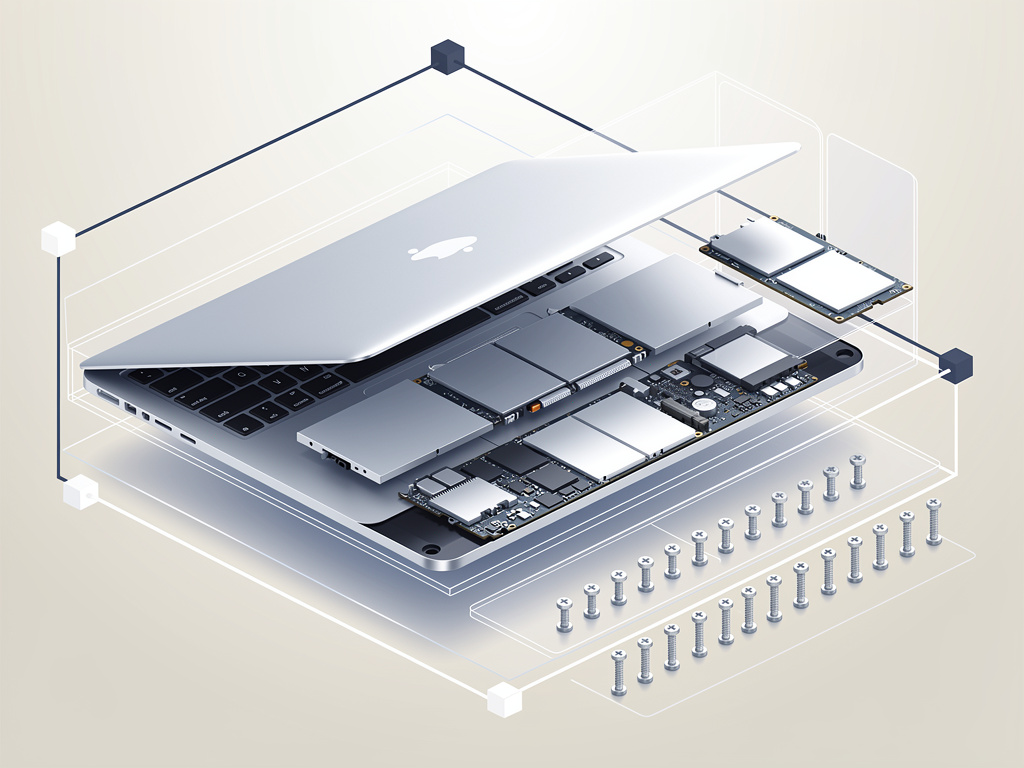
For two decades, Apple systematically made its laptops harder to fix. Glued-in batteries. Soldered RAM. Proprietary pentalobe screws designed to keep ordinary people out. The message was clear: don’t touch what’s inside.
Now, with the MacBook Neo, Apple has reversed course so dramatically that repair advocates are struggling to contain their surprise.
The MacBook Neo, Apple’s newest and most affordable laptop starting at $1,099, isn’t just a budget play. It’s the most repairable MacBook the company has ever shipped. A full teardown by iFixit — the repair advocacy organization that has spent years pressuring Apple on repairability — confirms that nearly every major component can be accessed, removed, and replaced with standard tools and minimal adhesive wrestling. As CNET reported, the teardown reveals a machine designed from the ground up with serviceability in mind, a stark departure from the company’s long-standing philosophy of sealed enclosures and disposable hardware.
This matters enormously — not just for consumers who want to swap a battery without visiting a Genius Bar, but for an entire industry watching to see whether right-to-repair legislation is actually changing how products get designed.
Inside the Neo: What the Teardown Actually Shows
iFixit’s teardown, published in late June 2025, is methodical and revealing. The MacBook Neo uses a modular internal layout where the battery, SSD storage, display, trackpad, keyboard, speakers, and ports can all be individually replaced. That’s a sentence that would have been unthinkable applied to any MacBook five years ago.
The battery uses pull-tab adhesive strips — the same kind of stretch-release strips found in iPhones since 2014 — rather than the aggressive glue that previously bonded cells directly to the chassis. According to CNET’s coverage of the teardown, this means the battery can be removed without solvents or heat guns. Just pull the tabs and lift.
Storage is a standout. Apple has used soldered NAND flash in its laptops since 2016, making it impossible to upgrade or replace storage after purchase. The Neo breaks from that pattern. It features a removable SSD module — not a standard M.2 slot, but a proprietary Apple module that can nonetheless be swapped out. For users who bought a base-model configuration and later need more space, or for anyone whose storage fails, this is a significant change.
The display assembly detaches cleanly. The trackpad comes out with screws, not glue. Speakers are modular. Even the USB-C ports, which on prior MacBooks were soldered to the logic board, appear to be replaceable as discrete components.
And the screws? Standard Phillips and Torx. Not pentalobe.
That last detail is almost symbolic. Apple introduced pentalobe screws in 2009 specifically to prevent users from opening their MacBook Pro batteries. The fastener had no legitimate engineering advantage over existing standards — it existed purely as a deterrent. Its absence in the Neo signals something more than an engineering choice. It signals a policy change.
iFixit gave the MacBook Neo a repairability score of 7 out of 10, the highest score any MacBook has received in the organization’s history. For context, the 2023 MacBook Pro scored a 4. The 2020 MacBook Air scored a 3. The notorious 2016-era MacBook Pro with Touch Bar scored a 1.
Seven out of ten. From Apple. In a laptop.
Why Now? Regulation, Reputation, and Revenue
Apple didn’t arrive at this design out of altruism. The company faces mounting legal pressure worldwide to make its products repairable.
In the European Union, new ecodesign regulations taking effect in phases between 2025 and 2027 will require laptops and tablets to meet minimum repairability standards, including battery replaceability and access to spare parts for professional and independent repair shops. France already assigns repairability index scores to electronics at point of sale — a system that directly affects purchasing decisions.
In the United States, right-to-repair legislation has passed in California, New York, Minnesota, Oregon, and Colorado, among other states. California’s law, SB 244, which went into effect in July 2024, requires manufacturers to make parts, tools, and repair documentation available for products sold in the state. Oregon’s law goes further, explicitly restricting the use of parts pairing — the practice of tying serialized components to a specific device so that only Apple-authorized replacements will function properly.
Apple had been fighting these laws for years through direct lobbying and through trade groups like TechNet and the Information Technology Industry Council. But the legislative tide turned. Rather than face a patchwork of compliance requirements across dozens of jurisdictions, Apple appears to have decided that designing for repairability globally was less costly than maintaining separate product strategies.
There’s also a market argument. Apple’s own self-service repair program, launched in 2022, was widely criticized as performative — the company charged near-retail prices for parts and required customers to rent a 79-pound toolkit shipped in two Pelican cases. The program technically gave users access to genuine parts, but it was so cumbersome and expensive that almost nobody used it. The MacBook Neo’s modular design makes self-service repair actually feasible, which could transform Apple’s repair program from a PR exercise into a functioning service channel.
And then there’s the competitive angle. Framework, the modular laptop startup founded by former Apple engineer Nirav Patel, has built a cult following among technically minded buyers by offering laptops where every component — from the mainboard to individual port modules — can be swapped by the user. Framework’s machines aren’t for everyone; they run Windows or Linux, and their build quality, while good, doesn’t match Apple’s fit and finish. But Framework proved that a meaningful segment of premium laptop buyers will pay for repairability. Apple noticed.
The timing also aligns with Apple’s broader sustainability messaging. The company has pledged to become carbon neutral across its entire supply chain by 2030. Longer product lifespans through easier repair directly support that goal by reducing the volume of devices manufactured and discarded. An unrepairable laptop that gets thrown away after three years because of a dead battery carries a carbon cost that no amount of recycled aluminum can offset.
So the MacBook Neo sits at the intersection of regulatory compliance, competitive pressure, sustainability commitments, and genuine consumer demand. Apple isn’t doing this because it suddenly believes in the right to repair. Apple is doing this because the cost of not doing it finally exceeded the cost of doing it.
What This Means for the Rest of Apple’s Lineup — and the Industry
The critical question is whether the Neo’s repairability represents a new baseline for Apple or an exception. The Neo is positioned as Apple’s entry-level MacBook, slotting below the MacBook Air and well below the MacBook Pro. It’s possible Apple views repairability as a feature appropriate for its budget tier but not for its premium machines, where thinness and integration take priority.
But that argument is harder to sustain than it used to be. The Neo is thin. It’s light. It doesn’t look or feel like a compromise machine. If Apple can deliver this level of modularity in a $1,099 laptop without sacrificing the industrial design standards that define its brand, the justification for soldering everything in the $2,499 MacBook Pro becomes much weaker.
Repair advocates are already making this point. Kyle Wiens, CEO of iFixit, noted in the teardown that the Neo proves repairability and premium design aren’t mutually exclusive — a claim Apple had implicitly rejected for years by arguing that integration was necessary for performance and aesthetics.
For the broader PC industry, the Neo sets a benchmark. Dell, HP, and Lenovo have made incremental improvements to laptop repairability in recent years, partly in response to the same regulatory pressures Apple faces. But none of them have made repairability a marquee feature of a flagship product launch the way Apple has with the Neo. If the most design-obsessed company in consumer electronics can ship a repairable laptop that looks this good, the excuse that repairability requires ugly compromises evaporates.
The parts pricing and availability story is still unwritten. Apple has historically charged steep premiums for replacement components — a practice that undermines repairability even when the hardware design supports it. Whether Apple will price Neo replacement parts reasonably, and whether it will make them available to independent repair shops without onerous certification requirements, will determine whether the Neo’s repairability is real or theoretical.
Parts pairing is another open question. Even if a component is physically removable, Apple can use software locks to prevent third-party or used parts from functioning fully. Apple has done this extensively with iPhone screens, batteries, and cameras, triggering warning messages or disabling features when non-serialized parts are detected. If the Neo implements similar restrictions, its modular hardware design becomes significantly less meaningful.
Early indications from iFixit’s testing suggest that some components — the display and the Touch ID sensor, specifically — do require Apple’s proprietary calibration process after replacement. But the battery and SSD reportedly work without any software pairing, which would be a meaningful step forward.
The MacBook Neo won’t single-handedly fix the electronics waste crisis. One repairable laptop model doesn’t undo the billions of devices designed to be disposable. But it does something perhaps more important: it eliminates the last credible argument against repairability in premium consumer electronics. The argument that it can’t be done. That the physics of thin, light, beautiful hardware demand sealed boxes and soldered chips.
Apple just proved otherwise. Now the question is whether the rest of its product line follows — and how quickly competitors respond.
The repair era, long promised and long delayed, may have finally arrived. Not with legislation or protest, but with a $1,099 laptop and a set of Phillips-head screws.


 WebProNews is an iEntry Publication