
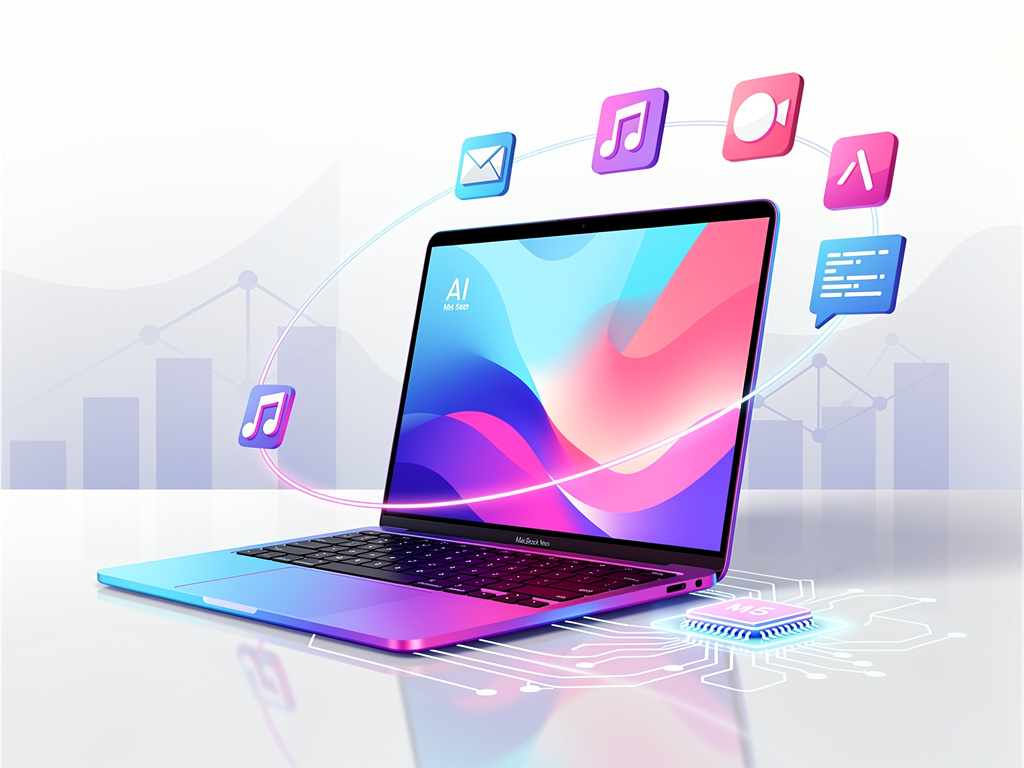
Apple has spent two decades courting professionals. The Mac Pro. The MacBook Pro with its ever-expanding port selection. Logic Pro, Final Cut Pro, the whole creative software stack priced and positioned for people who already know what they’re doing. But the MacBook Neo, unveiled earlier this month at Apple’s spring event, represents something different — a deliberate, calculated pivot toward the people who don’t know what they’re doing yet.
And that might be the smartest product decision Apple has made in years.
The MacBook Neo, starting at $999, is a 13-inch notebook powered by Apple’s M5 chip with a design language that borrows from the MacBook Air’s thin profile but adds a color-saturated aluminum finish in five options. It ships with a new version of GarageBand, a redesigned iMovie successor called Apple Clips Studio, and — most notably — a built-in AI creative assistant Apple is calling “Spark.” The machine is light. It’s loud, in the visual sense. And it’s aimed squarely at high school and college students who are making TikToks today but might be making films, albums, or design portfolios tomorrow.
9to5Mac’s opinion piece on the Neo called it “the most inspiring Mac Apple has ever made for young creatives,” arguing that the combination of accessible hardware, bundled creative software, and the Spark AI tool lowers the barrier to entry for teenagers and twenty-somethings who want to create but feel intimidated by professional tools. The piece noted that Apple’s decision to include six months of Apple Music for Artists and free access to Final Cut Pro’s mobile version with every Neo purchase signals a company thinking about pipeline — not just product.
That pipeline matters more than most analysts seem to appreciate.
The Creator Economy’s Hardware Gap
For years, the entry point into serious creative work on a Mac has been the MacBook Air at $1,099, or more realistically, a $1,299 configuration with enough storage to handle video projects. Chromebooks dominate the education market on price. Windows laptops from Acer and Lenovo own the budget tier. Apple’s share of the under-$1,000 laptop market has been negligible — essentially zero if you exclude refurbished units and education bulk deals.
But the creator economy doesn’t run on Chromebooks. It runs on tools that can handle multi-track audio, 4K video editing, graphic design, and increasingly, AI-assisted content generation. Adobe’s Creative Cloud suite costs $55 a month. A capable Windows laptop with a discrete GPU runs $800 to $1,200. The total cost of getting started as a young creator — really getting started, not just posting phone clips — has been climbing even as the cultural incentive to create has exploded.
Goldman Sachs estimated the creator economy at $250 billion in 2023. By some projections, it’ll double by 2027. The people entering that market are younger every year. They’re 15. They’re 12. They don’t have $2,000 to spend on a MacBook Pro, and their parents aren’t buying them one.
Apple sees this. The Neo is the answer.
What makes the Neo different from simply offering a cheaper MacBook Air isn’t the price cut alone — it’s the software bundle and the philosophical framing. Apple’s marketing materials for the Neo don’t mention spreadsheets, don’t mention productivity, barely mention email. Every image shows someone making something. Music. Video. Digital art. Code, but the visual, creative kind — SwiftUI interfaces, AR filters, interactive web designs.
The Spark AI assistant is particularly telling. According to Apple’s product page, Spark can analyze a rough voice memo and suggest chord progressions. It can take a collection of video clips and propose edit sequences. It can generate color palettes from text descriptions. None of this replaces skill. But it replaces the terrifying blank canvas that stops most aspiring creators before they start.
This is Apple doing what Apple does best: identifying a friction point and engineering around it. The friction here isn’t technical. It’s psychological. The Neo’s message to a 16-year-old is: you don’t need to know everything before you begin.
Why the Timing Is Right — and the Competition Is Watching
Apple’s launch of the Neo comes at a moment when several forces are converging. AI tools have made creative work more accessible across every platform. TikTok, YouTube Shorts, and Instagram Reels have created distribution channels that didn’t exist five years ago, channels where a teenager in rural Kansas has the same algorithmic shot as a studio in Los Angeles. And Gen Z’s relationship with technology is fundamentally different from that of millennials — they expect their devices to be creative instruments, not just consumption portals.
Google has noticed. Its Chromebook Plus line, launched in late 2023, added AI-powered photo and video editing tools. Microsoft has been pushing Copilot integration into every corner of Windows. But neither company has Apple’s vertically integrated advantage: hardware, software, silicon, and a creative software library all designed by the same company, all optimized for each other.
The M5 chip in the Neo reportedly handles real-time 4K video rendering without the fan noise that plagued Intel-era MacBooks. The neural engine — now in its sixth generation — powers Spark’s AI features on-device, meaning no cloud dependency for basic creative assistance. For a young creator working from a dorm room with spotty Wi-Fi, that’s not a minor detail. It’s a foundational one.
And then there’s the color question. It sounds trivial. It isn’t. Apple offers the Neo in Coral, Indigo, Sage, Sunlight, and Midnight. The MacBook Air comes in four muted metallic tones. The MacBook Pro comes in two. Color is identity for Gen Z buyers. It’s self-expression before the lid even opens. Apple’s industrial design team clearly understood this — the Neo doesn’t look like a shrunken professional machine. It looks like something you’d want to carry into a coffee shop, a lecture hall, a recording session.
The 9to5Mac piece made an interesting observation about Apple’s retail strategy for the Neo: Apple Stores will reportedly feature dedicated Neo demo stations with creative project templates preloaded, so walk-in customers can sit down and immediately start making a beat or editing a short film. No setup. No tutorials. Just creation. That’s a retail experience designed for conversion, and it targets exactly the demographic that still visits physical stores — teenagers with their parents.
Critics will point out that $999 isn’t cheap. Not for a family stretching to cover tuition. Not compared to a $300 Chromebook. But Apple isn’t competing with Chromebooks. It’s competing with the combined cost of a Chromebook plus a subscription to Adobe plus a MIDI controller plus months of YouTube tutorials trying to make those things work together. The Neo bundles the creative stack. That’s the value proposition.
So where does this leave Apple’s broader Mac lineup? The Air remains the generalist workhorse. The Pro stays the professional’s tool. The Neo carves out a new category underneath both — not a budget Mac, but a purpose-built creative onramp. Apple hasn’t had a product like this since the original iMac G3, which was also colorful, also opinionated, and also designed to make people feel like a computer was for them.
That comparison isn’t accidental. The iMac G3 launched in 1998 and sold millions to first-time computer buyers. It didn’t have the fastest processor or the most storage. What it had was permission. It told people: this is yours, and you can do things with it. The Neo carries that same energy, updated for an era where “doing things” means producing content, not just consuming it.
Whether the Neo succeeds commercially will depend on factors Apple can’t fully control — macroeconomic conditions, back-to-school spending trends, the durability of the creator economy hype cycle. But strategically, the product makes profound sense. Every 16-year-old who learns to edit video on a Neo is a potential Final Cut Pro customer at 22 and a Mac Studio buyer at 30. Apple is planting seeds.
The harvest comes later. Apple has always been patient enough to wait.


 WebProNews is an iEntry Publication