
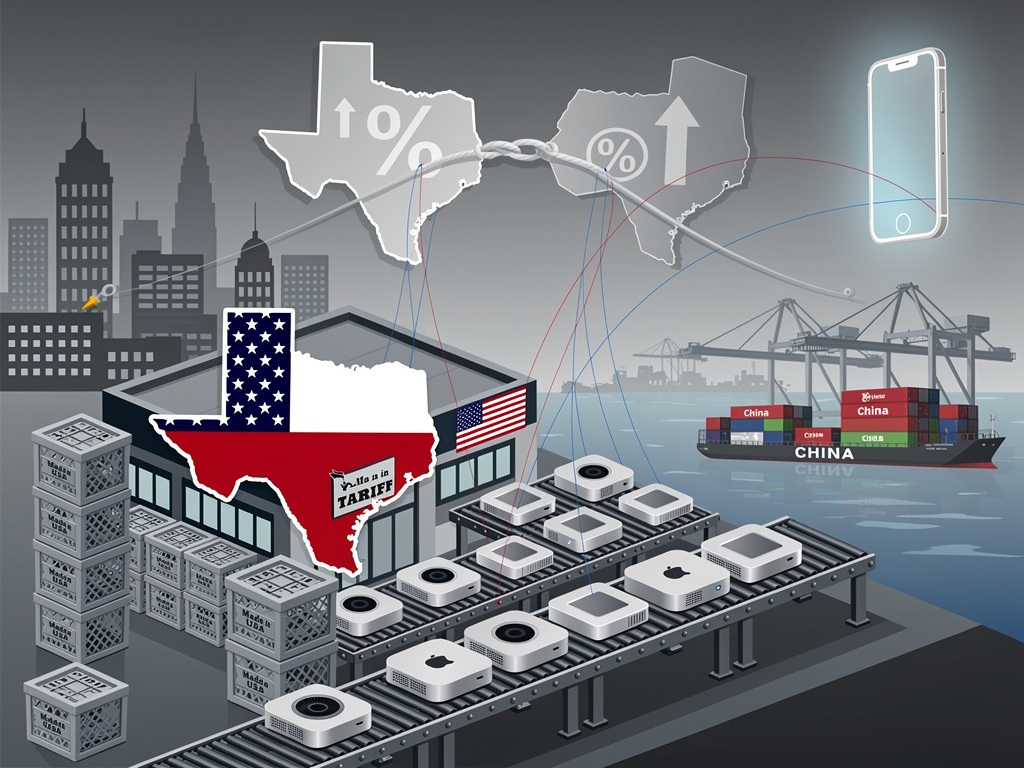
Apple Inc. is preparing to manufacture Mac Mini desktop computers in the United States, a strategic move that arrives amid escalating trade tensions between Washington and Beijing and growing political pressure on American technology companies to bring production home. The decision, confirmed by multiple reports, marks one of the most significant shifts in Apple’s manufacturing footprint in years — and raises hard questions about whether domestic production can truly insulate the company from the tariff storm battering global commerce.
According to Engadget, Apple will begin producing Mac Minis at a facility in Texas, reportedly the same Flex Ltd. plant in Austin that previously assembled the now-discontinued Mac Pro. The move comes as the Trump administration has imposed tariffs as high as 145% on Chinese imports, with a temporary 90-day reduction to 30% currently in effect. Apple, which assembles the vast majority of its products in China through partners like Foxconn and Luxshare, faces an existential cost challenge if those tariffs snap back to their full levels.
A Texas-Sized Bet on American Assembly
The Austin facility operated by Flex Ltd. has history with Apple. It was the site where Apple assembled its high-end Mac Pro for several years, a product that carried a “Assembled in USA” label but still relied heavily on components sourced from overseas. The Mac Mini, which was redesigned in late 2024 with Apple’s M4 chip family, is a compact desktop computer that starts at $599. Its relatively simple physical design — a small aluminum enclosure with minimal moving parts — makes it among the more feasible Apple products to assemble domestically.
But assembly is not the same as manufacturing. Industry analysts have long pointed out that even when Apple assembles products in the United States, the components inside — chips fabricated in Taiwan by TSMC, memory modules from South Korea, display controllers and sensors from Japan and China — still cross international borders and remain subject to various trade restrictions. The Mac Mini’s assembly in Texas would allow Apple to label the product as American-made, but the global supply chain behind it remains deeply international.
Tariff Arithmetic and the Pressure on Margins
Apple’s urgency is driven by simple arithmetic. The company reportedly airlifted approximately $2 billion worth of iPhones from India to the United States ahead of tariff deadlines earlier this year, a logistical operation that underscored just how seriously Cupertino is taking the trade war. According to reporting from Engadget, Apple CEO Tim Cook discussed the Mac Mini manufacturing plans during a recent conversation with President Donald Trump, who subsequently posted about the development on Truth Social, calling it “great news.”
The political dimensions of this decision are impossible to ignore. Trump has repeatedly singled out Apple as a company that should manufacture in the United States, and Cook has cultivated a careful relationship with the administration, visiting the White House and maintaining open lines of communication. Moving Mac Mini production to Texas gives Apple a tangible talking point — a physical factory on American soil — even as the company continues to produce its highest-volume products, particularly the iPhone, overseas.
Why the Mac Mini and Not the iPhone
The choice of the Mac Mini is telling. Apple sells tens of millions of iPhones each quarter, requiring manufacturing operations of staggering scale. Foxconn’s largest iPhone assembly facility in Zhengzhou, China, employs hundreds of thousands of workers and can produce roughly 500,000 units per day during peak periods. Replicating that capacity in the United States would require years of investment and a labor force that simply does not exist at comparable scale or cost.
The Mac Mini, by contrast, is a niche product. Apple does not break out unit sales for individual Mac models, but the desktop category represents a small fraction of the company’s overall revenue. Assembling Mac Minis in Texas is logistically manageable in a way that domestic iPhone production is not. It is, in effect, the low-hanging fruit of onshoring — a product simple enough and low-volume enough to move without fundamentally disrupting Apple’s operations or cost structure.
The Broader Onshoring Trend Across Big Tech
Apple is not alone in making these calculations. Across the technology sector, companies are reevaluating their manufacturing dependencies on China. TSMC is building advanced chip fabrication plants in Arizona, with the first facility expected to begin volume production soon. Samsung has committed billions to semiconductor manufacturing in Texas. Intel, backed by federal CHIPS Act subsidies, is expanding domestic fabrication capacity in Ohio and Arizona.
But there is a meaningful difference between semiconductor fabrication — which governments view as a national security priority and are willing to subsidize heavily — and consumer electronics assembly, which operates on thin margins and depends on low labor costs. Apple’s Mac Mini move falls into the latter category. Without significant government incentives or tariff relief specifically tied to domestic production, the economics of assembling consumer electronics in the United States remain challenging. American manufacturing workers command wages that are multiples of what their counterparts in China or India earn, and the supporting infrastructure of component suppliers, tooling specialists, and logistics networks that exists in Shenzhen has no domestic equivalent.
India, Vietnam, and the Diversification Strategy
The Texas Mac Mini plan is one piece of a larger diversification strategy that Apple has been executing for several years. The company has significantly expanded iPhone assembly in India through partners Foxconn and Tata Electronics, and has moved substantial iPad and AirPods production to Vietnam. These moves predate the current tariff crisis — Apple began shifting production to India as early as 2017 — but the trade war has accelerated the timeline.
India now produces a meaningful share of iPhones sold globally, and Apple has been investing in building out the supplier base there. However, India is not immune to tariffs either. The Trump administration has imposed duties on Indian imports as well, albeit at lower rates than those targeting China. Vietnam faces similar exposure. The fundamental challenge for Apple is that no single country — including the United States — can fully replace China’s role in its supply chain in the near term.
What Wall Street Is Watching
Investors have been closely monitoring Apple’s tariff exposure. The company’s stock experienced volatility earlier this year as the trade war escalated, and analysts at major banks have modeled various scenarios for how tariffs could impact Apple’s gross margins. Morgan Stanley estimated earlier this year that full 145% tariffs on Chinese imports could reduce Apple’s earnings per share by more than 25% if the company chose to absorb the costs rather than raise prices.
Apple has historically been reluctant to pass tariff costs directly to consumers, fearing demand destruction in a market where smartphone upgrade cycles are already lengthening. The Mac Mini’s domestic assembly could exempt that specific product from Chinese import duties, but the financial impact on Apple’s overall results would be modest given the product’s relatively small contribution to total revenue. The real question for Wall Street is what happens with the iPhone — and on that front, the answer remains tied to the outcome of trade negotiations between Washington and Beijing.
The Symbolism and Substance of Made in America
There is an undeniable symbolic power in Apple manufacturing a product in the United States. For decades, the “Designed by Apple in California, Assembled in China” label has been a shorthand for the globalization of technology manufacturing. A Mac Mini bearing an American assembly mark represents a partial reversal of that trend, and one that carries political weight regardless of its economic significance.
But substance matters more than symbolism in the long run. Apple’s supply chain is a finely tuned machine built over more than two decades, and no single factory in Texas will fundamentally alter its structure. The Mac Mini announcement is best understood as a tactical response to a specific political and trade environment — a move designed to buy goodwill in Washington while Apple works to diversify its manufacturing base across multiple countries. Whether it represents the beginning of a broader shift toward American manufacturing or remains an isolated gesture will depend on factors largely outside Apple’s control: the duration and severity of tariffs, the availability of skilled labor, and the willingness of the U.S. government to invest in the industrial infrastructure that large-scale electronics production demands.
For now, Apple is doing what it has always done — managing risk, maintaining relationships with those in power, and making incremental moves that preserve its options. The Mac Mini may be coming home to Texas, but Apple’s manufacturing heart remains, for the foreseeable future, distributed across the factories of East and South Asia.


 WebProNews is an iEntry Publication