
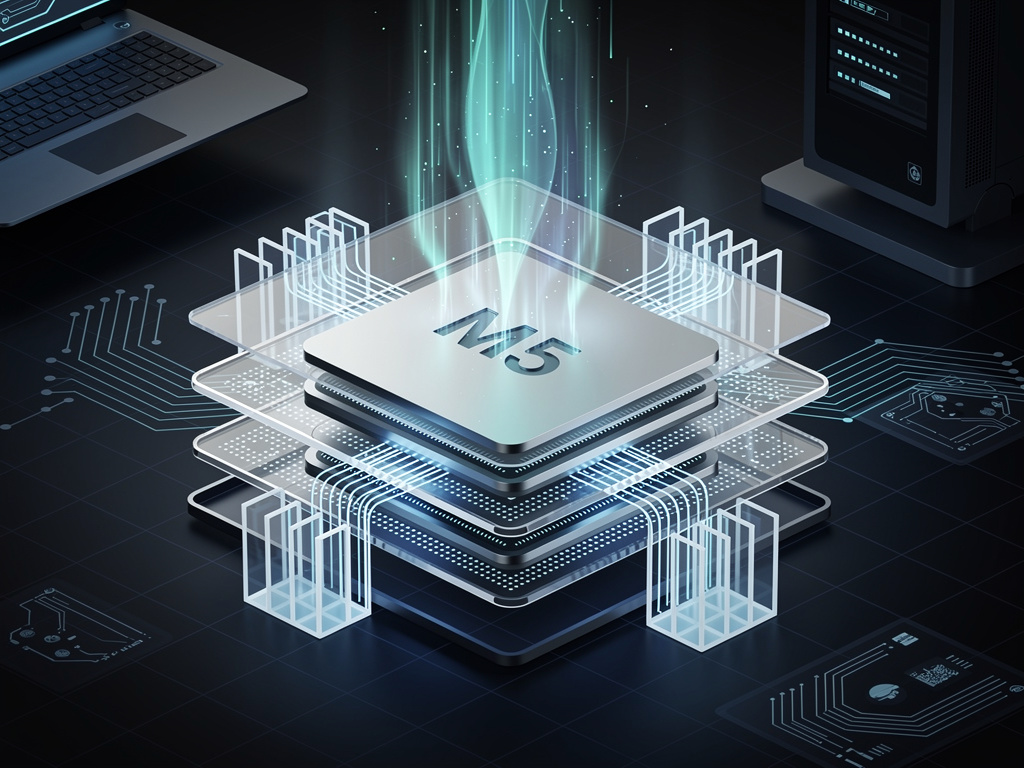
Apple’s next-generation M5 processors are poised to represent a fundamental shift in semiconductor design, with advanced chip packaging techniques promising to deliver unprecedented performance gains while simultaneously addressing thermal challenges that have plagued high-performance laptops. According to detailed technical analysis from AppleInsider, the M5 Pro and M5 Max variants will incorporate sophisticated packaging innovations that could redefine expectations for professional mobile computing.
The semiconductor industry has reached a critical inflection point where traditional scaling methods face diminishing returns. As transistor density approaches physical limits, manufacturers like Apple and its foundry partner TSMC are increasingly turning to advanced packaging as the primary vehicle for performance improvements. This strategic pivot represents more than incremental enhancement—it signals a fundamental reimagining of how chips are constructed, cooled, and optimized for real-world workloads.
The Technical Foundation: Understanding Advanced Chip Packaging
At the heart of Apple’s M5 strategy lies a transition to what industry insiders call 2.5D and 3D packaging architectures. Unlike conventional chip designs where all components exist on a single silicon die, these advanced approaches allow multiple chiplets to be interconnected with unprecedented density and efficiency. The M5 Pro and M5 Max are expected to leverage TSMC’s Integrated Fan-Out (InFO) technology combined with silicon interposer designs that enable high-bandwidth communication between discrete chip components.
According to AppleInsider’s technical breakdown, this packaging evolution allows Apple to separate different functional blocks—CPU cores, GPU clusters, neural engines, and memory controllers—into optimized chiplets manufactured using the most appropriate process node for each function. This heterogeneous integration approach delivers multiple advantages: reduced manufacturing costs through improved yields, better thermal characteristics through distributed heat generation, and enhanced performance through shorter interconnect distances between critical components.
Thermal Dynamics: Solving the Heat Equation
Heat dissipation has emerged as the primary constraint limiting performance in modern high-end laptops. Current M4 Max MacBook Pros can throttle under sustained workloads as thermal limits are reached, particularly when both CPU and GPU are simultaneously stressed. The M5’s packaging innovations directly address this challenge through improved thermal interface materials and more efficient heat spreading across the chip package.
The new packaging architecture enables more effective thermal management by distributing heat sources across a larger physical area rather than concentrating them in a single monolithic die. This distributed thermal profile allows the MacBook’s existing cooling system—heat pipes, vapor chambers, and fans—to operate more efficiently. Industry analysts suggest that M5 Pro systems could maintain peak performance up to 20% longer under sustained loads compared to their M4 counterparts, while M5 Max configurations might see even more dramatic improvements in thermal-limited scenarios.
Performance Implications Across Professional Workflows
The real-world impact of these packaging improvements extends far beyond synthetic benchmarks. Video editors working with 8K ProRes footage, 3D artists rendering complex scenes, and software developers compiling large codebases all stand to benefit from sustained higher clock speeds and reduced thermal throttling. The M5’s ability to maintain peak performance during extended work sessions could translate to meaningful productivity gains across creative and technical professions.
Memory bandwidth represents another critical area where advanced packaging delivers tangible benefits. By positioning high-bandwidth memory dies closer to compute elements and utilizing advanced interconnect technologies, the M5 Max is expected to achieve memory bandwidth figures approaching 600 GB/s—a substantial increase over the M4 Max’s already impressive specifications. This enhanced memory subsystem particularly benefits GPU-intensive applications and machine learning workloads that are increasingly memory-bound rather than compute-bound.
Manufacturing Economics and Supply Chain Considerations
The transition to advanced packaging carries significant implications for Apple’s supply chain and manufacturing economics. Chiplet-based designs allow Apple to improve yields by manufacturing smaller, less complex dies that are then assembled into complete processors. When a defect occurs during fabrication, only the affected chiplet is discarded rather than an entire large monolithic die, potentially reducing costs despite the added complexity of advanced packaging processes.
TSMC’s investment in advanced packaging capacity has been substantial, with the foundry allocating billions of dollars to expand its Chip-on-Wafer-on-Substrate (CoWoS) and InFO production capabilities. Apple’s adoption of these technologies for the M5 family represents a major validation of TSMC’s strategic direction and ensures the Cupertino company maintains access to cutting-edge manufacturing capabilities that competitors may struggle to replicate at similar scale and cost points.
Competitive Positioning in the Professional Computing Market
Apple’s packaging innovations arrive as the professional laptop market faces intensifying competition. Intel’s upcoming Arrow Lake mobile processors and AMD’s Zen 5-based mobile chips both promise significant performance improvements, while Qualcomm’s Snapdragon X Elite platform has demonstrated impressive efficiency in Windows laptops. The M5’s advanced packaging could provide Apple with a crucial differentiation point, particularly in sustained performance scenarios where thermal management becomes the determining factor.
The professional creative market—photographers, videographers, audio engineers, and designers—has become increasingly central to Apple’s Mac strategy. These users demand not just peak performance but consistent, reliable operation during hours-long rendering sessions and complex project workflows. The M5’s improved thermal characteristics directly address these professional requirements, potentially strengthening Apple’s position in segments where Windows workstations have traditionally competed effectively.
Power Efficiency and Battery Life Considerations
While much attention focuses on performance improvements, the M5’s packaging innovations also promise meaningful efficiency gains. Advanced packaging reduces the distance signals must travel between chip components, decreasing both latency and power consumption. Combined with TSMC’s continued process node refinements, the M5 family could deliver the same performance as M4 chips while consuming 15-20% less power, or significantly higher performance at equivalent power levels.
For MacBook Pro users, this efficiency improvement translates directly to extended battery life during mobile work sessions. The ability to maintain high performance while drawing less power from the battery represents a critical advantage for professionals who frequently work away from power outlets. Apple’s historical emphasis on all-day battery life suggests the company will balance performance improvements with efficiency gains to maintain or extend current battery runtime specifications.
Neural Engine and AI Workload Optimization
The M5’s packaging architecture appears particularly well-suited to accelerating machine learning and AI workloads that have become increasingly central to professional applications. By positioning the Neural Engine chiplet in close proximity to both system memory and GPU resources, Apple can minimize data movement overhead that typically constrains AI inference performance. This optimization becomes increasingly important as applications from photo editing to code completion incorporate sophisticated machine learning models.
Industry observers note that Apple’s integrated approach to AI acceleration—combining Neural Engine hardware with optimized software frameworks and on-device model execution—differentiates the company’s strategy from competitors who rely more heavily on cloud-based AI processing. The M5’s enhanced AI capabilities could strengthen this differentiation, particularly as privacy-conscious professionals seek powerful on-device intelligence without cloud dependencies.
Market Timing and Product Roadmap Integration
The anticipated timeline for M5-based MacBook Pro releases positions these systems to capture professional upgrade cycles in late 2025 and early 2026. Many current M1 and M2 MacBook Pro owners are approaching the three-to-four-year replacement window that typically characterizes professional computer purchases. The combination of significant architectural improvements and accumulated software optimizations could drive a substantial upgrade cycle among Apple’s professional user base.
Apple’s broader product strategy appears to increasingly leverage advanced packaging across its entire silicon portfolio. The iPhone’s A-series chips, iPad processors, and even the company’s custom silicon for accessories are all candidates for similar packaging innovations. This platform approach allows Apple to amortize substantial R&D investments across multiple product lines while maintaining the tight hardware-software integration that defines the company’s competitive advantage.
Looking Forward: The Post-Moore’s Law Era
The M5’s packaging innovations represent more than a single product generation improvement—they signal Apple’s strategic response to the fundamental challenges facing semiconductor advancement in the post-Moore’s Law era. As traditional transistor scaling delivers diminishing returns, advanced packaging emerges as the primary vehicle for continued performance improvement. Apple’s early and aggressive adoption of these technologies positions the company to maintain its performance leadership even as the broader industry grapples with physics-imposed limitations.
For technology professionals, the M5 generation promises not just faster computers but more capable, reliable tools that maintain peak performance during extended work sessions. The combination of improved thermal management, enhanced memory bandwidth, and optimized AI acceleration addresses real pain points that constrain current professional workflows. As these systems reach market in the coming months, the true measure of success will be whether these technical innovations translate to tangible productivity improvements for the creative professionals and technical users who depend on MacBook Pros for their livelihoods.


 WebProNews is an iEntry Publication