
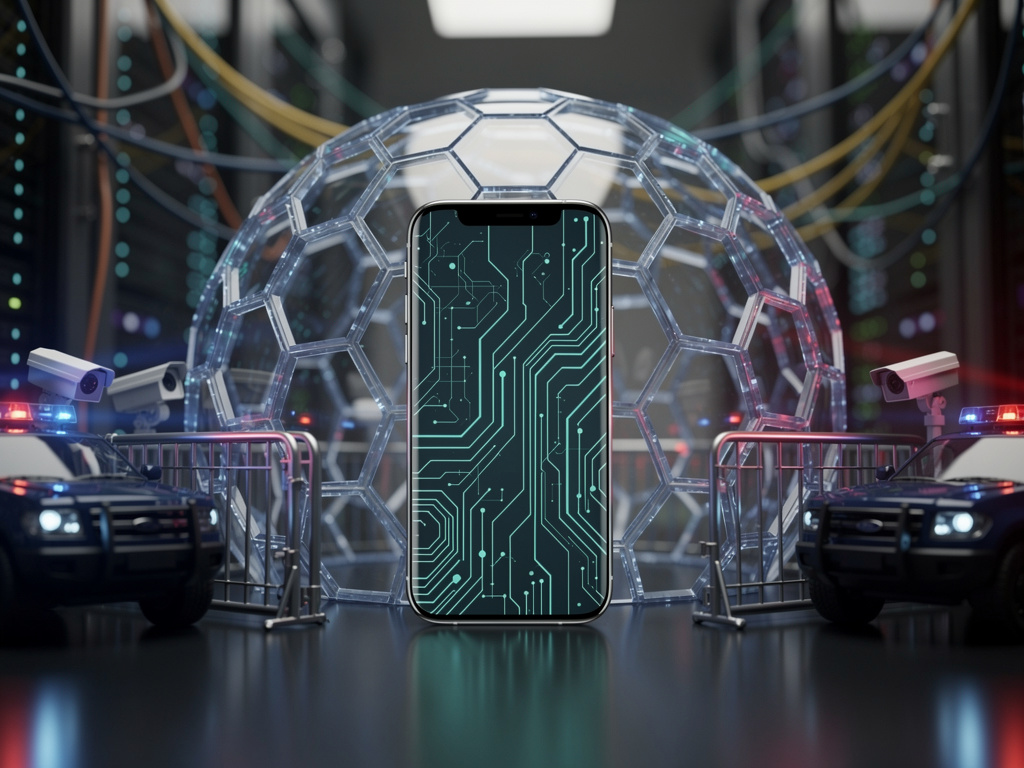
Apple’s Lockdown Mode, initially conceived as a defense mechanism against sophisticated spyware attacks, has evolved into something far more consequential: a virtually impenetrable barrier that even federal law enforcement agencies like the FBI cannot breach. This development marks a significant escalation in the ongoing encryption debate between technology companies and government authorities, with implications that extend far beyond individual privacy concerns into the realm of national security and corporate responsibility.
According to AppleInsider, the feature represents Apple’s most aggressive stance yet in the encryption wars, creating a security architecture so robust that it effectively renders traditional forensic techniques obsolete. The mode, when activated, disables numerous iPhone functionalities that could serve as potential attack vectors, including message attachments, FaceTime calls from unknown contacts, wired connections to computers, and configuration profiles. These restrictions, while inconvenient for everyday users, create a security perimeter that current law enforcement tools cannot penetrate.
The timing of this technological advancement comes at a particularly sensitive moment in the relationship between Silicon Valley and Washington. Federal agencies have long argued that encryption technology, while protecting legitimate privacy interests, also shields criminal activity from lawful investigation. The FBI’s inability to access data on devices protected by Lockdown Mode represents a complete reversal of the power dynamic that existed during the early smartphone era, when law enforcement could routinely access device contents through various technical means or legal compulsion.
The Technical Architecture Behind Impenetrability
Lockdown Mode’s effectiveness stems from its fundamental approach to security: rather than simply adding layers of protection, it removes potential vulnerabilities entirely. When enabled, the feature strips away much of iOS’s sophisticated functionality, returning the device to a more primitive but infinitely more secure state. Web browsing becomes restricted, with just-in-time JavaScript compilation disabled. Shared albums in Photos disappear. Even Apple services like Apple Music and Apple News face significant limitations in their ability to receive invitations or requests.
This scorched-earth approach to security represents a philosophical departure from traditional cybersecurity thinking. Rather than attempting to secure every possible feature and function, Apple has essentially acknowledged that true security requires sacrifice. For users facing nation-state level threats—journalists in authoritarian countries, human rights activists, corporate executives with sensitive information, or individuals targeted by sophisticated mercenary spyware operations—these sacrifices represent an acceptable trade-off for genuine protection.
Law Enforcement’s Growing Frustration
The FBI and other federal agencies have watched with increasing alarm as encryption technology has moved from being a niche concern to a mainstream impediment to investigation. The bureau has long maintained that it faces a “going dark” problem, where lawful warrants and court orders become meaningless when confronted with unbreakable encryption. Lockdown Mode represents the culmination of this trend, offering protection that even the most sophisticated government hackers cannot overcome without the user’s direct cooperation.
This reality has reignited debates about whether technology companies should be required to build backdoors into their products for law enforcement access. However, cryptography experts have consistently argued that any backdoor, no matter how carefully designed, creates vulnerabilities that malicious actors could exploit. Apple has positioned Lockdown Mode not as an anti-government tool, but as protection against the proliferation of commercial spyware tools like NSO Group’s Pegasus, which have been used by authoritarian governments to target dissidents, journalists, and political opponents.
The Commercial Spyware Industry’s Role
The rise of companies selling sophisticated surveillance tools to governments worldwide has fundamentally altered the threat environment that consumer technology companies must address. These commercial spyware operations have demonstrated the ability to exploit zero-day vulnerabilities in iOS and other operating systems, enabling silent compromise of devices without any user interaction. The discovery that such tools were being used not just against terrorists and criminals, but against civil society figures, created both a moral imperative and a business necessity for companies like Apple to respond.
Lockdown Mode emerged from this context as Apple’s acknowledgment that the traditional security model—patching vulnerabilities as they’re discovered—cannot keep pace with well-funded adversaries who stockpile unknown exploits. By disabling entire categories of functionality that these exploits typically target, Lockdown Mode sidesteps the vulnerability discovery and patching cycle entirely. This approach effectively neutralizes the commercial spyware industry’s product offerings, at least for users sophisticated enough to enable the protection.
Constitutional and Legal Implications
The legal implications of technology that even court orders cannot compel access to remain largely unexplored territory. The Supreme Court has established that individuals cannot be forced to provide testimonial evidence against themselves under the Fifth Amendment, but the application of this principle to biometric authentication and encryption passphrases continues to evolve through lower court decisions. Lockdown Mode adds another layer of complexity to this jurisprudence by making the technical question moot—even a fully cooperative subject cannot provide access that the technology itself prevents.
This reality forces a reconsideration of what “lawful access” means in an era of mathematics-based security. Law enforcement agencies argue that their inability to execute valid warrants undermines the rule of law and allows criminals to operate with impunity. Privacy advocates counter that strong encryption protects not just individual privacy but also economic security, intellectual property, and democratic discourse from both criminal hackers and authoritarian governments. The debate has remained largely deadlocked for years, with neither side willing to concede ground on what they view as fundamental principles.
Corporate Responsibility and Market Dynamics
Apple’s decision to offer Lockdown Mode reflects broader calculations about its brand identity and market position. The company has increasingly positioned privacy and security as key differentiators in the competitive smartphone market, arguing that its business model—based on hardware sales rather than advertising—aligns its interests with users rather than with data collection. Lockdown Mode represents the logical extreme of this positioning, offering protection that goes beyond what most users need but that signals Apple’s commitment to security as an absolute rather than a convenience feature.
This strategy carries risks as well as benefits. By creating technology that frustrates law enforcement, Apple invites regulatory backlash and potential legislation that could mandate backdoors or restrict encryption. Several countries have already passed or proposed laws requiring technology companies to assist with lawful access requests, even when doing so would require weakening security features. Apple must navigate this regulatory environment while maintaining its security-focused brand identity and meeting the needs of users who face genuine threats.
The International Dimension
The global nature of the technology industry adds another layer of complexity to the encryption debate. What American law enforcement views as a public safety necessity, activists in authoritarian countries see as essential protection for their lives and liberty. Apple sells devices worldwide and cannot easily create different security architectures for different jurisdictions without undermining the fundamental security model. Lockdown Mode’s existence benefits not just privacy-conscious Americans but also dissidents in countries where government surveillance poses existential threats.
This international dimension explains why technology companies have resisted pressure to weaken encryption even when faced with sympathetic cases involving terrorism or child exploitation. Any backdoor created for American law enforcement would inevitably be demanded by other governments with far less respect for human rights and due process. The technology itself cannot distinguish between a warrant issued by a federal judge and a demand from an authoritarian regime, making the question of backdoors not just a domestic policy debate but a global human rights issue.
Future Trajectories and Unresolved Questions
The introduction of Lockdown Mode does not resolve the encryption debate but rather moves it to new ground. As more users become aware of the feature and adopt it—either out of genuine security needs or simply as a precautionary measure—law enforcement’s ability to access digital evidence will continue to diminish. This trend may force a reckoning that has been postponed for years: whether democratic societies will accept that some evidence will remain beyond reach, or whether they will demand that technology companies compromise security in the name of public safety.
The answer to this question will shape not just the future of consumer technology but also the balance between privacy and security that defines modern democracies. Apple’s Lockdown Mode has effectively forced the issue by demonstrating that truly secure technology is possible but comes at the cost of both convenience and law enforcement access. Whether this represents the future of consumer technology or a high-water mark that will be rolled back through legislation or market pressure remains to be seen. What is certain is that the encryption wars have entered a new phase, with Lockdown Mode serving as both a technological achievement and a political statement about the proper role of privacy in the digital age.


 WebProNews is an iEntry Publication