
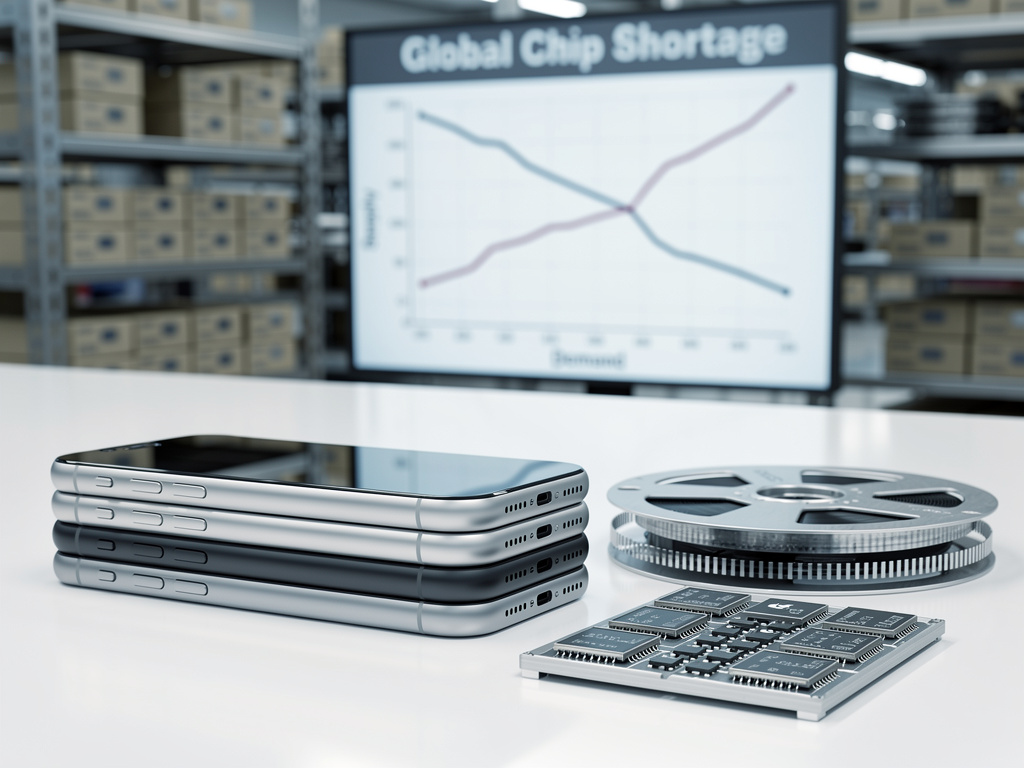
The global semiconductor industry’s persistent memory chip shortages are creating unprecedented challenges for Apple’s iPhone production lines, forcing the tech giant to navigate a complex web of supplier negotiations, pricing pressures, and potential product delays that could reshape the smartphone market’s competitive dynamics. As memory prices surge and availability tightens, Apple finds itself in a precarious position that tests both its supply chain mastery and its ability to maintain profit margins while delivering the premium devices consumers expect.
According to CNET, the memory shortage affecting Apple’s iPhone production stems from a confluence of factors including increased demand for AI-capable devices, manufacturing capacity constraints, and geopolitical tensions that have disrupted traditional supply chains. The situation has intensified as memory manufacturers struggle to balance production between different types of chips, with high-bandwidth memory for AI applications commanding premium prices and diverting capacity from smartphone-focused DRAM and NAND flash production.
Industry analysts tracking semiconductor markets have observed that memory prices have climbed substantially over recent quarters, reversing a prolonged period of declining costs that had benefited smartphone manufacturers. This reversal comes at a particularly challenging time for Apple, which relies on cutting-edge memory technology to differentiate its flagship iPhone models through features like advanced photography capabilities, seamless multitasking, and increasingly sophisticated on-device AI processing. The company’s commitment to using only the highest-quality components means it cannot simply switch to lower-grade alternatives without compromising the user experience that justifies premium pricing.
Manufacturing Capacity Constraints Intensify Competition
The memory shortage reflects broader structural challenges within the semiconductor industry, where building new fabrication facilities requires multi-billion dollar investments and years of lead time. Major memory manufacturers like Samsung, SK Hynix, and Micron have announced expansion plans, but these new facilities won’t reach full production capacity until 2025 or later, leaving a significant gap between current supply and surging demand. This timeline mismatch creates a seller’s market where memory suppliers can command higher prices and prioritize customers offering the most favorable terms.
Apple’s position as one of the world’s largest memory purchasers typically gives it significant negotiating leverage, but the current shortage has shifted power dynamics in favor of suppliers. The company must now compete not only with other smartphone manufacturers but also with data center operators, AI infrastructure providers, and automotive companies—all of whom require massive quantities of memory chips for their products. This multi-industry competition for limited supply has created a complex allocation challenge where traditional customer relationships and volume commitments may not guarantee priority access to scarce components.
Financial Implications Ripple Through Apple’s Business Model
The rising cost of memory components directly impacts Apple’s carefully calibrated pricing strategy and profit margins. Each iPhone contains multiple memory chips, including DRAM for active processing and NAND flash for storage, with higher-end models incorporating substantially more memory to support advanced features. Even modest increases in per-chip pricing can translate into significant costs when multiplied across the hundreds of millions of iPhones Apple produces annually. The company faces a difficult choice: absorb these increased costs and accept lower margins, or pass them along to consumers through higher retail prices at a time when economic uncertainty has made buyers more price-sensitive.
Financial analysts have noted that Apple’s services revenue and ecosystem lock-in provide some buffer against hardware margin compression, but the company’s stock valuation still depends heavily on iPhone sales performance. Any production delays or forced price increases could affect unit sales volumes, potentially creating a cascading effect on services adoption and accessory sales. The situation is particularly acute for Apple’s mid-range iPhone models, where memory costs represent a larger percentage of total bill of materials and where the company faces more direct competition from Android manufacturers who may be willing to accept thinner margins.
Strategic Responses and Supply Chain Diversification
In response to these challenges, Apple has reportedly intensified efforts to diversify its memory supply chain and secure long-term supply agreements that lock in pricing and availability. The company’s legendary supply chain management team, which has historically excelled at playing suppliers against each other to secure favorable terms, now focuses on building redundancy and resilience rather than simply minimizing costs. This strategic shift reflects a broader industry recognition that supply chain fragility poses existential risks that justify paying premium prices for security of supply.
Apple’s approach includes working more closely with memory manufacturers on product roadmaps, potentially committing to purchase future generations of memory technology in exchange for guaranteed allocation of current-generation chips. The company has also explored technical alternatives, such as optimizing iOS to require less memory for equivalent performance or implementing more aggressive memory compression techniques. However, these software-based solutions offer only limited relief when competing devices continue adding more physical memory to their specifications, creating a perception gap that could disadvantage Apple in spec-sheet comparisons.
Geopolitical Factors Compound Supply Uncertainties
The memory shortage’s geopolitical dimensions add another layer of complexity to Apple’s supply challenges. With most advanced memory production concentrated in South Korea and Taiwan, any escalation of regional tensions or trade restrictions could severely disrupt supply chains. The United States government’s efforts to build domestic semiconductor manufacturing capacity through initiatives like the CHIPS Act may eventually reduce dependence on Asian suppliers, but these domestic facilities remain years away from producing the volumes Apple requires. Meanwhile, China’s push for semiconductor self-sufficiency creates additional demand that further strains global memory supplies.
Apple’s significant exposure to the Chinese market, both as a manufacturing base and as a crucial consumer market, complicates its strategic options. The company must navigate competing pressures to diversify production away from China while maintaining relationships with Chinese suppliers and avoiding actions that might trigger regulatory retaliation. Memory procurement sits at the intersection of these tensions, as decisions about supplier selection and manufacturing location carry implications far beyond simple cost considerations. The company’s ability to balance these competing interests while maintaining product quality and availability will likely determine its competitive position for years to come.
Innovation Pressures Meet Component Constraints
The memory shortage arrives at a critical juncture for smartphone innovation, as Apple and competitors race to integrate artificial intelligence capabilities that require substantially more memory than previous generations of devices. On-device AI processing, which Apple has emphasized for privacy reasons, demands both increased memory capacity and higher-bandwidth memory interfaces to achieve acceptable performance. The company’s planned AI features for future iOS versions may need to be scaled back or limited to higher-end models if memory availability doesn’t improve, potentially undermining Apple’s competitive positioning against rivals who might accept cloud-based AI solutions that reduce on-device memory requirements.
This tension between innovation ambitions and component availability forces difficult product planning decisions. Apple’s typical multi-year product development cycles mean that decisions made today about memory specifications will affect devices launching in 2025 and beyond. The company must forecast not only memory availability and pricing but also competitive dynamics and consumer expectations in markets that remain highly uncertain. Getting these forecasts wrong could result in either over-specified devices that squeeze margins or under-specified products that disappoint customers and lose market share to better-equipped competitors.
Market Implications and Industry Adaptation
The broader smartphone industry watches Apple’s response to memory shortages closely, as the company’s actions often signal market-wide trends. If Apple successfully navigates these challenges through superior supply chain management and strategic supplier relationships, it may emerge with a strengthened competitive position as smaller manufacturers struggle to secure adequate component supplies. Conversely, if memory constraints force Apple to delay product launches or compromise specifications, competitors may seize the opportunity to gain market share by offering better-equipped devices or more attractive pricing.
The memory shortage’s resolution timeline remains uncertain, with industry observers offering widely varying predictions about when supply and demand might rebalance. Some analysts expect relief by late 2024 as new manufacturing capacity comes online and AI infrastructure buildouts moderate, while others foresee continued tightness through 2025 as emerging applications continue driving demand growth. For Apple, this uncertainty necessitates maintaining flexibility in product planning while building enough supply chain resilience to weather extended periods of component scarcity. The company’s response to this challenge will likely influence not only its near-term financial performance but also its long-term strategic positioning in an increasingly complex and volatile global technology market.


 WebProNews is an iEntry Publication