
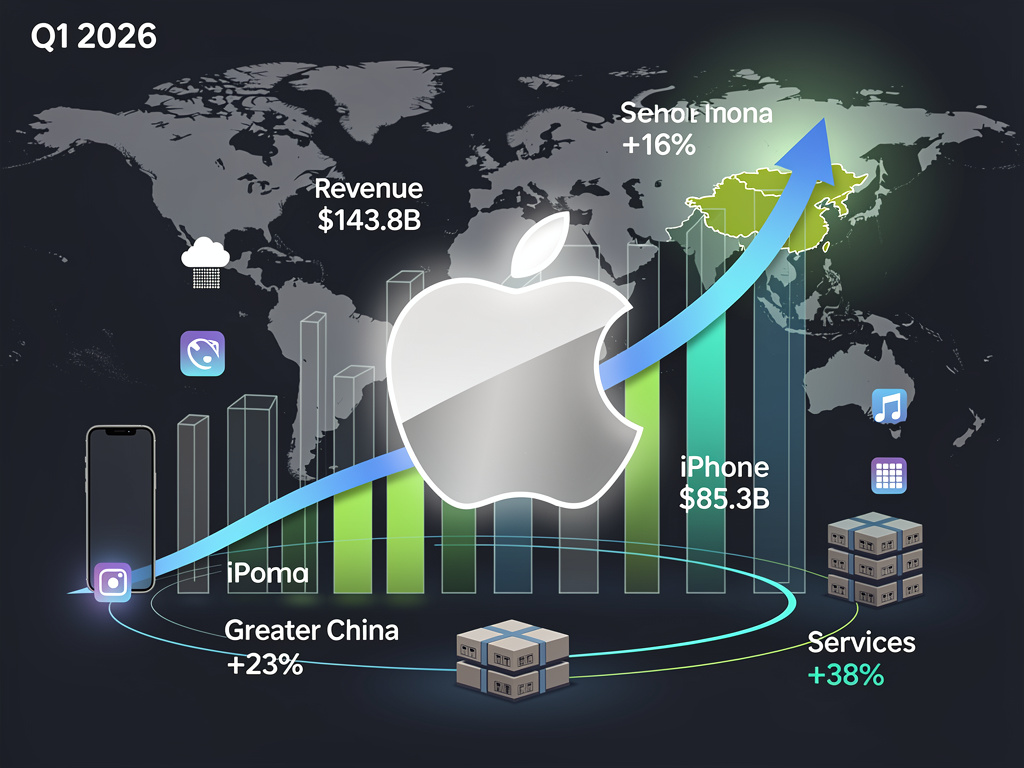
Apple Inc. delivered a fiscal first-quarter performance that shattered expectations, propelled by explosive demand for its latest iPhone models. Revenue climbed 16% year-over-year to $143.8 billion, topping LSEG consensus estimates of $138.48 billion, while net income reached $42.1 billion, or $2.84 per diluted share, surpassing forecasts of $2.67. The results, announced after markets closed on January 29, 2026, marked all-time records for total revenue, earnings per share, iPhone sales, and services, as detailed in Apple’s official release (Apple Newsroom).
At the heart of the beat stood iPhone revenue, which rocketed 23% to $85.3 billion, well above estimates of $78.65 billion. CEO Tim Cook described the demand as “simply staggering” in an interview with CNBC, attributing the surge to robust sales of the iPhone 17 lineup launched in September (CNBC). This reversed a modest decline from the prior holiday quarter, with Cook noting on the earnings call that “it was a fantastic quarter for iPhone,” per coverage from MacRumors.
iPhone Demand Defies Skeptics
The iPhone’s dominance extended across regions, particularly in Greater China, where sales leaped 38% to $25.53 billion. Cook highlighted an “all-time record for upgraders in mainland China” and double-digit growth among switchers, calling the lift “much greater than we thought we would see” and “product-driven” (CNBC). Counterpoint Research data shared on X corroborated this, showing iPhone shipments in China up 28% year-over-year in the holiday quarter, boosting Apple’s market share to 21.8% from 16.8%.
Apple’s active installed base expanded to 2.5 billion devices, up from 2.35 billion a year earlier, underscoring the vast addressable market for services and software updates (MacRumors). This milestone, closely tracked by investors, signals sustained ecosystem stickiness amid lengthening replacement cycles.
China Rebound Powers Global Growth
Services revenue, a high-margin pillar, hit a record $30.01 billion, up 14% but just shy of $30.07 billion estimates. Highlights included Apple TV viewership surging 36% in December and over $550 billion earned by developers on the App Store since 2008, as noted in the earnings call transcript (Yahoo Finance). Apple Pay processed merchant transactions exceeding $100 billion last year, eliminating over $1 billion in fraud for partners.
Other segments showed mixed results: iPad revenue rose 6% to $8.60 billion, beating estimates with half of buyers being first-timers; Mac fell 7% to $8.39 billion; wearables dipped 2% to $11.49 billion. Gross margins expanded to 48.2%, topping 47.5% forecasts, aided by favorable product mix (CNBC).
Services Solidify Profit Engine
Operating cash flow hit a record $53.9 billion, enabling $32 billion in share repurchases and dividends, including a $0.26 per share payout declared for February 12 (Apple Newsroom). R&D expenses climbed to $10.89 billion from $8.27 billion, reflecting heavy AI investments, while capital expenditures dipped to $2.37 billion.
Looking ahead, Apple guided current-quarter revenue growth of 13% to 16%, or $107.8 billion to $110.66 billion, outpacing LSEG’s $104.84 billion estimate. CFO Kevan Parekh flagged iPhone supply constraints from advanced chip nodes, with Cook adding, “We’re in a supply chain mode to meet the very high levels of customer demand we’re currently constrained” (CNBC). Margins are projected at 48% to 49%, pressured by rising memory prices tied to AI shortages.
Forward Guidance Signals Momentum
Shares rose over 1% in extended trading post-earnings, though some X posts noted tepid investor reaction amid high valuations. Wedbush analyst Daniel Ives remained bullish pre-earnings, calling 2026 “massive” for Apple on AI and services tailwinds. The results affirm resilience against China competition and geopolitical risks, with iPhone 17 driving a potential supercycle.
Cook touted Apple’s AI platforms as “the best in the world,” amid partnerships like Google Gemini integration for Siri upgrades in spring 2026 (The New York Times). Reports of a $2 billion Q.ai acquisition for facial AI tech further bolster capabilities (Yahoo Finance).
AI Investments Shape Next Phase
Memory pricing surges from AI data center demand pose headwinds, with minimal Q1 impact but more in Q2, per executives. Tariffs cost $1.4 billion this quarter, yet did not derail results. India’s iPhone exports projected at $28 billion for FY26 highlight supply chain diversification, up from zero in FY20.
For industry insiders, these figures reveal a company firing on multiple cylinders: hardware refresh cycles, services scale, and AI positioning. As Cook emphasized, the 2.5 billion device base positions Apple for multiyear growth, even as supply bottlenecks test execution.
Investor Focus Sharpens on Execution


 WebProNews is an iEntry Publication