
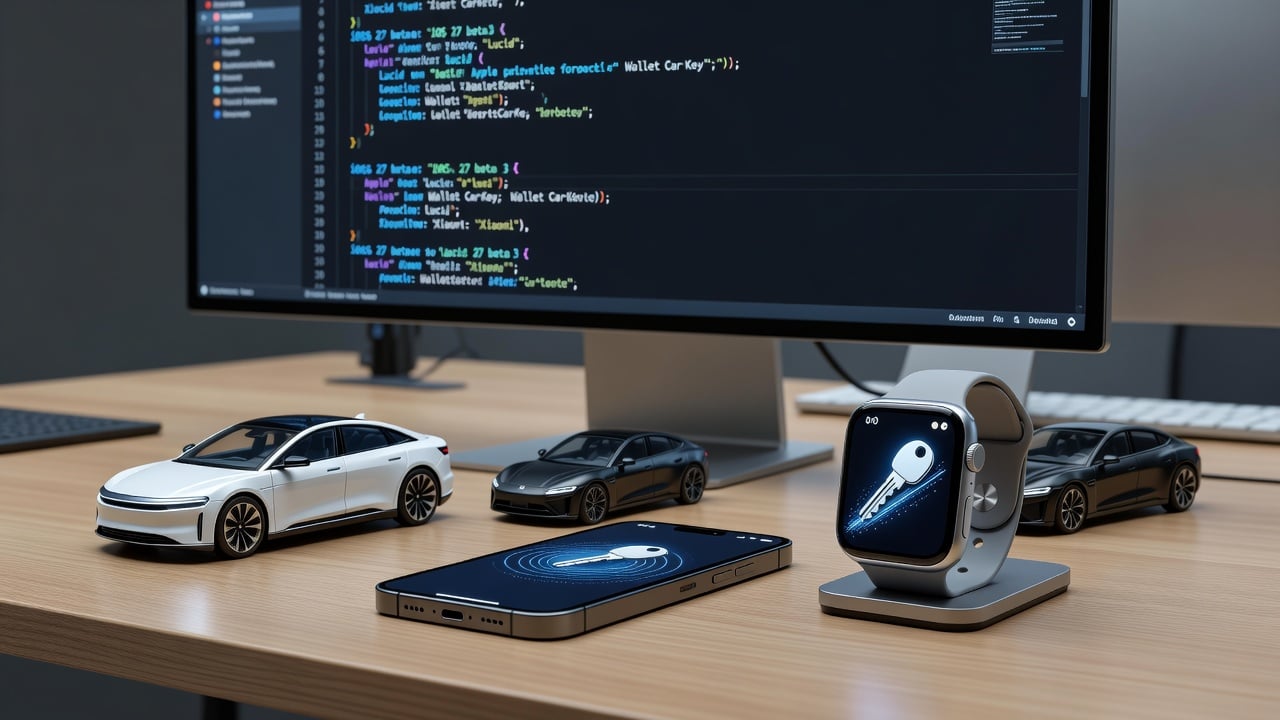
Code buried inside the third developer beta of iOS 27 has surfaced two cryptic identifiers. “LCID” and “XIA1.” They point to Lucid Motors and Xiaomi. The discovery suggests Apple stands ready to let iPhone and Apple Watch owners lock, unlock and start vehicles from both brands using nothing more than their devices.
The findings come from MacRumors, where reporter Aaron Perris spotted the strings while examining the beta build released earlier this week. Similar code patterns have preceded official rollouts before. This one feels different. It arrives amid growing momentum for digital car keys and a broadening list of automakers willing to embrace Apple’s Wallet-based system.
Lucid’s inclusion was expected. At WWDC 2025 Apple named the California-based luxury EV maker as one of 13 brands slated for future support. The full list included Acura, Chevrolet, Cadillac, GMC, Porsche, Rivian, Smart, Tata Motors, Hongqi, WEY, Chery and Voyah. No firm timeline emerged then. Lucid has remained silent on exactly when its Air or Gravity models might gain the feature. Yet the beta code now hints that preparations have advanced far enough for software integration to begin in earnest.
Xiaomi represents the real surprise. The Beijing company burst into the auto sector with the SU7 sedan and later the YU7 SUV. Its vehicles have sold briskly in China. Until now Xiaomi had shown no public signs of partnering with Apple on car keys. The rivalry between the two in smartphones runs deep. That a collaboration on digital access could emerge speaks to the pragmatic pull of consumer convenience and the rapid maturation of the connected-vehicle market.
Car Key itself has evolved since its debut. Owners add a digital key to Apple Wallet. They tap their iPhone or Apple Watch against the driver’s door pillar to unlock. Proximity detection handles passive entry. Starting the car requires no physical fob. The system supports key sharing through Messages or AirDrop with adjustable permissions. Express Mode lets the key work even when the device battery sits at zero. These details appear consistently across reports from 9to5Mac and TechRepublic.
Recent backend updates have already added Volkswagen to the supported roster. Earlier code hints paved the way for General Motors brands. The pattern holds. Strings in a shipping beta rarely appear by accident. They signal that Apple has begun the technical handoff. Automakers still control the hardware side. Compatibility depends on whether a given model carries the necessary NFC, Ultra Wideband or Bluetooth Low Energy radios. Not every Lucid Air or Xiaomi SU7 will qualify on day one. Regions matter too. Some features roll out first in markets with strong Apple adoption.
Industry watchers note the competitive dynamics at play. Tesla owners have long relied on the company’s own phone-key app. It works well. Yet it fails when the phone dies. Apple Car Key does not. Forum discussions on MacRumors highlight that edge. One user remarked that Lucid’s current keyless system feels clunky by comparison. Another pointed out that certain brands, including Kia and Toyota, tie full remote functions to paid subscriptions. The friction points persist even as the technology spreads.
Xiaomi’s move carries extra weight. The company has built its EV business on aggressive pricing and software smarts. Integrating with Apple Wallet could broaden its appeal beyond China. It might also ease tensions in a market where Xiaomi phones compete directly with iPhones. For Apple the addition extends the reach of its digital-key platform into one of the world’s fastest-growing EV segments. Lucid, positioned at the premium end, gains another way to differentiate its vehicles from rivals that still hand drivers bulky fobs.
Timelines remain fuzzy. iOS 27 is expected to ship publicly in September. That offers a natural window for announcements. Yet automakers often stagger their support. Some models may arrive with the feature enabled at launch. Others could receive it later through over-the-air updates. Neither Lucid nor Xiaomi has issued statements since the beta leak. Their silence matches past practice. Official confirmation usually follows months of quiet testing.
The broader trend looks clear. Digital keys have moved from novelty to expectation. Early adopters praised the convenience of leaving physical fobs at home. Security benefits followed. Keys stored in the iPhone’s Secure Element resist cloning better than many traditional fobs. Sharing works without handing over a physical object. Expiration timers let owners grant temporary access to valets or friends. These capabilities have drawn more manufacturers into the fold.
Analysts tracking the auto-tech intersection see room for further growth. Porsche and BMW rolled out early support with polished experiences. Hyundai and Kia followed with wider availability. Rivian, already on Apple’s announced list, targets tech-savvy buyers who would welcome Wallet integration. The addition of Lucid and Xiaomi fills gaps at both the luxury and mass-market ends of the EV spectrum. And the list keeps expanding.
Of course challenges linger. Not every driver trusts leaving vehicle access inside a phone. Battery anxiety persists despite Express Mode. Some regions still favor physical keys for insurance or regulatory reasons. Automakers must also decide how deeply to integrate. Full passive entry demands precise antenna placement and calibration. That work takes time. The beta code shows Apple has done its part. The ball now sits in Lucid and Xiaomi’s court.
Recent coverage reinforces the momentum. Gadget Hacks noted that the identifiers surfaced alongside a fresh backend update for Volkswagen. The site reminded readers that Apple supplies the platform while carmakers decide implementation tiers based on their hardware. The Car Connectivity Consortium’s Digital Key standard underpins much of the technical foundation. Support levels vary. Basic NFC unlock sits at the low end. Ultra Wideband precision and remote commands sit higher.
Owners who already use Car Key with supported vehicles report high satisfaction. The phone simply stays in a pocket. The car senses its presence. Doors open. The engine starts with a button press or brake tap. Shared keys arrive as notifications. Recipients accept and the digital token appears in their own Wallet. Revocation happens instantly. These flows have become routine for millions. Soon Lucid and Xiaomi drivers may join them.
The identifiers themselves tell a small story. “LCID” maps neatly to Lucid’s stock ticker. “XIA1” feels like a shorthand for Xiaomi’s automotive ambitions. Developers often choose such terse labels during early integration. Their presence in a public beta means the strings have moved beyond internal prototypes. Testing likely involves real vehicles or sophisticated simulators. Apple does not embed references lightly.
Look closer at the competitive map and patterns sharpen. Chinese EV makers have embraced digital features faster than many Western counterparts. Xiaomi’s SU7 already offers advanced driver-assistance and over-the-air updates. Adding Apple Car Key fits that profile. It also gives the company a story to tell affluent buyers who split their loyalty between Android phones and premium cars. For Lucid the feature aligns with its focus on refined user experience. The Air already boasts one of the industry’s best in-cabin interfaces. A polished digital key would complete the picture.
Industry insiders expect formal word before iOS 27 launches. Apple typically updates its public Car Key compatibility page in tandem with new announcements. Automakers often stage events or send press releases highlighting the integration. When that happens the identifiers will lose their mystery. Until then they serve as a reliable leading indicator. Beta code has proven accurate on Volkswagen and GM. History suggests it will hold here too.
The expansion also reflects shifting priorities inside Apple. With iOS 27 the company has emphasized refinement over splashy new categories. Siri gains context awareness. Lock Screen receives tweaks. Yet underneath those headline items sit steady improvements to Wallet and its growing list of real-world uses. Car Key sits at the top of that list. Each new partner widens the feature’s utility and deepens Apple’s foothold in the automotive software stack.
Drivers weighing a Lucid or Xiaomi purchase now have one more factor to consider. The promise of ditching the key fob entirely may not close the deal on its own. It does remove one small daily annoyance. For some that proves decisive. For others it simply adds to an already compelling package of range, performance and software polish. Either way the direction feels set. Physical keys are fading. Digital ones are taking their place. And with every beta that drops, the transition accelerates.
Whether the feature lands this fall or slips into 2027 depends on final validation cycles. Hardware certification, regional approvals and over-the-air readiness all take time. But the code does not lie. Apple has started the work. Lucid and Xiaomi appear ready to follow. The era of the smartphone as universal car key draws closer for two more brands. Owners will notice the difference the first time they approach their vehicle empty-handed and watch the doors open anyway. Convenience like that tends to stick.


 WebProNews is an iEntry Publication