
Apple’s Intel Foundry Gambit: iPhone Silicon’s American Pivot
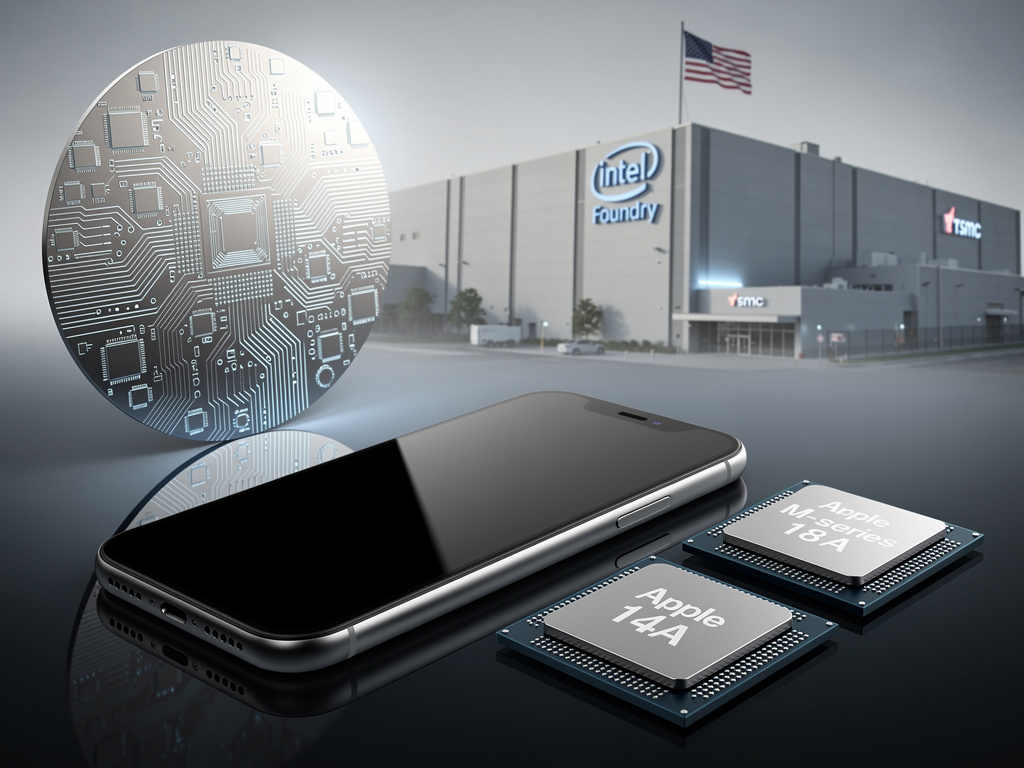
Apple Inc. is poised to revive its ties with Intel Corp. in a manufacturing twist that could reshape semiconductor supply chains. Analyst Jeff Pu of GF Securities has reaffirmed expectations that Intel will fabricate Apple-designed chips for non-Pro iPhone models starting in 2028, using the chipmaker’s forthcoming 14A process node. This development, detailed in Pu’s latest research note, builds on earlier reports and signals Apple’s push to diversify beyond longtime partner Taiwan Semiconductor Manufacturing Co.
The arrangement keeps Apple firmly in control of chip design, with Intel serving solely as a foundry. “We reiterate our expectation of potential order-wins such as Apple’s SP SoC,” Pu wrote in the note obtained by 9to5Mac. Pu’s December 2025 forecast had already flagged Intel’s role in base-model iPhone silicon, potentially including A21 or A22 chips for devices like a future iPhone 20 or 20e.
This isn’t a full-circle return to the Intel-powered Mac era that ended with Apple’s 2020 silicon transition. Back then, Intel supplied x86 processors; now, Intel would produce Arm-based Apple silicon. Historical precedent exists—Intel provided modems for iPhone 7 through 11 models—yet the scale here targets core application processors.
Analyst Consensus Builds on Timelines
Tianfeng Securities analyst Ming-Chi Kuo laid early groundwork in November 2025, predicting Intel shipments of Apple’s lowest-end M-series chip—likely the base M7—for select Mac and iPad models as soon as mid-2027. Kuo cited Apple’s nondisclosure agreement with Intel for the 18AP process design kit (PDK) version 0.9.1GA, with full PDK 1.0/1.1 slated for the first quarter of 2026. “Apple’s plan is for Intel to begin shipping its lowest-end M processor, utilizing the 18AP advanced node, as early as 2Q–3Q27,” Kuo noted on X, as reported by 9to5Mac.
Jeff Pu’s updates align M-series entry via Intel’s 18A (roughly 2nm-class) with iPhone expansion on 14A (1.4nm-class), expected for mass production in 2028 per MacRumors. Pu highlighted Intel’s “solid external customers pipeline” for 14A, naming Apple alongside AMD and Nvidia. This dual-node strategy—18A for M7 base models in 2027, 14A for A-series non-Pro in 2028—positions Intel as a secondary supplier after TSMC handles premium variants like M7 Pro/Max or A19 Pro.
Supply-chain whispers suggest Intel’s U.S.-based fabs, bolstered by CHIPS Act funding, appeal amid geopolitical tensions. Kuo emphasized diversification: “Apple…still needs to secure a second source to meet supply-chain management requirements,” per 9to5Mac. Nvidia’s surge as TSMC’s top customer, displacing Apple, adds urgency, as noted in MacRumors.
Intel’s Technical Leap Meets Apple Demands
Intel’s 18A introduces RibbonFET gate-all-around transistors and PowerVia backside power delivery, critical for efficiency in mobile chips. The 18AP variant, tailored for Apple, supports Foveros Direct 3D stacking. Transitioning to 14A adds second-generation RibbonFET, PowerDirect, and high-NA EUV lithography, aiming to rival TSMC’s A14 node in 2028. Pu’s note flags Intel’s 14A PDK 0.5 release, with commitments eyed for late 2026 to early 2027.
For Apple, Intel’s volumes could hit 15-20 million low-end M-series units annually, per analyst estimates echoed in AppleInsider. Non-Pro iPhone allocation remains smaller initially, testing yields before scaling. Intel’s foundry execution has improved post-delays, with Panther Lake CPUs debuting 18A internally.
Risks loom: Intel must prove yields match TSMC’s, especially for power-sensitive iPhone silicon. Failure could limit Intel to M-series proofs-of-concept. Success, however, validates Intel Foundry Services (IFS), reeling from lost leadership to TSMC.
Strategic Imperatives Drive Reunion
Apple’s calculus blends resilience and policy. Heavy TSMC reliance exposes it to Taiwan risks; Intel’s Arizona and Ohio fabs offer U.S. redundancy, aligning with Trump-era “Made in America” mandates. Pu ties 14A wins to this trend in his GF Securities analysis, covered by TechTimes.
Geopolitics aside, pricing leverage emerges. Dual-sourcing pressures TSMC on costs as AI demand spikes. Intel gains prestige and revenue; Apple secures capacity for volume iPhone lines, where margins tolerate slightly lower efficiency in base models.
Recent X chatter reinforces momentum. Posts from January 23-24, 2026, cite Pu’s reaffirmation, with users debating U.S. fab impacts. One German-language thread from @appletechnikbl detailed 14A iPhone prospects, linking to broader business implications.
Industry Ripples and Watchpoints
Broader fallout hits competitors. TSMC retains high-end dominance, but Intel’s entry fragments the field. AMD and Nvidia in 14A pipelines signal IFS traction. For Intel, Apple validates post-Gelsinger turnaround under new leadership.
Apple’s in-house design stays sacrosanct—no x86 regression. Base models get Intel silicon; Pro lines stick with TSMC’s bleeding-edge nodes. Timeline watchpoints: PDK 1.0/1.1 delivery Q1 2026 for 18A trials; 14A risk production 2027.
Stakeholders eye Intel’s Q4 2025 earnings for foundry hints, though specifics remain guarded. If realized, this pact marks semiconductors’ next U.S.-centric chapter, blending old rivals in new roles.


 WebProNews is an iEntry Publication