
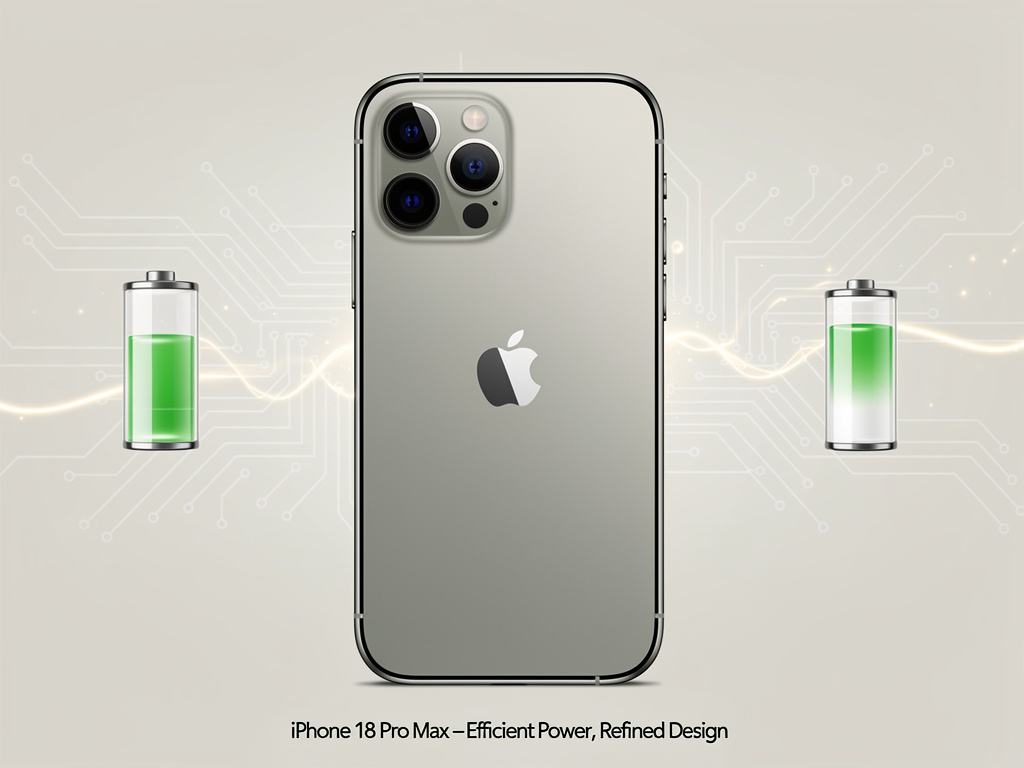
For years, battery life has been the single most requested improvement among iPhone users, and Apple has responded with a steady cadence of incremental gains rather than revolutionary leaps. The iPhone 18 Pro Max, expected to arrive in the fall of 2026, appears poised to continue that tradition — delivering a modest but meaningful bump in battery capacity that reflects Apple’s careful balancing act between device thickness, thermal management, and user expectations.
According to a report from AppleInsider, the iPhone 18 Pro Max is expected to feature a battery capacity increase over the iPhone 17 Pro Max, though the improvement will be relatively modest. The report draws on supply chain intelligence and analyst forecasts that suggest Apple is continuing to push the boundaries of what its internal battery engineering can deliver within the physical constraints of its flagship form factor. While exact milliamp-hour figures remain subject to confirmation, the trajectory is clear: Apple is committed to year-over-year improvements, even when those improvements amount to single-digit percentage gains.
The Engineering Calculus Behind Every Milliamp-Hour
Apple’s approach to battery engineering has always been defined by a systems-level philosophy. Unlike some Android manufacturers who have opted for dramatically larger batteries — sometimes exceeding 6,000 mAh — Apple has historically relied on tight integration between hardware and software to maximize efficiency. The A-series and now M-series chips that power iPhones are designed with power efficiency as a first-order concern, and iOS itself is aggressively optimized to minimize background power draw. This means that even a small increase in raw battery capacity can translate into a noticeable improvement in real-world endurance when paired with a more efficient processor.
The iPhone 17 Pro Max, which is expected to debut in the fall of 2025, is already rumored to carry a significantly larger battery than the iPhone 16 Pro Max. Apple’s adoption of new battery chemistry and stacked battery technology has allowed the company to pack more energy into roughly the same physical volume. The iPhone 18 Pro Max would build on this foundation, leveraging further refinements in battery cell density and potentially new cathode materials that are being explored across the consumer electronics industry. Industry analysts have noted that silicon-carbon anode technology, which Apple has been reportedly investigating, could be a key enabler for future capacity gains without requiring thicker devices.
Why “Not By Much” Still Matters to Apple’s Bottom Line
It would be easy to dismiss a modest battery improvement as insignificant, but in the context of Apple’s competitive positioning, even small gains carry outsized importance. Battery life consistently ranks as one of the top three purchase drivers for smartphone buyers, according to multiple consumer surveys. When Apple can claim — as it did with the iPhone 16 Pro Max — that its latest device offers the “longest battery life ever in an iPhone,” that marketing message resonates powerfully with consumers who are evaluating whether to upgrade from a device that is two or three years old. The cumulative effect of several years of incremental improvements can be dramatic: a user moving from an iPhone 14 Pro Max to an iPhone 18 Pro Max would likely experience a transformative difference in daily endurance.
Apple’s strategy also reflects a broader industry reality. Battery technology does not follow the exponential improvement curves that have historically characterized semiconductor performance. Lithium-ion chemistry is a mature technology, and gains in energy density are measured in low single-digit percentages per year. The major breakthroughs that could change this equation — solid-state batteries, lithium-sulfur cells, or entirely new chemistries — remain years away from commercial viability at the scale Apple requires. In the meantime, Apple’s engineering teams are left to extract every possible advantage from manufacturing process improvements, cell geometry optimization, and system-level power management.
The Supply Chain Signals and What They Reveal
Supply chain reports, which have become an increasingly reliable window into Apple’s product planning, suggest that the company has been working with its battery suppliers — primarily companies like TDK, LG Energy Solution, and China’s Sunwoda — to secure cells with higher energy density for the iPhone 18 lineup. As AppleInsider noted, the improvements are expected to be evolutionary rather than revolutionary, consistent with the pattern Apple has established over recent iPhone generations.
The timing of these supply chain leaks is notable. Early February reports about a device that won’t ship for approximately eight months suggest that Apple has already locked in key component specifications for the iPhone 18 series. This is consistent with Apple’s typical product development timeline, in which major hardware decisions are finalized roughly 12 to 18 months before a product ships. Battery cell specifications, in particular, must be determined early because they influence thermal design, structural engineering, and regulatory certification processes that have long lead times.
Software Optimization: The Other Half of the Battery Equation
While raw capacity gets the headlines, Apple’s software engineering is arguably the more consequential factor in real-world battery performance. iOS 19, which will ship alongside the iPhone 18 series, is expected to include further refinements to power management, including more intelligent scheduling of background tasks, improved machine learning models for predicting user behavior and pre-loading content during optimal charging windows, and potentially new features that leverage the neural engine to reduce the power burden on the GPU and CPU during common tasks.
Apple Intelligence, the company’s suite of on-device AI features introduced with iOS 18, represents both a challenge and an opportunity for battery life. On-device inference — running large language models and generative AI features locally rather than in the cloud — is computationally intensive and can draw significant power. However, Apple’s custom silicon is specifically designed to handle these workloads efficiently, and each generation of the A-series chip has delivered meaningful improvements in performance per watt for neural engine tasks. The iPhone 18 Pro Max’s expected A20 Pro chip (or whatever Apple ultimately names it) will likely continue this trend, potentially offsetting the power demands of more capable AI features with greater silicon efficiency.
Competitive Dynamics in the Premium Smartphone Tier
Apple does not operate in a vacuum, and the battery improvements in the iPhone 18 Pro Max must be understood in the context of what competitors are delivering. Samsung’s Galaxy S series and Google’s Pixel lineup have both made aggressive moves on battery life in recent generations. Samsung, in particular, has been willing to increase device thickness slightly to accommodate larger batteries, a trade-off that Apple has historically been reluctant to make. Chinese manufacturers like Xiaomi and OnePlus have pushed even further, offering devices with 6,000 mAh or larger batteries and extremely fast charging speeds that can refill a device in under 30 minutes.
Apple’s response has been characteristically measured. Rather than engaging in a raw specification war, the company has focused on delivering competitive real-world endurance through its integrated approach. The company has also been gradually increasing charging speeds, with the iPhone 16 series supporting faster MagSafe charging than its predecessors. The iPhone 18 Pro Max could see further improvements on this front, potentially supporting higher wattage wired charging that would bring Apple closer to parity with the fastest-charging Android devices. For many users, fast charging serves as a practical complement to battery capacity — if you can quickly top up during a brief break, the total battery size becomes somewhat less critical.
What the iPhone 18 Pro Max Tells Us About Apple’s Long-Term Vision
The incremental nature of the iPhone 18 Pro Max’s battery improvement is, in many ways, a microcosm of Apple’s broader product philosophy. The company has never been interested in spec-sheet one-upmanship for its own sake. Instead, Apple’s approach is to deliver a holistic user experience in which every component — from the display to the processor to the battery — is optimized as part of a unified system. This philosophy has served the company extraordinarily well, helping it maintain premium pricing and industry-leading customer satisfaction scores even when individual specifications appear to lag behind competitors on paper.
Looking further ahead, the real inflection point for iPhone battery life may come not from incremental chemistry improvements but from more fundamental architectural changes. Apple’s reported interest in solid-state battery technology, which promises dramatically higher energy density and improved safety characteristics, could eventually enable a step-function improvement in battery life. However, most industry experts believe that solid-state batteries at smartphone scale are still several years away from mass production. In the meantime, Apple will continue its methodical approach: squeezing out every available percentage point of improvement, year after year, until the next technological breakthrough arrives.
For the millions of consumers who will ultimately purchase the iPhone 18 Pro Max, the modest battery improvement will be just one factor in a complex purchasing decision that also encompasses camera quality, display technology, AI capabilities, and ecosystem integration. But as AppleInsider has highlighted, the fact that Apple continues to push forward on battery life — even incrementally — underscores the company’s recognition that endurance remains a critical differentiator in the premium smartphone market. In a world where our devices are asked to do more every year, even a small improvement in the amount of time they can do it on a single charge is worth noting.


 WebProNews is an iEntry Publication