
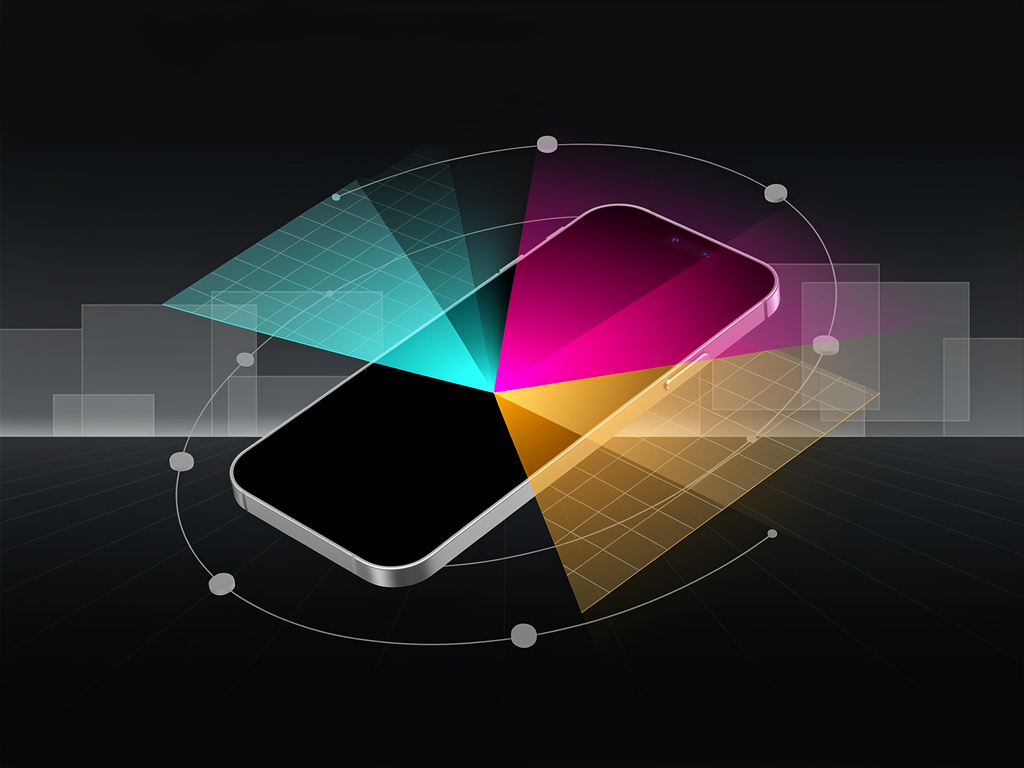
Whispers from the supply chain point to something extraordinary. Apple may be developing a device insiders call the Spatial iPhone. This isn’t another incremental upgrade. It could feature a holographic display that projects depth and floating images without any glasses.
The claims surfaced this week from a leaker known as Schrödinger on X. He shared screenshots of messages with an unnamed insider. Those details quickly spread across technology sites. MacRumors first highlighted the rumor, noting Samsung appears to be crafting the screen under the codename MH1 or H1.
But hold on. This project sits in early research and development. A realistic arrival might not come until 2030. Still, the technical vision described feels different from past attempts. It pairs eye-tracking cameras with diffractive beam-steering. Microscopic structures inside the panel bend light precisely toward the viewer’s eyes. The result promises convincing depth that seems to hover above the glass.
A nano-structured holographic layer integrates directly into what would likely be an AMOLED panel. For ordinary tasks the screen operates at full 4K resolution. No clarity sacrificed. Switch to compatible content and the holographic mode activates. Objects gain volume. Spatial AI avatars could float overhead. Tilt the phone and a patented algorithm lets you peer around elements in video. The leaker described it as offering “360-degree rotation.”
Apple has chased this idea for nearly two decades. Company patents date back to 2008 for glasses-free autostereoscopic displays that track viewer position. Another from 2014 outlined an interactive holographic system using lasers, microlenses and sensors. None reached consumers. The Digital Trends report captured the excitement. It quoted the leaker directly: “Samsung is reportedly moving its 3D Plate tech to mobile with the MH1 (H1) display. Forget 2D we’re talking glasses-free holographic depth & spatial AI avatars floating above the glass.”
Previous efforts fell short. Nintendo’s 3DS delivered glasses-free 3D but suffered from narrow viewing angles and noticeable blur. HTC and Amazon tried similar concepts with limited success. The new approach claims to solve those problems. It maintains image quality in standard mode while delivering genuine depth only when needed. Samsung’s Advanced Institute of Technology has published research on slim-panel holography since 2020. One paper detailed a steering-backlight unit that expanded viewing angles dramatically.
And Samsung isn’t working in isolation. Supply chain sources have heard talk of Apple’s project among component makers. The South Korean giant already provides many iPhone OLED panels. Collaboration makes sense. Apple avoids building its own displays. It focuses instead on system integration, software and the user experience that would tie this hardware to its Vision Pro spatial computing platform.
John Ternus, Apple’s hardware engineering chief, once called spatial computing an inevitability. Current iOS features like Spatial Scenes offer a preview. They create depth effects on existing phones. A true holographic iPhone would take that much further. Users might manipulate 3D models with gestures or view medical scans with realistic volume. Video calls could feel more present. Entertainment would gain new dimensions.
Skeptics abound. The leaker’s account is relatively new. While some past predictions proved accurate, many rumors never materialize. Phase one R&D status suggests years of work remain. Power consumption, heat management and manufacturing yields at scale pose serious hurdles. Eye-tracking must work reliably across different face shapes and lighting conditions. The diffractive layer cannot drive costs so high that the phone becomes unreachable for most buyers.
Yet the rumor arrives at an interesting moment. Apple continues to push Vision Pro despite slow adoption. A pocket-sized spatial device could broaden access to those capabilities. It might also pressure competitors. Google, Samsung and Chinese manufacturers have experimented with advanced displays. If one company cracks convincing glasses-free 3D, others will race to match.
Recent coverage reinforces the early nature of these claims. Wccftech rated the rumor about 55 percent plausible based on technical specifics and supply chain alignment. It noted the display would activate holographic effects selectively. PhoneArena highlighted the 2030 window and potential for spatial AI integration.
So what might this mean for the iPhone lineup? Don’t expect it in the next few generations. The standard iPhone 18 or 19 will likely focus on faster chips, better cameras and perhaps under-display Face ID. A foldable model could appear sooner. The holographic version would represent a bigger leap. It might carry a new name or sit in a premium tier.
Success would depend on software as much as hardware. Developers need tools to create content that takes advantage of the display. Apple would probably introduce new APIs for spatial interfaces. Existing apps could gain depth effects automatically. The company has shown skill at making complex technology feel natural.
Challenges extend beyond the screen. Battery life becomes critical when eye-tracking and light-steering run constantly. Thermal design must prevent the device from warming up during extended use. Network speeds matter too if high-resolution 3D content streams from the cloud. 5G and eventual 6G will help but latency must stay imperceptible.
Privacy questions arise with always-on eye-tracking. Apple has built a strong reputation for on-device processing. It would need to extend that here. The diffractive structures themselves represent manufacturing complexity. Scaling production while keeping yields high could take years.
Still the vision excites. A phone that breaks the flat rectangle barrier. One that makes digital objects feel present in physical space. It aligns with Apple’s long-term bets on augmented reality. Tim Cook has repeatedly said AR will change how we interact with technology. This display could be a key piece.
Whether the Spatial iPhone arrives in 2030 or later remains uncertain. The underlying research at Samsung and interest from Apple feel real. Supply chain chatter rarely emerges from nothing. For an industry that has grown used to incremental camera bumps and processor tweaks this represents something more ambitious.
Watch the patents. Apple files many but some reveal genuine directions. Follow Samsung’s display announcements too. The company often showcases prototypes at trade shows before they reach products. And listen to what Apple executives say about spatial computing. Their words have grown more confident.
The iPhone transformed personal computing once. A holographic successor wouldn’t replace the phone as we know it. It would expand what a phone can be. Depth without compromise. Interaction that feels magical yet intuitive. If the technology matures as described the wait could prove worthwhile.


 WebProNews is an iEntry Publication