
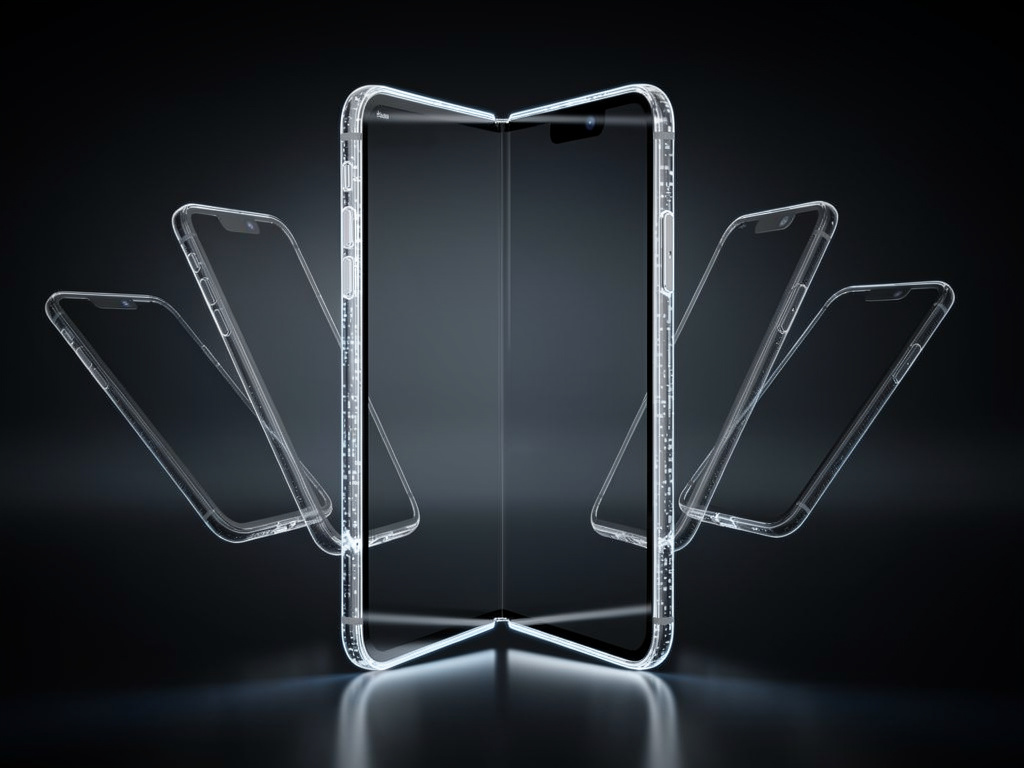
For years, the crease has been the scarlet letter of foldable phones. That visible line running down the center of every Samsung Galaxy Z Fold, every Motorola Razr, every Honor Magic — it’s the compromise buyers accept when they trade rigidity for flexibility. Apple, characteristically, has refused to ship that compromise. Now there’s growing evidence that Cupertino thinks it has found a way around it.
According to a report from MacRumors, Apple’s long-anticipated foldable iPhone will employ a layered glass structure specifically engineered to minimize — or potentially eliminate — the visible crease that plagues every foldable device currently on the market. The approach reportedly involves multiple ultra-thin sheets of specially treated glass bonded together in a composite stack, rather than the single flexible OLED cover layers or plastic-based solutions competitors have relied on since Samsung launched the original Galaxy Fold in 2019.
This isn’t a small engineering distinction. It’s the difference between accepting a known flaw and engineering it out of existence.
The foldable phone market has grown steadily but hasn’t exploded the way early proponents predicted. IDC estimated that foldable shipments reached roughly 22 million units in 2025, a respectable number but still a fraction of the 1.2 billion smartphones shipped globally. The crease is one reason. Durability concerns are another. Price is a third. Apple’s entry into the category — widely expected sometime in 2026 or early 2027 — could reshape demand overnight, but only if the company delivers something that feels meaningfully better than what already exists.
The layered glass approach described in the MacRumors report draws on patents Apple has filed over the past several years. One key patent, granted in 2024, describes a “foldable electronic device” with a cover layer composed of multiple thin ceramic or glass sheets separated by polymer interlayers. The idea borrows from automotive windshield technology, where laminated glass achieves both strength and flexibility that a single thick pane cannot. Applied to a phone display, the principle is the same: distribute bending stress across multiple layers so no single layer deforms enough to create a permanent visible mark.
Apple’s supplier relationships matter here. Corning, the maker of Gorilla Glass and a longtime Apple partner, has been developing ultra-thin glass (UTG) formulations for foldable applications. Samsung Display pioneered UTG for the Galaxy Z Flip series starting in 2020, but those implementations still produce a noticeable crease over time. The glass is thin enough to bend but not sophisticated enough in its current single-layer form to fully resist the memory effect — the tendency of a material to retain the shape of its most common position.
What Apple appears to be doing is stacking the deck. Literally.
By laminating several UTG layers with compliant polymer adhesives between them, the composite behaves differently under repeated folding than any individual layer would on its own. Each glass sheet can be made thinner than what Samsung uses, reducing the bending radius each layer must accommodate. The polymer interlayers absorb shear forces and allow adjacent glass sheets to slide microscopically relative to each other during folding, preventing stress concentration at the fold line. The result, at least in theory, is a display cover that feels like glass — hard, smooth, optically clear — but folds like something much more forgiving.
There are skeptics. Display industry analyst Ross Young of Display Supply Chain Consultants has noted that any glass-based foldable solution faces fundamental tradeoffs between hardness and flexibility. “You can make glass very thin and it will bend, but you sacrifice scratch resistance,” Young said in a post on X earlier this year. “The question is whether a laminated stack recovers enough hardness to matter.” Apple’s answer, based on the patent filings, seems to involve optimizing the outermost layer for scratch resistance while letting the inner layers handle the mechanical stress of folding.
Samsung, for its part, hasn’t been standing still. The company’s latest Galaxy Z Fold models have progressively reduced crease visibility, and Samsung Display has been working on its own next-generation UTG solutions. But Samsung faces a different incentive structure than Apple. Samsung has been shipping foldables for seven years. Its customers have accepted the crease as a known tradeoff. Apple’s customers have not accepted anything, because Apple hasn’t asked them to. The first foldable iPhone will be judged not against the original Galaxy Fold but against the iPhone 16 Pro Max — a device with a perfectly flat, perfectly uniform display. Any visible crease will be treated as a defect, not a compromise.
Apple knows this. It’s why the company has waited so long.
The supply chain signals have been building for months. Reports from Nikkei Asia and The Information have described Apple working with both Samsung Display and LG Display on foldable OLED panels, with Samsung Display currently in the lead for initial production. The display itself is one challenge. The cover material is another. And the hinge — the mechanical heart of any foldable — is a third. Apple has filed extensive patents on hinge mechanisms that maintain tight bend radii while distributing force evenly across the display surface, a prerequisite for any crease-reduction strategy to work in practice.
The interplay between hinge and display cover is something the industry has learned the hard way. Motorola’s Razr, which uses a plastic display cover, achieves a tighter fold than Samsung’s Z Flip but suffers from a deeper crease and a surface that scratches more easily. Samsung’s UTG approach is harder and more scratch-resistant but doesn’t fold as tightly, requiring a small gap at the hinge that adds thickness to the folded device. Apple’s laminated glass concept could thread the needle — folding tightly without sacrificing surface hardness — but only if the hinge delivers a precise, controlled bend radius that matches the engineered flexibility of the glass stack.
Manufacturing this at scale presents its own challenges. Laminating multiple ultra-thin glass sheets with uniform polymer interlayers, cutting them to precise dimensions, and bonding them to flexible OLED panels without introducing optical distortion or delamination risks is extraordinarily difficult. Apple’s manufacturing partner Foxconn and its display suppliers will need to achieve yields high enough to support tens of millions of units per year. Early production runs of any new display technology tend to have low yields, which is one reason first-generation foldable iPhones are expected to carry premium pricing — likely above $2,000, according to estimates from multiple analysts including Ming-Chi Kuo of TF International Securities.
That price point would position the foldable iPhone above every current iPhone model and in direct competition with Samsung’s Galaxy Z Fold series, which starts around $1,800. But Apple has historically commanded higher average selling prices than any Android competitor, and a crease-free foldable display would give the company a tangible, visible differentiator that’s easy to demonstrate in a retail store. You can see a crease. You can also see the absence of one.
The timing of Apple’s entry matters for the broader market too. Chinese manufacturers including Huawei, Honor, Oppo, and Xiaomi have been aggressively iterating on foldable designs, with Huawei’s Mate X5 and Honor’s Magic V3 earning strong reviews for their thin profiles and reduced crease visibility. These companies have been competing primarily on hardware design and price, often undercutting Samsung significantly in Asian markets. Apple’s arrival would add a competitor that competes on brand, software integration, and — if the layered glass works as described — display quality.
And then there’s the software question. Apple’s iOS has never been optimized for a foldable form factor. Android’s flexible window management, split-screen multitasking, and app continuity features have been refined over multiple generations of foldable hardware. Apple will need to deliver an iPadOS-like multitasking experience on a phone-sized device that unfolds to something approaching a small tablet. The company’s work on Stage Manager for iPad suggests it has been thinking about flexible window management, but adapting that to a foldable phone screen with different aspect ratios in folded and unfolded states is a nontrivial software challenge.
None of this is guaranteed to work. Patents describe possibilities, not products. Apple has filed patents on everything from smart rings to television sets without shipping either. But the convergence of supply chain activity, patent filings, analyst reports, and now the layered glass details reported by MacRumors paints a picture of a company that has moved well beyond the research phase.
So what would a crease-free foldable iPhone actually mean for the industry?
It would raise the bar immediately. Samsung, which has tolerated incremental crease improvement over seven product generations, would face sudden pressure to match Apple’s standard or explain why it can’t. Chinese manufacturers, many of whom have been closing the gap with Samsung on crease reduction, would face the same pressure. Display material suppliers would need to invest in laminated glass production capacity, potentially shifting R&D budgets away from plastic and single-layer UTG solutions. The entire competitive dynamic of the foldable category would shift from “who can fold a phone” to “who can fold a phone without any visible penalty.”
For consumers, the calculus changes too. The crease has been a psychological barrier as much as a physical one. It signals fragility. It signals compromise. It signals “this is a first-generation technology that isn’t quite ready.” Remove the crease, and you remove the most visible reminder that a foldable phone is different from a regular one. That’s when foldables stop being a niche and start being a default form factor.
Apple has built its business on exactly this kind of transition. The company didn’t invent the smartphone, the tablet, the smartwatch, or the wireless earbud. It entered each category after competitors had established the basic concept, then delivered a version polished enough to reach a mass audience. The foldable phone is following the same pattern. Samsung proved the concept. Motorola proved the nostalgia. Huawei proved the engineering could get thinner. Apple, if it delivers on the layered glass promise, would prove that the compromise everyone accepted was never actually necessary.
That’s a powerful message. And it’s one Apple has been quietly engineering for years, one ultra-thin glass layer at a time.


 WebProNews is an iEntry Publication