
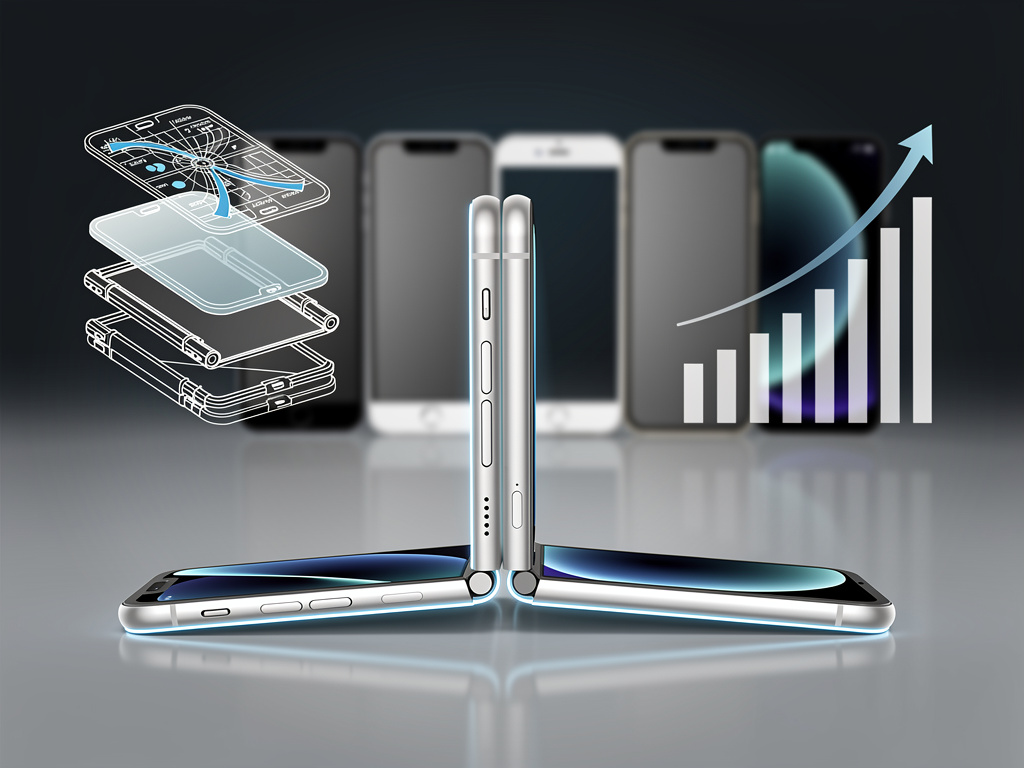
After years of watching Samsung, Motorola, and Chinese manufacturers dominate the foldable smartphone market, Apple is finally preparing to enter the arena with its own clamshell-style iPhone, according to multiple industry reports. The move represents a significant strategic shift for a company that has historically waited years to perfect technologies before bringing them to market, and signals Apple’s recognition that foldable devices have evolved from experimental novelties into a legitimate product category worth pursuing.
According to CNET, Apple is actively developing a flip-style iPhone that would compete directly with Samsung’s Galaxy Z Flip series and Motorola’s Razr lineup. The project reportedly involves extensive work on the hinge mechanism and display technology, two critical components that have plagued early foldable devices with durability concerns and screen crease visibility. Apple’s characteristic perfectionism means the device likely won’t reach consumers until the company feels confident it has addressed these fundamental challenges that have limited mainstream adoption of competitors’ foldable phones.
The timing of Apple’s entry into foldables comes as the market for these devices shows signs of maturation. Global foldable smartphone shipments reached approximately 15.9 million units in 2023, representing substantial growth but still comprising less than 2% of the overall smartphone market. Samsung has maintained its dominant position with roughly 70% market share in the foldable segment, while Chinese manufacturers including Huawei, Oppo, and Xiaomi have captured most of the remaining share. Apple’s entry could fundamentally reshape these dynamics, given the company’s track record of popularizing technologies after perfecting them—a pattern seen with smartwatches, wireless earbuds, and facial recognition.
The Engineering Challenges Behind Cupertino’s Delay
Industry analysts have long speculated about Apple’s reluctance to rush into foldables, and the technical hurdles explain much of the hesitation. The primary challenge involves creating a display that can withstand hundreds of thousands of fold cycles without developing visible creases or experiencing mechanical failure. Current foldable phones from competitors typically show noticeable creases after months of use, and some users have reported screen failures within the first year. For a company that built its reputation on premium build quality and longevity, releasing a product with these compromises would represent an unacceptable risk to the brand.
Display technology represents another significant obstacle. Apple has historically relied on Samsung Display and LG Display for its iPhone screens, but foldable OLED panels require specialized manufacturing capabilities that few suppliers possess. The ultra-thin glass or plastic substrate needed for foldable displays must balance flexibility with durability while maintaining the color accuracy, brightness, and touch responsiveness that iPhone users expect. Apple’s suppliers have been working for years to develop foldable display technology that meets the company’s exacting standards, with prototypes reportedly undergoing rigorous testing in Apple’s laboratories.
The hinge mechanism presents equally complex engineering challenges. Samsung’s latest Galaxy Z Flip 5 uses a “waterdrop” hinge design that allows the phone to fold nearly flat while minimizing stress on the display. Motorola’s Razr employs a different approach with its teardrop hinge architecture. Apple’s engineers are reportedly exploring proprietary hinge designs that would differentiate the product while providing superior durability. Patents filed by Apple in recent years reveal concepts for multi-axis hinges, self-healing display coatings, and advanced housing designs that could protect the flexible screen from dust and debris—common failure points in current foldable devices.
Market Dynamics Driving Apple’s Strategic Pivot
Despite the technical challenges, several market forces are compelling Apple to accelerate its foldable iPhone development. The global smartphone market has reached saturation, with annual shipments declining or remaining flat in most developed markets. Foldable devices represent one of the few product categories showing consistent growth, offering Apple a potential avenue for premium-priced products that could reinvigorate iPhone revenue growth. With average selling prices for foldable phones exceeding $1,000—and some models approaching $2,000—the category aligns perfectly with Apple’s focus on high-margin products.
Consumer interest in foldable devices has steadily increased as the technology has matured. Early adopters who purchased first-generation foldables often became enthusiastic advocates, praising the versatility of having a compact phone that unfolds into a larger screen. This form factor appeals particularly to users who want tablet-like functionality without carrying multiple devices. For Apple, which has long emphasized the integration of hardware, software, and services across its ecosystem, a foldable iPhone could create new opportunities for multitasking features, split-screen applications, and innovative user interface designs that leverage the unique form factor.
Competitive pressure also factors into Apple’s calculus. Samsung has refined its foldable lineup through five generations of the Galaxy Z Flip and Z Fold series, building manufacturing expertise and supply chain relationships that create significant barriers to entry. Chinese manufacturers have introduced increasingly sophisticated foldable devices at competitive prices, with some models featuring advanced specifications that rival or exceed Samsung’s offerings. If Apple delays too long, it risks entering a market where competitors have established strong positions and consumer preferences have solidified around existing platforms.
Software Innovation and the iOS Ecosystem Advantage
While hardware challenges dominate discussions of Apple’s foldable iPhone development, the software dimension may prove equally important to the product’s success. iOS would require significant modifications to support foldable displays, including new APIs for developers, revised user interface guidelines, and system-level features that take advantage of the unique form factor. Apple’s control over both hardware and software gives it a potential advantage over Android-based competitors, whose foldable devices must rely on Google’s generic foldable support in Android rather than deeply integrated, device-specific optimizations.
App developers would need time and resources to optimize their applications for a foldable iPhone, a process that Apple has historically managed through early developer access and comprehensive documentation. The company’s App Store review process could ensure that major applications support foldable-specific features before the device launches, avoiding the fragmented experience that has plagued some Android foldables. Features like Continuity, which allows seamless transitions between Apple devices, could be extended to support workflows that begin on a folded iPhone and expand when the device is opened, or vice versa.
The integration with Apple’s broader ecosystem presents another differentiator. A foldable iPhone could work seamlessly with iPad, Mac, and Apple Watch, with features like Universal Control and Handoff adapted for the new form factor. Apple’s services, including Apple TV+, Apple Arcade, and Apple Fitness+, could offer experiences specifically designed for the foldable display. The company’s focus on privacy and security would extend to the foldable iPhone, potentially giving it an advantage among enterprise customers and privacy-conscious consumers who have been hesitant to adopt foldable devices from competitors.
Supply Chain Complexity and Manufacturing Scale
Bringing a foldable iPhone to market requires solving not just engineering challenges but also supply chain and manufacturing complexities at a scale few companies can match. Apple typically ships tens of millions of units for new iPhone models in the first quarter after launch, a volume that would strain the limited production capacity for foldable displays. Current foldable phone manufacturers produce devices in the hundreds of thousands or low millions, constrained by the specialized equipment and processes required for foldable display assembly.
Apple’s suppliers have been investing in foldable display production capacity in anticipation of the company’s entry into the market. Samsung Display, despite being a key supplier to Apple’s competitors, maintains a business relationship with Apple and possesses the most advanced foldable OLED technology. However, Apple has been working to diversify its display supply chain, with LG Display and Chinese panel makers BOE and Tianma also developing foldable display capabilities. This multi-supplier strategy would be essential for achieving the production volumes Apple requires while maintaining competitive pricing and supply security.
The cost structure of foldable devices presents another consideration. Foldable displays and complex hinge mechanisms significantly increase bill-of-materials costs compared to traditional smartphones. Current foldable phones typically carry retail prices $300 to $800 higher than comparable non-foldable devices. Apple would need to determine whether to position a foldable iPhone as an ultra-premium product above the Pro Max models, or integrate it into the existing lineup at a price point that balances profitability with market accessibility. The company’s pricing strategy will signal whether it views foldables as a niche category for early adopters or a mainstream product line with mass-market potential.
The Broader Implications for Mobile Computing
Apple’s development of a foldable iPhone reflects broader trends in mobile computing, where the boundaries between smartphones, tablets, and laptops continue to blur. Foldable devices represent one approach to providing users with multiple screen sizes in a single device, addressing the fundamental tension between portability and screen real estate. As remote work and mobile productivity have become increasingly important, consumers are seeking devices that can adapt to different use cases—compact for communication and portability, expanded for content consumption and productivity tasks.
The success or failure of Apple’s foldable iPhone could determine the trajectory of the entire foldable device category. Apple has a history of entering product categories after competitors and quickly becoming the market leader through superior execution and ecosystem integration. The iPod, iPhone, iPad, and Apple Watch all followed this pattern, entering markets where other companies had established early positions but failed to achieve mainstream adoption. If Apple can deliver a foldable iPhone that addresses current limitations while offering compelling new capabilities, it could accelerate the transition from traditional smartphones to foldable devices across the industry.
However, Apple also faces the risk that foldable phones may prove to be a transitional technology rather than a long-term product category. Some analysts believe that advances in augmented reality glasses, rollable displays, or other form factors could make foldables obsolete before they achieve mass-market penetration. Apple’s simultaneous development of its Vision Pro mixed-reality headset and rumored work on AR glasses suggest the company is hedging its bets across multiple potential futures for mobile computing. The foldable iPhone may serve as a bridge product that maintains Apple’s competitiveness in smartphones while the company develops more radical innovations.
Timeline and Market Expectations
Industry observers expect Apple’s foldable iPhone to launch no earlier than 2025, with some analysts predicting a 2026 or even 2027 release date. The extended timeline reflects both the technical challenges involved and Apple’s methodical approach to new product categories. The company typically spends years refining products before launch, conducting extensive testing and iteration to ensure they meet Apple’s quality standards and deliver meaningful improvements over existing solutions. This cautious approach has served Apple well historically, though it also means the company sometimes misses early market opportunities.
When the foldable iPhone does arrive, it will enter a market significantly different from today’s foldable segment. Samsung will likely have released seventh or eighth-generation foldable devices with further refined designs and reduced prices. Chinese manufacturers will have expanded their global presence, and Google’s foldable Pixel may have established Android’s foldable software capabilities. Apple will need to differentiate not just through hardware quality but through software innovation, ecosystem integration, and the intangible brand appeal that has driven iPhone success for nearly two decades. The stakes are high: a successful foldable iPhone could open a new growth chapter for Apple’s most important product line, while a flawed execution could damage the company’s reputation for innovation and quality that has been carefully cultivated over decades.


 WebProNews is an iEntry Publication