
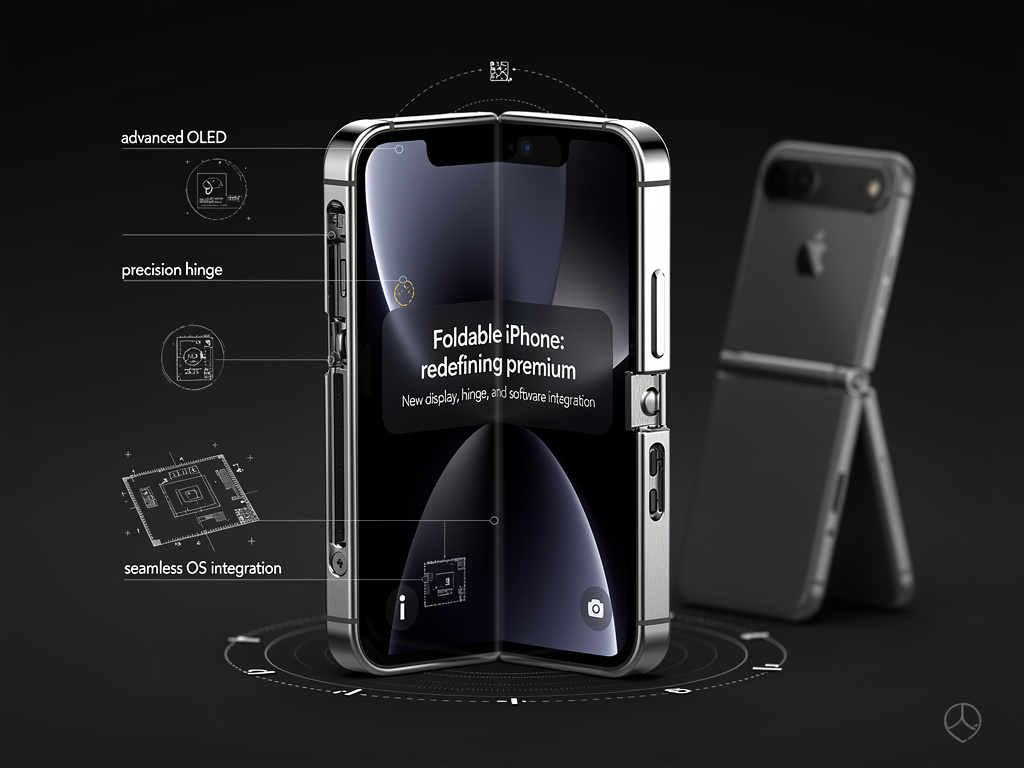
Apple’s long-anticipated entry into the foldable smartphone market appears closer than ever, with recent intelligence suggesting the tech giant is preparing a device that could fundamentally challenge Samsung’s dominance in this nascent category. According to TechRadar, leaked specifications and design details reveal Apple’s approach will diverge significantly from Samsung’s established Galaxy Z Fold playbook, potentially setting new industry standards for durability, display technology, and user experience in foldable devices.
The timing of Apple’s move into foldables represents a calculated strategic decision. While Samsung has dominated the foldable market since 2019, capturing approximately 80% of the segment according to recent market analysis, Apple has characteristically waited, observing competitors’ missteps and technological limitations. This patience has allowed Cupertino to avoid the early durability issues, screen crease problems, and software optimization challenges that plagued first-generation foldable devices. Industry analysts suggest this deliberate approach mirrors Apple’s historical pattern with smartwatches and wireless earbuds, where late entry enabled market-defining products.
Engineering Philosophy: Where Apple Parts Ways with Samsung
The fundamental distinction between Apple’s rumored foldable iPhone and Samsung’s Galaxy Z Fold 7 begins with screen technology. TechRadar reports that Apple is developing a virtually crease-free display using advanced ultra-thin glass technology, potentially partnering with specialty glass manufacturers to achieve a folding radius that minimizes visible creasing. This represents a departure from Samsung’s current Ultra Thin Glass implementation, which still exhibits a noticeable crease after extended use. The engineering challenge involves balancing flexibility with durability, a problem Apple’s materials science teams have reportedly been addressing through proprietary coating technologies.
Display specifications suggest Apple will implement a 7.9-inch internal OLED panel with ProMotion technology supporting adaptive refresh rates up to 120Hz, optimized specifically for the foldable form factor. Unlike Samsung’s approach of using separate display suppliers for internal and external screens, Apple is reportedly working with a single supplier to ensure color consistency and uniform performance across both displays. The external display, rumored to measure approximately 6.5 inches, would provide full iPhone functionality without requiring users to unfold the device for routine tasks, addressing a common criticism of Samsung’s narrower cover screen design.
Hinge Mechanism: Rethinking the Fold
The hinge mechanism represents perhaps the most critical engineering component of any foldable device, and Apple’s approach reportedly emphasizes longevity and user experience over compactness. Sources familiar with the development process indicate Apple is targeting a hinge rated for at least 400,000 folds, significantly exceeding Samsung’s 200,000-fold rating for the Galaxy Z Fold 7. This durability focus extends to the hinge’s resistance to dust and debris, with Apple potentially implementing a more sophisticated seal design that prevents particulate intrusion without adding bulk.
The hinge design also incorporates Apple’s attention to tactile feedback and precision. Unlike Samsung’s current implementation, which offers limited resistance adjustment, Apple’s hinge system reportedly features variable resistance that provides distinct feedback at specific angles, particularly at the fully open and closed positions. This mechanical refinement aims to eliminate the slight wobble present in competing devices when partially opened, enabling more stable use in tent or presentation modes. The engineering team has allegedly tested numerous alloy compositions to achieve optimal strength-to-weight ratios while maintaining the premium feel expected of Apple products.
Software Integration: iOS Reimagined for Foldable Form Factors
Apple’s software advantage could prove decisive in the foldable market. While Samsung has made significant strides with One UI’s foldable optimizations, the company must work within Android’s framework and coordinate with third-party developers for app optimization. Apple’s control over both hardware and software enables deeper integration and more consistent experiences across applications. Industry sources suggest iOS 19, anticipated to launch alongside the foldable iPhone, will introduce new multitasking paradigms specifically designed for the larger unfolded display.
The software approach reportedly includes enhanced continuity features that seamlessly transition applications between the external and internal displays, maintaining exact scroll positions, cursor locations, and application states. Apple’s developer guidelines for the foldable iPhone are expected to be more prescriptive than Samsung’s, potentially requiring apps to support specific split-screen and multi-window configurations to be featured in the App Store. This stricter approach could ensure higher-quality foldable-optimized experiences from launch, addressing the fragmented app support that has hindered Android foldables.
Camera System: Photographic Capabilities in a Foldable Package
Camera technology presents unique challenges in foldable devices, where internal space constraints conflict with the increasingly sophisticated lens arrays found in flagship smartphones. According to leaked specifications, Apple’s foldable iPhone will feature a triple-camera system comparable to the iPhone 16 Pro Max, including a 48-megapixel main sensor, ultra-wide camera, and telephoto lens with 5x optical zoom. This represents a more ambitious camera implementation than Samsung’s Galaxy Z Fold 7, which makes compromises in optical zoom capability due to space limitations.
The foldable form factor enables unique photographic use cases that Apple is reportedly optimizing through software. The ability to partially fold the device creates a self-supporting tripod mode, while the external display can serve as a viewfinder for subjects being photographed with the superior rear camera array. Apple’s computational photography algorithms, already industry-leading in conventional iPhones, will be adapted to take advantage of the device’s unique form factor, potentially including enhanced stabilization modes that leverage the device’s folded position.
Battery Technology and Thermal Management
Power management in foldable devices requires innovative approaches to battery placement and thermal dissipation. Apple’s design reportedly incorporates a dual-battery system with cells positioned on either side of the hinge, totaling approximately 4,800mAh combined capacity. This configuration distributes weight more evenly across the device while maintaining a slim profile when folded. The battery management system will employ advanced algorithms to balance charging across both cells, extending overall battery longevity and preventing the degradation issues that can occur when battery cells age at different rates.
Thermal management presents particular challenges in foldable devices, where heat-generating components must be distributed across a more complex internal architecture. Apple’s solution allegedly involves a vapor chamber cooling system that spans both halves of the device, connected by flexible heat pipes that maintain thermal transfer efficiency even when folded. This approach addresses the thermal throttling issues that have affected some Android foldables during intensive tasks, ensuring consistent performance whether the device is folded or unfolded.
Pricing Strategy and Market Positioning
Apple’s pricing strategy for its foldable iPhone will be scrutinized by industry observers, as it could significantly influence the broader foldable market’s trajectory. Samsung’s Galaxy Z Fold 7 is positioned at approximately $1,800, establishing a premium price point that has limited foldables to early adopters and technology enthusiasts. Industry analysts anticipate Apple will price its foldable iPhone at or above $2,000, positioning it as the ultimate premium smartphone while maintaining healthy margins on the complex device.
This pricing approach reflects Apple’s confidence in delivering superior value through integration, durability, and ecosystem advantages. The company’s installed base of over 1.4 billion active iPhone users provides a substantial addressable market of potential upgraders, particularly among users of iPhone Pro Max models who have already demonstrated willingness to pay premium prices for larger displays and advanced features. Apple’s trade-in programs and carrier partnerships will likely play crucial roles in making the device accessible to a broader audience despite its high entry price.
Supply Chain Complexity and Production Challenges
Manufacturing foldable devices at Apple’s scale presents extraordinary supply chain challenges. The company reportedly plans initial production volumes of 3-5 million units in the first year, conservative compared to conventional iPhone launches but substantial for the foldable category. This measured approach allows Apple to refine manufacturing processes and address any quality issues before ramping to higher volumes. The company is allegedly working with multiple display suppliers to ensure production capacity and reduce dependence on single sources for critical components.
Quality control standards for the foldable iPhone are expected to exceed even Apple’s typically stringent requirements. Each device will undergo extensive testing of the hinge mechanism, display durability, and seal integrity before shipment. This rigorous quality assurance process may limit initial availability and create supply constraints in the first several months following launch, a scenario Apple has managed successfully with previous product introductions.
Competitive Implications and Industry Impact
Apple’s entry into foldable smartphones will inevitably reshape the competitive dynamics of the premium smartphone market. Samsung, which has invested heavily in establishing the foldable category, faces the prospect of a formidable competitor with superior ecosystem integration and brand loyalty. The Korean company’s response will likely include accelerated innovation in its own foldable lineup and potentially more aggressive pricing to maintain market share. Chinese manufacturers including Huawei, Xiaomi, and Oppo, which have developed sophisticated foldable devices for their domestic market, may view Apple’s entry as validation of the category’s long-term potential.
The broader implications extend to component suppliers and technology partners throughout the smartphone ecosystem. Display manufacturers, hinge specialists, and specialized materials companies that successfully partner with Apple on its foldable iPhone will gain credibility and potentially secure contracts with other smartphone makers seeking to match Apple’s capabilities. This ripple effect could accelerate innovation across the industry, driving down costs and improving reliability for all foldable devices. As Apple brings its considerable resources and engineering expertise to bear on the foldable category’s remaining challenges, the entire smartphone industry may finally see foldables transition from niche curiosity to mainstream product category.


 WebProNews is an iEntry Publication