
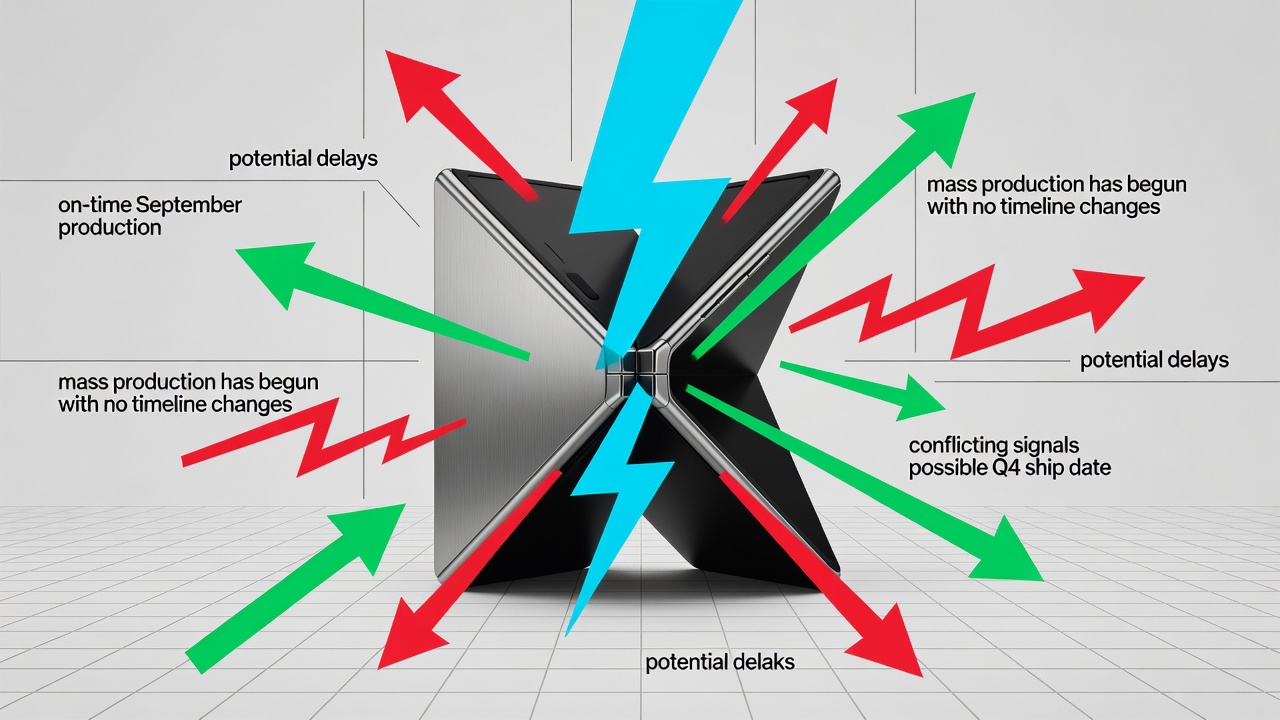
Whispers from factories across Asia have kept the tech world guessing for months. One week, hinge problems threaten to push Apple’s first foldable phone into 2027. The next, suppliers insist everything runs exactly to plan. A fresh report published today by AppleInsider captures the latest swing. Multiple companies in Apple’s supply chain told Chinese financial outlet Cailian Press that peak production has begun. Components sit in mass output. No one has heard talk of altered September delivery dates.
But the contradictions run deeper than a single story. They reflect the unique headaches of building a device that bends in half without breaking. Flexible screens demand tolerances measured in microns. Hinges must endure hundreds of thousands of folds. Assembly lines that once snapped rigid phones together now wrestle with layers of ultra-thin glass, adhesives and circuitry that shift when creased. Yields start low. Fixes take time. And Apple, famous for refusing to ship until every detail satisfies its standards, moves with characteristic caution.
Yet the calendar does not wait.
Analysts once penciled in a modest debut. Early forecasts called for seven or eight million units in the first year. Then Nikkei Asia revealed Apple had quietly raised the target. The company now wants suppliers ready for roughly 10 million foldable iPhones across 2026, according to that report covered by MacRumors. The jump signals confidence. Or at least a bet that demand will justify the risk of a premium newcomer priced north of $2,000.
Production volume matters. So does timing. Bloomberg’s Mark Gurman first reported in March that the foldable would miss the initial September sales window shared by the iPhone 18 Pro models. He walked that back a month later, saying the launch stayed on track for a September debut with availability coming at the same time or slightly later. The back-and-forth only fed the rumor mill.
Korean outlet The Elec added more color in June. Mass production would start at the end of July, its sources said, even though hinge tests still produced slight noise after repeated openings and defect rates ran higher than ideal. Most of those problems had been fixed. A September unveiling remained the goal. Samsung would supply the 7.8-inch inner OLED and 5.5-inch cover display. Hinges from Shin Zu Shing and Amphenol would use 3D-printed techniques. An A20 chip, C2 modem and side-mounted Touch ID button would round out the package.
Fast forward to this week. Cailian Press spoke with several suppliers who pushed back hard against delay talk. The design locked months ago. The device now sits in mass production. Rumors of complex assembly and low yields had not reached their ears. A September delivery window still looked realistic. East Money and The Bell noted separately that Foxconn had begun hiring for the project, another sign of ramp-up.
Ming-Chi Kuo, the analyst known for his supply-chain connections, offered a more measured take on X. The foldable, which some reports now call iPhone Ultra, would appear onstage alongside the iPhone 18 Pro models in September. Actual sales might slip into the fourth quarter. That gap would echo the original iPhone X, which Apple announced in fall 2017 but delivered in November.
Such staggered availability would not shock longtime Apple watchers. The company has managed similar rollouts before. Limited initial stock for a complex first-generation product often forces exactly this pattern. But any visible delay feeds investor nerves. Wall Street wants proof that Apple can still deliver hardware magic after years of incremental iPhone refreshes.
The technical challenges explain the caution. Foldables from Samsung, Huawei and Motorola have improved across multiple generations, yet creases remain visible, hinges loosen over time and durability questions linger. Apple has studied the category for years. It reportedly demanded displays thin enough to leave room for bigger batteries and other components. Samsung’s Color Filter on Encapsulation technology and M16 OLED materials aim to deliver that thinner stack while boosting efficiency.
Suppliers see only slices of the puzzle. A display maker might hit its milestones while hinge or assembly partners struggle. That fragmented view produces the conflicting headlines that have defined this story. One outlet hears good news from Samsung Display, which cleared Apple’s validation process and moved into commercial output. Another hears lingering hinge noise or circuit-board headaches. Both can be true at once.
So far, the balance tilts toward optimism. Apple’s decision to book parts for 10 million units suggests it expects the device to drive an upgrade cycle. Some analysts project the foldable could help lift total iPhone shipments by 10 percent in 2026. That kind of lift rarely comes from a product Apple treats as experimental.
Still, history offers warnings. The first iPhone faced production bottlenecks. The iPhone X pushed Face ID technology to its limit and arrived later than many hoped. Each time, Apple absorbed the pain to protect its reputation. A foldable that arrives creased, noisy or fragile would damage far more than one quarter’s sales. It would hand ammunition to competitors who already sell foldables by the millions.
Apple has stayed silent, as it always does on unreleased products. No official confirmation. No comment on rumors. The silence leaves the field open to supply-chain leaks that sometimes contradict each other within days. Today’s report from Cailian Press, relayed by AppleInsider and analyzed in depth by MacRumors, adds one more data point. Peak production. No delay signals. But the flip-flop continues.
Industry insiders will watch the next few weeks closely. If July production hits targets and yields improve, September remains possible. If new issues surface, the Q4 slip Kuo described could stretch longer. Either outcome will shape how Apple positions its most ambitious iPhone in years. The hardware may fold. The narrative around its arrival has already bent in every direction.


 WebProNews is an iEntry Publication