
Apple has spent years convincing corporate IT departments that its devices belong at the center of business operations. The effort shows results. Macs appear in more conference rooms. iPhones handle sensitive company data under management profiles. Yet this success brings new expectations. Stability now matters as much as innovation.
Bradley Chambers made the point clearly in a column for 9to5Mac. “You simply cannot break core office functionality in a security patch, and if you do, you have to fix it ASAP.” Chambers, an IT administrator with long experience managing Apple fleets, argues that routine updates must not create fresh headaches for enterprise teams. His column highlights one recent case that drove home the risk.
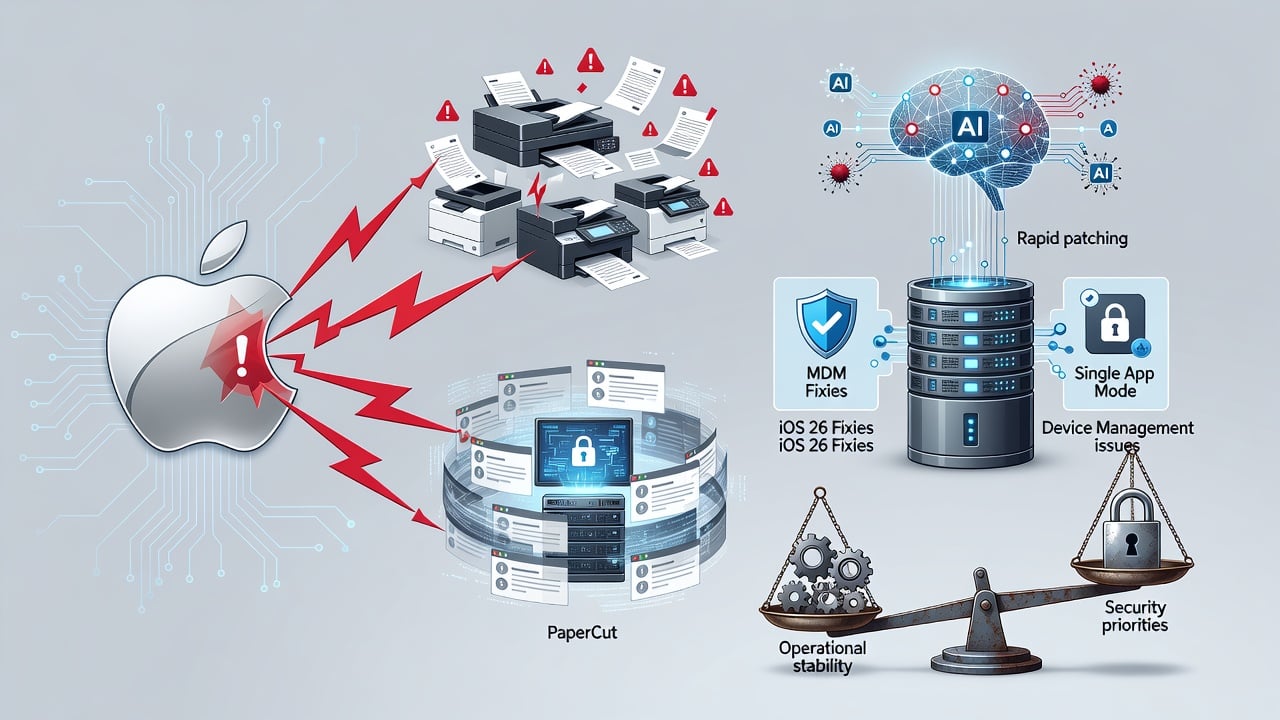
Last March, Apple shipped security updates for macOS 26.4, along with patches for older versions. Almost immediately, administrators saw trouble with printing. The culprit was PaperCut Mobility Print, a tool common in schools and large offices. Users suddenly faced authentication prompts for every print job. macOS ignored stored keychain credentials. The problem hit every discovery method — known hosts, mDNS, DNS. Workarounds existed only for queues deployed through Print Deploy. Everyone else scrambled.
Enterprise customers now expect faster responses to such breaks.
PaperCut opened a support case with Apple. IT teams fielded floods of help-desk tickets. For organizations that had trusted Apple devices to reduce friction, the episode felt like a step backward. Chambers noted that redeploying print queues across hundreds or thousands of machines wastes time and money. “When Apple ships a patch that breaks something core, such as secure printing, it disrupts business operations and costs organizations money,” he wrote. “If Apple truly wants to be the ultimate enterprise vendor, it needs to squash bugs like these.”
The incident was not isolated. Apple’s own release notes for iOS 26 document multiple fixes aimed at corporate environments. One addressed enterprise apps that refused to launch on devices without internet after the initial iOS 26.0 update. Another corrected Single App Mode devices that stopped responding at the Hello screen following an update. A third fixed cases where devices lost contact with device management services. These read like acknowledgments that updates can break the very management features companies rely on. (Apple Support)
Shared iPad setups saw attention too. Updates ensured new accounts could log in despite storage limits. Lock screens now appear properly on Single App Mode devices with passcodes. Declarative device management notifications stopped pestering users before the final enforcement window. Each fix targets a scenario that matters when fleets number in the hundreds or thousands.
But. The pace sometimes lags behind expectations. Recent security releases, including iOS 26.5.2 on June 29, focused heavily on vulnerabilities. The update patched dozens of issues ranging from kernel race conditions to WebKit memory problems. None carried explicit enterprise labels. Yet any one of them could affect managed devices in the field. (Apple Support)
Apple has responded to the broader pressure. In late June, the company told Reuters it now releases some updates earlier than in past cycles. The reason ties directly to artificial intelligence accelerating the creation of hacking tools. By decoupling certain fixes from major OS versions, Apple hopes to shrink the window attackers enjoy. The shift marks a departure from bundling everything together. (Reuters, published June 29, 2026)
Enterprise adoption data supports the urgency. A May 2026 report card from Six Colors gave Apple high marks for future prospects in business, with optimism rising sharply. Panelists scored enterprise programs at B, up from prior years, while future outlook reached A-. Mac adoption has grown steadily. One analysis noted an 18 percent increase in enterprise Mac usage over three years, outpacing Windows and Android in some surveys. (Six Colors, May 1, 2026; Addigy, referencing 2025 data)
Apple itself expanded its business tools. In March it launched Apple Business, an all-in-one platform for device management and customer reach. The service extended Apple Business Manager to more than 200 countries and added features like cryptographic separation of work and personal data. Managed Apple Accounts keep company information secure while respecting employee privacy. (Apple Newsroom, March 24, 2026)
At WWDC this year, Apple emphasized declarative management as the new standard for device fleets. Sessions highlighted how this approach reduces complexity for administrators. Vendors and identity providers must now build support quickly. The message was direct: organizations still using older methods work harder than necessary. (Apple Developer)
So the tension grows. Apple ships sophisticated management capabilities. It patches vulnerabilities at record speed. Yet a single overlooked interaction with third-party print software can generate weeks of pain. Forrester research on Mac deployments found employees reclaim more than 100 minutes per month from faster startups and fewer troubleshooting episodes. Those gains disappear when updates force IT teams into reactive mode. (Forrester TEI report)
Chambers closed his column on a practical note. Bugs happen. The difference lies in priority. When the affected users sit inside corporate networks, the response must come faster. Enterprise buyers measure vendors on uptime and predictability as much as features. Printing may seem mundane. For the finance team sending sensitive documents or the school issuing schedules, it is core.
Apple’s trajectory points higher. Revenue from Macs rose 12.7 percent in fiscal 2025. Services passed $100 billion. The installed base exceeds two billion active devices. With that scale comes scrutiny. Security researchers already credit Apple with patching more vulnerabilities in 2026 than in previous years. The company uses background improvements and rapid releases to stay ahead.
Still, the PaperCut episode lingers. It showed how a security improvement can create an operational regression. No one disputes the need for patches. The question is whether Apple applies the same urgency to functional breaks in enterprise tools as it does to memory corruption flaws.
Administrators hope the answer is yes. They have deployed more Apple hardware than ever. They want those devices to stay reliable through the next update, the one after that, and the one after that. The bugs Apple must address first are exactly the ones that strike at daily business tasks. Fix them. Fix them immediately. The enterprise customers who have embraced Apple are watching.


 WebProNews is an iEntry Publication