
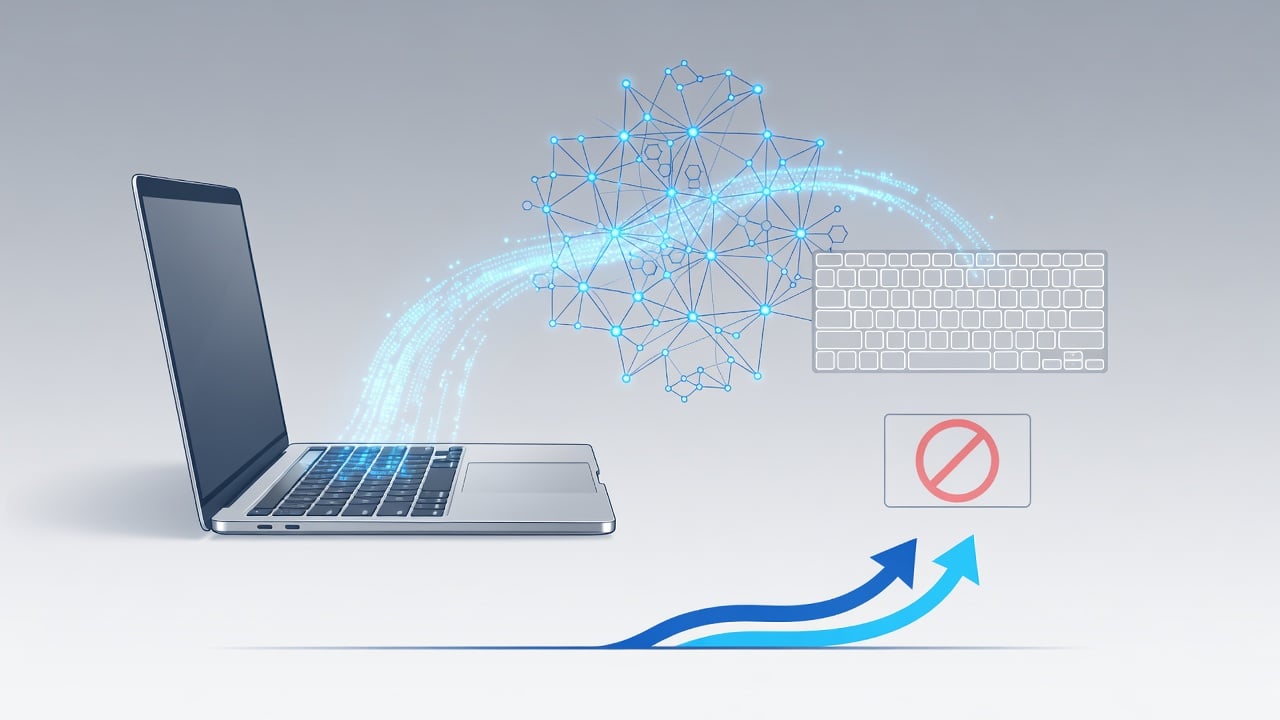
Apple’s approach to hardware control often leaves Linux developers untangling layers of custom interfaces. One such piece, the DockChannel, has long defined how built-in input devices talk to the main processor on recent MacBooks. Now a fresh set of kernel patches brings that channel to life for M3 systems. The work promises functional keyboards on hardware that until today offered little more than a serial console.
Phoronix first reported the patches on June 30, 2026. Michael Reeves submitted ten changes that add support for internal keyboards on Apple Silicon M2 and M3 MacBook models. The series targets mainline Linux rather than downstream distributions alone. https://www.phoronix.com/news/Apple-DockChannel-M3-Keyboard
Reeves laid out the architecture in his cover letter. “This series introduces support for the internal keyboards on Apple Silicon M2 and M3 MacBook models. On these platforms, built-in input devices are managed by a dedicated coprocessor running an RTKit-based operating system. Communication between this coprocessor and the main processor is carried out over a low-latency hardware byte FIFO interface called DockChannel.”
The new code creates an apple-dockchannel mailbox driver for the byte-stream FIFO. It adds a DockChannel HID transport driver, called apple-hid, that boots the coprocessor through the RTKit framework and wraps the HID protocol. Small updates to existing apple-rtkit and hid-apple drivers handle a TraceKit endpoint and fold the keyboards into Linux’s input-quirks system. Device tree bindings and DTS files describe the hardware on M2 and M3 laptops.
Developers first encountered DockChannel during early M1 and M2 bring-up. The Asahi Linux project documented the interface in a July 2022 progress report. Hector Martin explained that the M2 trackpad coprocessor, or MTP, reused the same FIFO module Apple employed for debug on M1 chips. “MTP reused the same FIFO module as a simple byte channel between it and the main OS, with a new HID transport protocol running over it.”
DockChannel itself proved straightforward. The HID layer on top did not. Martin’s original out-of-tree driver exceeded one thousand lines. It managed firmware upload, GPIO proxying and complex nested data structures. Apple had, in the words of the Asahi team, over-complicated the transport. Reeves took that foundation and rewrote it for upstream. The new version relies on the standard Linux mailbox framework, follows HID design patterns more closely and cuts back on hacks.
Progress on M3 has accelerated in recent months. A February 2026 Phoronix article noted that keyboard, touchpad, WiFi, NVMe and USB3 already functioned inside Asahi Linux with local patches. https://www.phoronix.com/news/Apple-M3-Asahi-Linux-2026 By April the downstream kernel carried additional M3 enablement including PCIe, SMC-based RTC, reboot controller and the NVMe driver, again thanks to Reeves and Alyssa Milburn. That work lifted M3 support roughly to the level of the original M1 alpha.
Yet mainline support has lagged. Linux 7.2 gained basic boot capability for M3 hardware through device tree patches from Janne Grunau. Those changes delivered a kernel that reached an initramfs and serial console. Everything else stayed missing. GPU acceleration, display output and input devices simply did not exist in the upstream tree. The keyboard patches change that equation for one critical component.
Reeves made clear limits in the current series. The coprocessor controls both keyboard and trackpad. This round enables only the keyboard. It initializes without external firmware. Trackpad support demands firmware loading and will arrive later once the transport layers stabilize. Testing occurred on a MacBook Air M3 identified as J613.
The distinction matters. Linux users expect a laptop to accept typing from the moment the display lights up. Without keyboard support, even a booted M3 MacBook remains an awkward development board. Trackpad and Force Touch can wait. Basic text input cannot.
Apple’s design choice reflects broader patterns. The company places input processing in a dedicated real-time coprocessor. That offloads work from the main application processors and allows tighter power management. It also creates another firmware boundary. The coprocessor runs its own RTKit operating system. Linux must speak the right protocol across the DockChannel FIFO or the keys stay silent.
Earlier Asahi efforts on M2 revealed how fragile handoff can be. The team never fully solved resetting the MTP coprocessor to a clean state. That prevented clean reprobing or seamless transition from U-Boot to Linux. Reeves’ upstream driver sidesteps some of those issues by focusing on initialization that does not require firmware for the keyboard alone.
But. The patches still represent only one piece of a larger puzzle. Display, GPU, audio, cameras and power management all need attention before anyone would call an M3 MacBook a daily Linux driver. Asahi Linux developers have repeatedly asked the community to stop asking for release dates. Work proceeds when it proceeds.
Still, the arrival of these patches signals forward momentum. Mainline Linux will soon type on M3 keyboards without out-of-tree modules. That milestone matters for developers who want to run current kernels on new Apple hardware. It also validates the years of reverse engineering invested in understanding DockChannel, RTKit and the HID transport Apple built on top.
Reeves based his transport driver on Martin’s original implementation but reworked it heavily. The shift from out-of-tree hacks to standard mailbox and HID patterns improves maintainability. Future changes to either subsystem should break the Apple driver less often. That discipline reflects lessons learned across the entire Asahi effort.
Trackpad support will test the same transport layer in more demanding ways. Firmware loading adds complexity. Power states, gesture processing and Force Touch calibration all cross the same FIFO. Success on the keyboard paves a documented path. Failure would have blocked everything that follows.
Apple has shown no sign of simplifying these interfaces. Each generation of Silicon carries similar coprocessors and similar custom protocols. The Linux community therefore keeps investing in drivers that speak Apple’s language. DockChannel now joins the list of understood pathways alongside the existing RTKit helpers, mailbox abstractions and HID quirks.
Results will not appear in the next kernel release. Review takes time. Device tree bindings must reach consensus. Yet the code exists. It works on real M3 hardware. And for a platform that booted to nothing but a prompt only months ago, functional typing counts as tangible progress.
Developers following the Linux kernel mailing list can watch the series advance. Those running Asahi Linux already benefit from equivalent functionality through downstream patches. The gap between the two narrows. M3 Macs move another step closer to becoming viable Linux laptops. The keyboard, that most basic of tools, leads the way.


 WebProNews is an iEntry Publication