
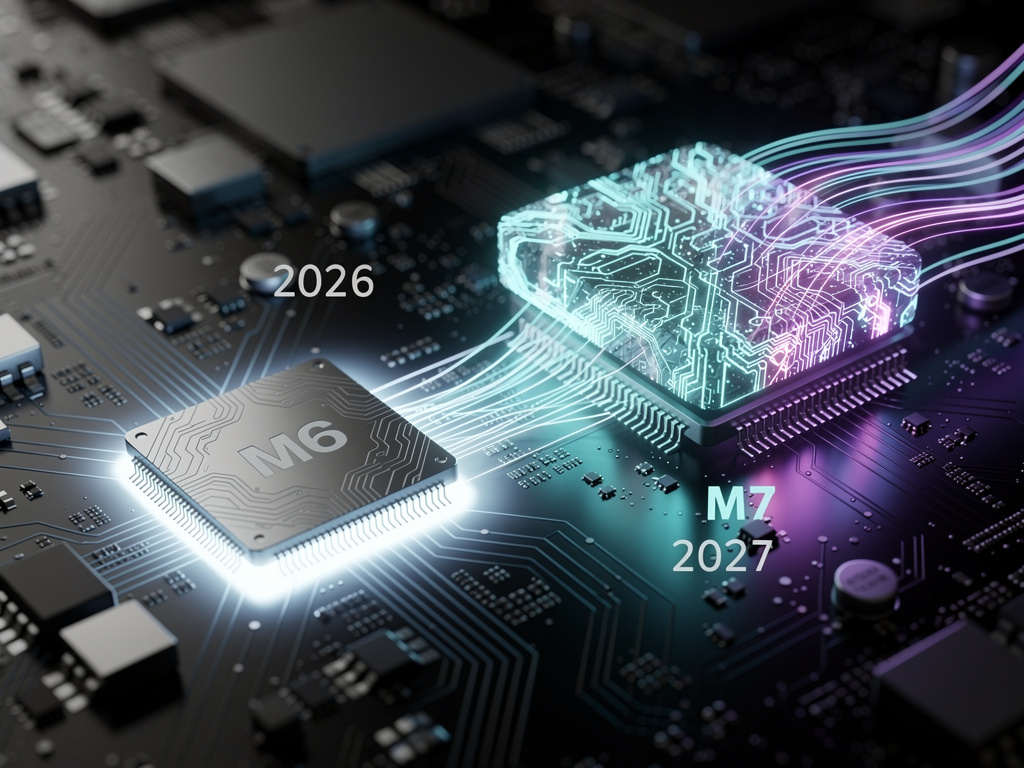
Apple just rewrote its own playbook on Mac processors. According to a report published today by Bloomberg, the company will release a base M6 chip for entry-level machines as soon as late 2026. Yet it has no plans for M6 Pro, M6 Max or M6 Ultra variants. Instead, the next high-performance silicon arrives as the M7 family in 2027, built from the ground up with a sharper focus on on-device artificial intelligence.
This marks the first time Apple has broken its pattern of offering tiered chips within a single generation. The decision reflects mounting pressure to deliver meaningful gains in AI workloads without flooding the market with incremental updates. But it also leaves pro users waiting longer for their next big upgrade.
One generation. Skipped.
Mark Gurman, writing for Bloomberg, notes the company is currently finishing the M5 series. An M5 Ultra chip, with roughly 36 CPU cores and 80 GPU cores and support for up to 768GB of unified memory, could appear in a refreshed Mac Studio before the end of 2026. The base M6 follows closely behind for machines like the entry-level MacBook Pro, Mac mini or iMac. People familiar with the plans told Bloomberg the M6 will bring memory bandwidth around 200GB/s, up from 153GB/s on the base M5, along with an updated neural engine, improved video codecs and a 12-core GPU configuration tested for running AI and graphics tasks at the same time.
Yet those gains stop at the base level. Higher-end configurations jump straight to M7. The first M7 chips are expected in the first half of 2027. M7 Pro and M7 Max would follow by the end of that year, with an M7 Ultra potentially arriving in 2028. The base M7 could push memory bandwidth to roughly 240GB/s. More importantly, Apple has designed these chips with “major advancements to on-device AI processing” in mind, according to the people cited in the Bloomberg report.
The shift comes after years of steady annual progress. Apple introduced the original M1 in 2020. Each subsequent generation brought both base and pro-level chips, letting the company refresh MacBook Pros, Mac Studios and Mac Pros on a predictable cadence. No longer. The M6 line will stand alone as a modest step for budget and midrange systems. Professionals chasing maximum performance must hold out for M7 silicon that emphasizes neural-network acceleration over raw CPU or GPU core counts alone.
9to5Mac broke down the implications hours after the Bloomberg story dropped. The site points out that Apple appears willing to accept a gap in its high-end MacBook Pro lineup rather than ship an M6 Pro that might only offer modest improvements over the current M5 Max. By folding the pro-tier features into the M7 generation, the company can concentrate engineering resources on technologies that support local AI models, faster inference and reduced reliance on cloud processing. The strategy echoes comments made at WWDC 2026, where executives highlighted on-device intelligence as a core priority.
Analysts have watched this evolution closely. The move risks frustrating creative professionals who expected an M6-powered MacBook Pro with OLED display sometime in 2026 or early 2027. Earlier rumors, including those covered by MacRumors, had anticipated a more conventional rollout with M6 Pro and Max chips arriving in spring 2027. Those expectations now appear outdated.
So what does this mean for the Mac lineup? Entry-level models get the M6 bump first. Think thinner MacBook Air successors or updated desktop machines aimed at students and knowledge workers. They will see solid gains in battery life, everyday performance and basic machine-learning tasks. But the machines that power video editing suites, 3D rendering farms and software development teams will wait for M7 silicon that promises bigger leaps in neural engine throughput.
The decision also hints at manufacturing realities. Apple has been aggressive in adopting newer process nodes. The M6 is expected to use a 2-nanometer-class technology from TSMC. Jumping to M7 allows the company to refine that process before committing it to the more complex, higher-core-count designs required for Pro and Max variants. Yield issues or power-consumption targets may have played a role, though neither Bloomberg nor its sources offered specifics on that front.
Industry watchers on X reacted quickly to the news. Several noted that the 40GB/s jump in memory bandwidth between M6 and M7 could prove more significant for video encoding and large language model inference than many realize. One post observed that releasing an M6 Pro now might simply cannibalize sales of the forthcoming M7 Pro models. The sentiment across recent threads suggests acceptance of the delay among those who understand the AI-driven roadmap.
Apple has not commented publicly on the report. The company rarely does. Yet its actions over the past five years show a clear pattern: it will accept short-term gaps in its product slate if the payoff is a more capable platform two years later. The original M1 disrupted the entire PC industry. The M4 and M5 series tightened integration between hardware and the growing Apple Intelligence features. Now the M7 appears positioned as the chip that finally delivers on the full promise of local AI without constant cloud round-trips.
That bet carries risks. Competitors like Qualcomm and Intel continue to push their own AI PC chips with aggressive roadmaps. If Apple’s M7 arrives later than expected or fails to deliver noticeable real-world gains in applications like Final Cut Pro, Logic Pro or Xcode, customers may look elsewhere. But the company’s tight control over both silicon and software has historically allowed it to outperform rivals on efficiency and battery life even when raw benchmark numbers looked comparable.
For now, the message to pro users is clear. If your current M4 or M5 MacBook Pro still meets your needs, keep using it. The next truly compelling upgrade for high-end workloads likely sits in the M7 generation. That machine could arrive with a redesigned chassis, improved thermal design and display technology that better matches the power inside. Until then, the base M6 will serve as a bridge for everyone else.
The strategy underscores a broader truth about Apple’s approach. It no longer feels compelled to release a new chip tier every year simply because the calendar says so. When the engineering and market conditions align for a bigger leap, the company is prepared to wait. In this case, that wait buys time to perfect the AI-focused architecture that will define Mac computers for the second half of the decade.
Whether the bet pays off won’t be known until the first M7-powered MacBook Pro reaches reviewers in 2027. Until that day, the silicon roadmap looks a little flatter than usual. And a little more ambitious at the same time.


 WebProNews is an iEntry Publication